PHOTOJOURNALISM NIGHTS 28TH EDITION

Yemen: UN has declared the situation in Yemen as the greatest humanitarian disaster in 2018. ©RasmusFlindtPedersen

23rd November 2022 18:00-20:30
The Invention Rooms, Imperial College
Door C, 68 Wood Lane
London
W12 7TA

To join us HERE (in person) and HERE (online)

Photojournalism Hub presents Carly Clarke, Francesca Gabbiadini and Rasmus Flindt Pedersen.
Carly Clarke is a British documentary and portrait photographer working primarily with medium format film. After completing her BA in photography at Middlesex University, London she was awarded the Luck-Hille Postgraduate Photography scholarship for her Master’s degree in Photography, also at Middlesex. Her work mainly focuses on social and political issues that may otherwise go unnoticed. Storytelling through the voices of the people she photographs is key to her work. She has personally researched, organised and sought funding for all of her overseas projects, which include – Remember Me: Vancouver’s DTES, Godhūlikāla: India’s Forgotten Elders and Jamadagni’s Temple: The Real Full Moon Festival. When she was diagnosed with Hodgkin Lymphoma in 2012, she created a self-portrait project, Reality Trauma, documenting her journey through treatment and recovery. She subsequently created a second project, In the Blood, seven years later when her younger brother Joe was diagnosed with the same type of cancer. Reality Trauma has been widely commended and has been featured worldwide on BBC News Online, BBC TV local news, photography podcasts, and a radio show. She has won several honourable mentions for her projects through the International Photography Awards (IPA) and has been shortlisted for the Portrait of Britain. Her work has been published by the BBC, in the British Journal of Photography, Portrait of Britain, the charity Lymphoma Action, International Photography Awards (IPA), Suitcase Magazine, Jornal Contacto, POV Magazine (Canada), Lensculture, Portrait Salon and has been shown at the National Portrait Gallery in London. www.carlyclarkephotography.co.uk

Francesca Gabbiadini is a photojournalist from Italy. She reports on socio cultural taboos related to femininity and female identities into current society. Her two major ongoing projects are “The Call of Eve”, focused on female rage and the places where it can be expressed, and “Because”, a participatory archive on female identities. After the Master’s in Documentary Photography and Photojournalism at the University of Westminster (2018), she has been working as a freelance photojournalist in London. She collaborates with international and national media outlets, such as La Repubblica and Elle magazine. Francesca’s projects have been shown in various exhibitions between Italy and London, such as the group exhibition at the International Centre of Photography in Palermo (2021) led by Letizia Battaglia. In March 2022 she co-founded Femminsista, an international and intersectional feminist community on Instagram, where she works as an Editor-in-Chief. In May 2019, Francesca led the first workshop on documentary photography in Bergamo, Italy, with the editorial goal to ethically report the community of one of the city’s most multicultural neighbourhoods. www.francescagabbiadini.com

Rasmus Flindt Pedersen (40) is a Danish photojournalist, documentary filmmaker and father of two with 10+ years of experience documenting the world around him. He has won several awards for his work and has had his images exhibited in places like London, New York, Tokyo, Paris and Copenhagen. His work in the world’s hotspots has focused more on depicting the everyday struggle of civilians trapped in the war zones than on the actual fighting. It’s not that the dramatic photos of combat aren’t important to him, it’s just that he finds the struggles of regular people much more impactful. Rasmus’ latest war assignment brought him to Ukraine to document the initial phases of the Russian invasion at the beginning of the year. During the summer Rasmus has spent more time home to focus on his own family and the birth of his second son before he’ll start work on a documentary film project early next year. www.flindtpedersen.com

Photo Above ©Rasmus Flindt Pedersen

BECOME A PJH MEMBER
Consider becoming a member of the Photojournalism Hub and receive the benefits of free access to events, Photojournalism Hub resources, premier editorial content, portfolio reviews, photography exhibitions, discounts on our courses and training, whilst you will be supporting our work advocating, advancing social justice and human rights. If there were ever a time to join us, it is now. Support the Photojournalism Hub from as little as £1 every month. If you can, please consider supporting us with a regular amount each month. Thank you. JOIN US HERE

PHOTOJOURNALISM NIGHTS 27th edition

21st September 2022 18:00-20:30
The Invention Rooms, Imperial College
Door C, 68 Wood Lane
London
W12 7TA

To Join: HERE (in person) or HERE (online)

Photojournalism Hub presents Encarni Pindado , Jakob Dall and James Hopkirk whose work bring to the attention underreported stories of our times.

Encarni Pindado is an award-winning photojournalist and documentary photographer from Spain. Educated in Spain and London. Her work focuses on social and Human rights issues, particularly on violence, migration, and gender. She publishes in some of the most prestigious media outlets in the English and Spanish-speaking world. Such as The Guardian, BBC, The Sunday Times, Al Jazeera, NPR, Reuters, AP, El País, Univision, EFE, among many others. She also collaborates with international institutions such as the UN, ICRC, Amnesty International, UNHCR, OXFAM among many others.Encarni has a long-term project about Mesoamerican women’s migration, focusing on violence (structural, explicit, and symbolic) as a migratory experience from Central America, in transit through Mexico, to the US. She is currently finishing an MSc in Migration, Mobility and Development at SOAS University. Encarni has won several journalism scholarships and awards including, COVID19 Emergency Found from National Geographic, IWMF “underreported story grant”, Pulitzer (producer team); Peabody Award, Finalist W. Eugene Smith Humanitarian Photography Award with her work “The other side of migration: Central American women”. Her work has been exhibited in different galleries and universities across Mexico, US, and the United Kingdom, and she gives conferences and seminars on migration and photojournalism.

Jakob Dall is a freelance photojournalist with a degree from the Danish School of Journalism. He is based in Copenhagen and works as a photojournalist for several daily newspapers like New York Times, magazines, companies and organizations like Copenhagen University, The Danish Parliamentary Ombudsman’s office and with HRH Crown Prince of the Denmark, he has traveled to Mozambique, Nepal and Bangladesh to document the international work of Red Cross. He has also worked as photo editor and photographer at newspaper Berlingske Tidende and Dagbladet Information in Denmark. Jakob Dall ́s photo stories mainly focus on how individuals are affected by events which often receive little media coverage. Through his photos of people from areas of conflict, disaster and crisis he wishes to show the faces and the realities of life in areas that need attention and help from the international community. In parallel with his frequent assignments for different NGO ́s, Red Cross, Danish Church Aid, CARE, Action Aid …, Jakob is working on a personal long-term project called “Climate Change Documentary”, which illustrates the impact climate change has on living conditions and daily life for people around the world. Jakob Dall has won awards from World Press Photo, Picture of the Year International (POYi), Picture of the year Denmark and an international EISA award for his photo essay about climate change impacts in Ethiopia. He has also received the photographers “Fogtdals Grant” for his specific work with climate change impacts.

James Hopkirk has been working as a writer and photographer for over 20 years. In 2015 he launched the South London Stories project, documenting underreported aspects of life in his community. Working collaboratively with Lambeth residents, often over many months or years, he uses photography, text, film, exhibitions and workshops to explore complex social issues, including immigration, homelessness, food poverty, addiction, mental health and the benefits system. www.southlondonstories.com

Photo Above ©Jakob Dall

BECOME A PJH MEMBER
Consider becoming a member of the Photojournalism Hub and receive the benefits of free access to events, Photojournalism Hub resources, premier editorial content, portfolio reviews, photography exhibitions, discounts on our courses and training, whilst you will be supporting our work advocating, advancing social justice and human rights. If there were ever a time to join us, it is now. Support the Photojournalism Hub from as little as £1 every month. If you can, please consider supporting us with a regular amount each month. Thank you. JOIN US HERE

What is it like to be a young person today

What is it like to be a young person today is a photography project with young people living in Hammersmith & Fulham. The young participants learned about photography and visual narrative whilst engaging with documenting the local area. The project also allowed the development of photo stories bringing about their own personal reflections about living in the area, including the impact of the Covid-19 pandemic in their lives.

Young people photography exhibition

We worked with a group of youths living in White City and Wormholt to talk about their experiences of growing up in the area. We met once a week from January to March and we used photography as a means to represent their lives. Initially the group learned the basics of photography and once they had confidence in using the medium they slowly moved onto working in pairs. They directed their photography, finding their ideal environmental settings, to take photos of each other. As time went on, they started to incorporate in the sessions, their personal experiences. These were coupled with intermittent sessions where all the group engaged in discussions.
We did not input the subject matter, we just facilitated the conversations. We took audio recordings and photos of what they shared as being relevant to their lives.

One of the emerging worry for young people was fear of the future, anxiety which was greatly impacted by Covid-19 pandemic and the drastic changes that it brought to their lives. Loneliness and confusion were also established somewhat by fear of catching covid and the transition from lockdowns to moving back to ‘normal’. One of the participants, expressed very beautifully:

Photographically the group worked on expressing what was like to be a young person today, producing great set of photo stories, which they document, their lives through friends, their state of mind, self portraits and photo story on one of the participant.

Following a visual narrative, one of the participants took photos to describe the subject inner life.

Self expression was the method used by this participant, producing a stunning set of landscape photograph that would show their inner mind.

The experience of being a young refugee is shown in a beautiful set of photographs. The participants expresses her fears, longing to see their family and hopes for the future.

The teenage world is brought to life by this great set of images captured with a mobile phone. The images document her life through her friends, social life and being together. These photos are wonderfully candid.

The project culminated in a Youth Arts Showcase on the 2nd of April at Our Lady of Fatima Hall in White City . The event was a great opportunity for the participants to show their work in a public context.
Photojournalism Hub has worked with young people living in White City and Wormholt in west London to help them to tell their story through photography of what it is like to grow up today in west London.
The poignant and inspiring photography produced reflect the state of being of young people following the experiences of upheaval, loss, and insecurity poised by Covid-19 pandemic and the extended lockdowns to contain the spread of the virus. Finding metaphors in water, leaves and reflective materials in nature, the young photographers have taken to landscape photography, to their peers, and to the documentation of their friends’ lives as a means of presenting their own lives.
The event was attended by many people and was punctuated by presentations and arts workshops. Beneficiaries received a Certificate to award them for their work and participation. They are also officially part of youth arts development team.
Beneficiaries were asked to feedback on the project, at the start of the project, mid way and at the end. We measured:

Improved confidence
Improved wellbeing
Learned new skills
Improved further education, cv, prospects

We share the digital version of the booklet that accompanied the photography exhibition.

We are continuing to work with the participants by inviting them to have their say and be part of future arts developments in White City and Wormholt. The project was kindly supported by W12together, who where also the organisers of the Arts Showcase.

The project was supported by the charity W12Together 


Recognising Women

Laura James

Photojournalism is an industry that is still dominated by men. Suzanne Plunkett, award winning photojournalist, reaffirmed this fact during the Photojournalism Hub’s talk event last Monday. She recounted her impressive career and highlighted that she was always among only a handful of women photographers within a sea of men when working for agencies. Her lived experience can be reflected in the fact that ‘just 18% of the AOP’s accredited photographers and assistant photographers are women.’ (Steven: 2019). Along with the clear gender bias towards employing male photographers, she also touched on issues of sexism from managers in agencies, not being taken as seriously as her male counterparts and the lack of demand for stories that cover important female issues.

Talking about these issues was pertinently timed as International Women’s Day was to be celebrated just 6 days ahead of the talk. The theme of this year’s IWD was Each for Equal – aiming to help create a more equal world where women are always on the same platform as men. Suzanne, along with Chiara Ceolin and Quintina Valero (the two other speakers at the event) are certainly helping to create gender equality by doing such amazing work with women around the world and documenting their stories. They have worked on projects with victims of female genital mutilation, sex trafficking and female prison.

By having more amazing female photojournalists in the industry we are creating a levelled playing field and going against a male centric selection of stories in the media. We need to keep recognising the achievements of female photographers and those who are telling the stories of women to come closer to a world where gender discrimination is a thing of the past.

Reference 

Knowing You – What it means to know someone

By Laura James

This image has an empty alt attribute; its file name is IMG_20200208_104149-3-1024x768.jpg

We can learn someone’s name, age, job and where they live. We can ask about their interests, hobbies and how they spend their time. We can acquire many facts and details about them, but can we say we truly know that person?

I believe to really know another we need to go deeper than the surface level, delve beneath the trivia and touch upon one’s core. We must unearth the defining moments in a person’s life and understand what has shaped them. Ask about their deepest fears, their hardships and come to understand their dreams, passions and longings. When we discover the complex, messy and beautiful nuances of a person, we are beginning to know them.

And this is what the Knowing You project is all about. It is about going beyond the small talk and making those connections. It’s asking us to break down barriers and cross unknown territory. It is bringing women from diverse backgrounds together and learning who they really are underneath the exterior glaze. Through the project I hope to truly get to know the other women participating and allow myself to be known to others. I am excited for the journey to unfold and to see how this manifests in the photographs taken.

Picturing Community Engagement

White City Place Holds PhotojoWhite City Place | 18 April 2019

In April 2019, Photojournalism Hub brought together photographers, community organisations and practitioners at White City Place for a discussion exploring participatory photography and ways of working with communities.

Curated by Photojournalism Hub founder and director Cinzia D’Ambrosi, the event brought together Tom Elkins, CEO of PhotoVoice; Andy Fearn, Director of Protection Approaches; photographer and FotoSynthesis director Ingrid Guyon; and photographers Becky Warnock and Grace Gelder, whose work includes participatory approaches.

The discussion explored how photography can be used collaboratively with communities and considered different methodologies for engaging people in projects that address sensitive social issues.

A central part of the event was the question of how community outreach can be developed in a respectful and safe way. During the Q&A, local community members asked the speakers about building meaningful relationships, reaching people who may be excluded from traditional photography projects and ensuring that participation does not cause further harm.

The speakers drew on their own experiences of working with communities around sensitive subjects, including projects involving young people and self-harm.

The event reflected an important strand of Photojournalism Hub’s early work: bringing practitioners together to question how photojournalism is made, who gets to tell stories and how photographers can work responsibly with the people whose lives they document.

It also reflects the Hub’s wider commitment to using photography not simply to represent communities, but to engage people in the process of telling stories and addressing issues that matter to them.

Read the original article on White City Place:
White City Place Holds Photojournalism Hub Talk on ‘Picturing Community Engagement

White City Place Holds Photojournalism Hub Talk On ‘Picturing Community Engagement’

‘Helping others through images’: Photojournalism Hub launches at White City

George Hope

Imperial College London | 16 November 2018

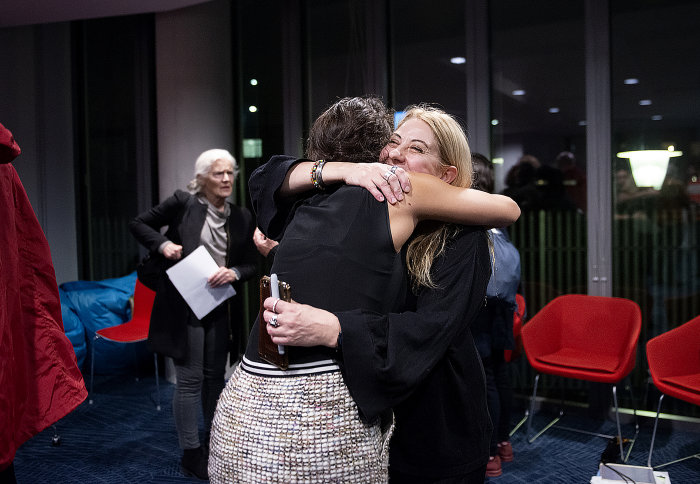
Cinzia D'Ambrosi hugs attendee of photojournalism event

A new community-led Photojournalism Hub launched at Imperial’s White City Incubator this week.

In November 2018, Imperial College London reported on the launch of Photojournalism Hub at its White City Incubator, marking the beginning of a new community-led initiative founded by photographer and journalist Cinzia D’Ambrosi.

Supported by Hammersmith United Charities, the Photojournalism Hub was established with a clear purpose: to use photojournalism to generate positive outcomes for vulnerable communities and individuals, while supporting the development and dissemination of photojournalistic work.

From the outset, the Hub brought together photography, journalism, social justice and community engagement. Its programme was intended to include exhibitions, investigative visual and written content, debates, community-led forums, training and research, creating opportunities for people to engage with important contemporary social justice issues through photography.

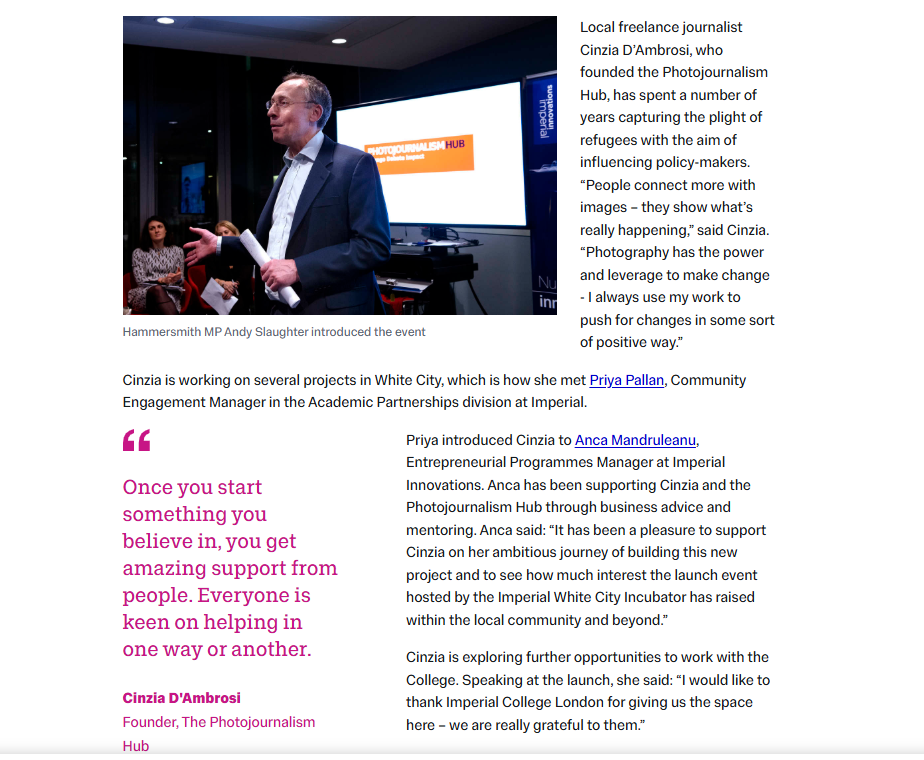
The launch was introduced by Andy Slaughter MP, then MP for Hammersmith, alongside local activists, journalists and photographers. Among the speakers was Daniel Renwick, who presented Failed by the State, his film made following the Grenfell Tower fire. Other contributors included Katie Webb of the Writers’ Union of Italy and veteran photojournalist David Hoffman.

The article also introduced Citizen Visual Journalism, a concept developed by D’Ambrosi through Photojournalism Hub. The idea was to enable community groups and individuals to learn how to tell their own stories through high-quality images and to identify and raise social justice issues that matter to them.

Rather than simply documenting communities, the approach aimed to give people the tools to communicate their experiences and reach those with the power to influence policy and create change.

The launch at White City established the foundations for what Photojournalism Hub continues to develop today: using photography and visual journalism to question injustice, amplify overlooked voices and create opportunities for communities to tell their own stories.

Read the original article on Imperial News:
‘Helping others through images’: Photojournalism Hub launches at White City


KNOWING YOU

©Cinzia D’Ambrosi

Knowing You is a Photography and Storytelling project working with women of different faiths and backgrounds living in White City to inspire self expression, bonding and community cohesion.

Knowing You is a Photography and Storytelling programme developed by the Photojournalism Hub. It works on the principle that by getting to know each other, the process contributes to community cohesion and abating barriers of prejudice.

‘Knowing You’ is a Photography and Storytelling project with a community focus that uses the teaching of visual narrative as a means to educate, instil empowerment, erase barriers and foster community cohesion.
The first ‘Knowing You’ project took place with women of White City supported by the charity Near Neighbours. The project allows a therapeutic and safe space in which participants go on a journey of self- expression, bonding and empowerment whilst learning new skills. It created a safe space for women of different faiths to meet, get to know each other and contributing to community cohesion. Women learned photography and photo storytelling by developing a visual narrative about a participant of the project with the photography showcased in a photobook.


The Knowing You project has been Awarded Recognised project (2020) and it is among the 40 selected projects ‘deemed exceptional’ by the judges of the Faith & Belief Forum and Her Majesty’s Lord Lieutenant of Greater London’s Council on Faith    for having provided support, respite and are working to make London a city that is inclusive to everyone and continuing to do so despite the challenges posed by the current pandemic.

Knowing You project has been kindly supported by the charity Near Neighbours