The Photojournalism Hub Calendar 2026 showcasing the incredible work of photojournalists and documentary photographers who have contributed to our mission.
Ofir Berman is an Israeli documentary photographer and visual storyteller whose work focuses on social and cultural issues. Her work gives an intimate view of people living within the fringes of society and aims to capture the resilience and the authentic spirit in the lives of the subjects. In 2020 she finished her Master studies in Madrid and continued to work on personal projects. Recently, she has been documenting Palestinian refugees from Gaza, with the intention of provoking discourse and a new vision of Palestinian-Israeli relations through photography, media, and a new perception of interpersonal communication. The series was published in different European and Israeli newspapers and in the French i24news TV channel. In 2021 she was chosen for the 30 under 30 women photographers by Artpil and was nominated for the Leica Oskar Barnack Newcomer Award.
Ruth Toda-Nationphotographic work explores themes present in her everyday life documenting issues relating to family, ageing, loneliness, transience and departure. Her photographic journey began documenting on the streets of Liverpool in the 1980’s. Ruth is currently living in Milton Keynes where she continues to document issues around aging as well as developing new work entitled ‘Birthing a City’ which explores the development of a new town and the lived experiences of its residents.
Sebastian Barros – Løng is a freelance documentary and fashion photographer based in Bogotá, Colombia covering politics, social issues, and health working as a contributor for Italian agency NurPhoto and as a stringer for the Agence France-Presse. Sebastián’s work covers the COVID-19 pandemic and how it actively changes and evolves in Colombia along the raise of protests and how politics shape Colombia’s next presidential elections, also helping young and new documentary and journalism photographers at @longvisualpress a photo agency stablished by him and his girlfriend that distributes their photos across the globe reaching local news sites in Colombia and international ones as The Guardian.
Photographer Denise Laura Baker answers questions from the public.
Written by Fatima Sanchez
On Friday 23rd, the Photojournalism Hub hosted the 15th edition of the Photojournalism Nights event at The Studio inside The Westworks, dynamic venue in White City Place.
The night was filled with an engaged public, thought-provoking conversations and presentations from outstanding photographers documenting outstanding current affairs .
Our guests for the night included Denise Laura Baker,Simon King and Carolina Rapezzi who shared great insights on the work they have been producing over the last few years of their career.
The event started with the presentation of the photojournalist and portrait photographer Denise Laura Baker. Denise’s work is heavily embedded in socially engaged work. She has been documenting communities and events since the age of 11 as well as becoming a psychologist, studies that have added an incredible depth to her photographic work. In her compelling presentation, she explained the importance of drawing back from any subjectivity, ‘putting aside your personal biases’, which also ‘strengthens the [psychological] work’ that she captures.
Furthermore, her family environment, engaged in social justice, has contributed to her inclination towards photographing issues that surround communities around the UK and Wales. Her key interests surround the travellers and environmentalist communities.
One compelling aspect from Denise’s personal approach to photojournalist work is that she is in the look-out for the bigger picture in a story. Yet, not losing to capture the small details, like it is the human “gaze” in an image.
Simon Black talks about his latest and ongoing project.
The second guest of the evening was Simon King, British documentary photographer who brought to us captivating documentary work shot on film. He presented us his photographic documentation of Washington, D.C. when it was subject to militarised observation to a degree not seen in about 53 years, due to fears of right-wing violence after the MAGA riot at the Capitol of January 6.
When asked why investigating this topic, he explained ‘to keep exploring Patriarchism and the political landscape in America’.
Simon proved transparency, honesty and openness with his words which all encompassed with the strong visual work from his project, yet to be shown in its entirety.
Simon’s photographs seem to bring together elements that form conversations and interactions that are symbolic and representative of the political landscape in America. Some of the work he shared from this project evidenced how the journalists and police force members’ body language mirrored the political scene at the time.
Carolina Rapezzi shares insights behind her iconic photo of a girl taking a short rest amid e-waste disposal in Ghana.
The last guest of the Photojournalism Nights event, was Carolina Rapezzi, who is a self-taught Italian photographer who has been working on social, humanitarian, and environmental issues. She took the initiative to merging her journalistic background and interest for photography to document current affairs such as migration issues, various protests, and ultimately environmental issues.
Carolina introduced us to her timely long-term project Burning dreams which she has invested herself in for the past few years. Her project was inspired by an investigation that she came across while researching on e-waste. A gps was placed inside an old washing machine in the UK and it eventually ended up been shipped to Agbogbloshie in Ghana. This was Carolina’s starting point of her ongoing and timely project.
She travelled to Ghana to investigate the way the e-waste was disposed as well as the impact of this in the communities. She learned that the cheapest way to get rid of huge amounts of e-waste was by burning it – often by local children.
Her project exposes the impact of disposing e-waste illegally and/or using methods that are not environmentally friendly.
Her presentation also opened up conversations on how important it is for a country to develop and sustain several sources of income, in order to divert from reliance on e-waste disposal, a completely non-sustainable activity.
Her presentation and insights, make us reconsider expanding the life of our day-to-day devices such as our mobile phones or laptops, something we often overlook.
Furthermore, her powerful work stresses how important it is for environmental issues to be talked about at a global level rather than simply national because of its scale and repercussions.
The Photojournalism Nights presented photographers whose work is committed to bringing to the wider public topics that impacts social justice. Bringing people together to learn and talk about these pressing issues is a fundamental step for action and positive change.
Ghana, Accra, November 2018. Rashida is a young girl originally from the North of Ghana, she sells water in the scrap yard of Agbogbloshie. Along with other girls living in the area, she carries water bags into a wheelbarrow and sell them for 1 Ghanaian Cedi each (the equivalent of £0,15) to workers who need to extinguish the fire and cool down the copper extracted from burning cables, wires and other appliances.
Carolina Rapezzi is an award-winning photographer based in London, part of the collective Women Photograph. Her works focus on social, humanitarian and environmental issues. She worked on migration issues in Sicily and France, covered the 100th anniversary of the Russian Revolution in Moscow and St. Petersburg, followed several protest movements in London, including the more recent Black Lives Matter and, since 2018 she has been working on environmental issues. Her independent project Burning Dreams on electronic waste in Ghana has been awarded internationally and exhibited multiple times: Portrait of Humanity 2019, Winner Flash Forward 2019, Winner 1st Prize Single Images, Winner World Water Day 2020, Shortlisted Sony World Photography 2020, Winner Siena International Award 2020.
Denise Laura Baker is a photojournalist, documentary, and portrait photographer. Her work draws on influences from the many different strands of her career, particularly her time as an ethnographic psychologist where she interviewed and collected the stories of the people with whom she worked. She has been exhibiting since 2016 and have, exhibited at various locations in Wales, including holding her first solo exhibition as part of LLAWN 2019 (Llandudno arts Weekend). She is the recipient of an Arts Council for Wales R&D grant for a project examining interconnecting communities within Gwynedd, Conwy and Ynys Mon. She also teaches and give talks on the role of narrative in photography and photo book making.
Simon King is a documentary photographer, currently working on a series of long-term projects, all on 35mm film. Simon teaches at UAL, and with Leica Akademie (UK). Simon works with the collective New Exit Group to publish photo-essays highlighting intimate, local stories. Simon’s recent publications include BARDO (in collaboration with NEG), a USA Digest which includes work from 2019 – Winter 2021, and Transiting Bulgaria, from his recent time there over Christmas 2020.
The Photojournalism Nights is an event that promotes committed and courageous photojournalism and engages the public to social justice and human rights. To join HERE
Thanks to White City Place for supporting our events
Beau Patrick Coulon,Beau Patrick Coulon, Beau Patrick Coulon, is a New Orleans based photographer and filmmaker whose imagery draws from class struggle and sub-cultural movements. At The Photojournalism Nights, Beau will be talking about his latest book, Revel & Revolt, a straightforward-yet-personal book of photography that documents protests, parades, and the punk scene in New Orleans from 2013 to 2020. It is published by Burn Barrel Press and DNO books.
Arsène Mpiana Monkwe, is a photojournalist and active artist based in Kinshasa. Arsène is also a tutor at the Department of Photography at the Academy of Fine Arts in Kinshasa. He has been Nominated for the Joop Swart masterclass (2020) of the World Press Foundation. Ini 2019, he became a freelance writer for Jeune Afrique then joined Agence France-Presse and in 2021, he tried his luck with the New York Times.
Justin Makangara, is an independent photojournalist and documentary photographer based in Kinshasa. His work focuses on underreported developing documentary and storytelling reporting on stories focusing on social justice, politics, music, and daily life. Justin is a member of APJD African Photojournalist Database, VII academy Insider, and Congo in conversation.
The Photojournalism Nights is an event that promotes committed and courageous photojournalism and engages the public to social justice and human rights. To join HERE
The Photojournalism Nights is an event that promotes committed and courageous photojournalism and engages the public to social justice and human rights. To join here
The Photojournalism Nights is an event that promotes committed and courageous photojournalism and engages the public to social justice and human rights.
Photojournalist Hub eleventh edition of the Photojournalism Nights presents an amazing line-up of photographers: Barbara Traver, Brian Ongoro, Hannah Kozak.
Barbara Traver, is a photographer based in Spain. She studied at the Espai d’art fotogràfic school (Valencia, Spain) and completed a master’s degree in production and photographic projects at the same centre together with the University of Valencia. That same year, Barbara won a scholarship to study in Madrid (Spain) at the EFTI school, where she took a course in contemporary photography and another in photojournalism and documentary photography. She has self-published two photo-books, exhibited in various national and international venues, and given several lectures where she delves into visual education and bringing photography to all audiences. Barbara is also the founder of @iphotograp.her , a collective of women photographers around the world.
Brian Ongoro, is a photojournalist based in Kisumu, Kenya majoring on documentary, editorial and commercial photography. He has carried out assignments for media houses, news agencies and non-governmental organisations. Brian’s work is known for covering East Africa and has been published nationally and internationally, including BBC, Al Jazeera, Guardian, CNN, Bloomberg, Le Monde. Brian is a contributor of AFP photo.
Hannah Kozak, is a photographer based in Los Angeles, California, who was born to a Polish father and a Guatemalan mother. At the age of ten, she was given a Kodak Brownie camera by her father, Sol, a survivor of eight Nazi forced labour camps and began instinctively capturing images that felt honest and real. While working in a camera store at the age of twenty, Hannah’s life changed when she met a successful stunt woman who became her mentor and helped her start a career in stunts. For over twenty-five years, Hannah followed a career in the film industry capturing images of far away lands, however after decades of standing in for someone else, Hannah has turned the camera on herself documenting subjects that touches her emotionally, including her painful and deeply touching relationship with her mother, powerfully captured in ‘He Threw the Last Punch Too Hard’ photo book and photo story.
The Photojournalism Nights is an event that promotes committed and courageous photojournalism and engages the public to social justice and human rights.
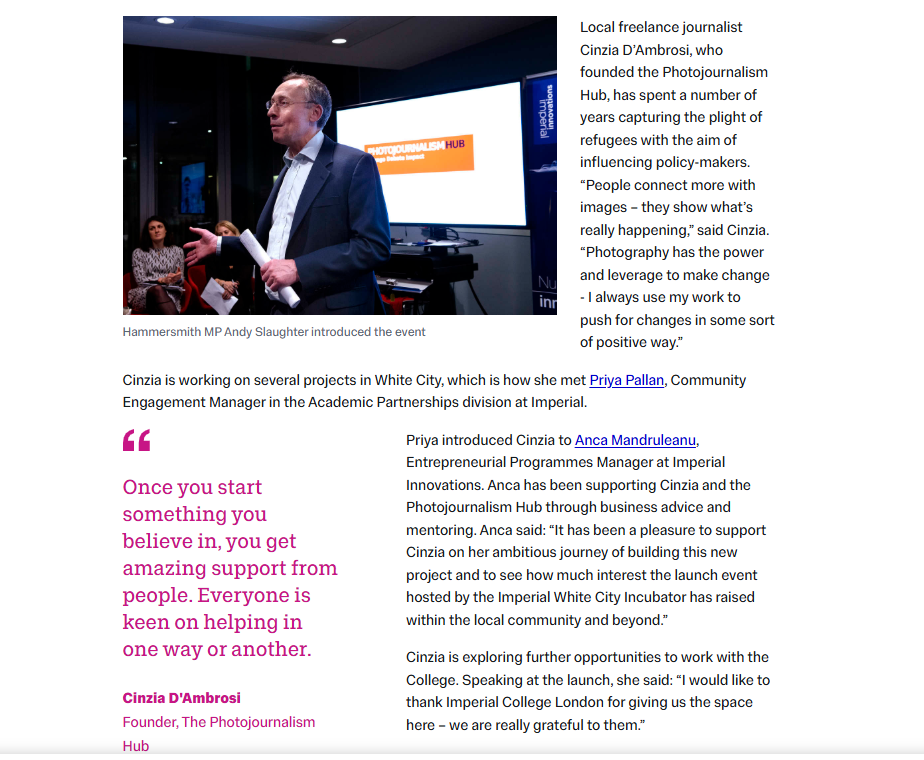
A new community-led Photojournalism Hub launched at Imperial’s White City Incubator this week.
In November 2018, Imperial College London reported on the launch of Photojournalism Hub at its White City Incubator, marking the beginning of a new community-led initiative founded by photographer and journalist Cinzia D’Ambrosi.
Supported by Hammersmith United Charities, the Photojournalism Hub was established with a clear purpose: to use photojournalism to generate positive outcomes for vulnerable communities and individuals, while supporting the development and dissemination of photojournalistic work.
From the outset, the Hub brought together photography, journalism, social justice and community engagement. Its programme was intended to include exhibitions, investigative visual and written content, debates, community-led forums, training and research, creating opportunities for people to engage with important contemporary social justice issues through photography.
The launch was introduced by Andy Slaughter MP, then MP for Hammersmith, alongside local activists, journalists and photographers. Among the speakers was Daniel Renwick, who presented Failed by the State, his film made following the Grenfell Tower fire. Other contributors included Katie Webb of the Writers’ Union of Italy and veteran photojournalist David Hoffman.
The article also introduced Citizen Visual Journalism, a concept developed by D’Ambrosi through Photojournalism Hub. The idea was to enable community groups and individuals to learn how to tell their own stories through high-quality images and to identify and raise social justice issues that matter to them.
Rather than simply documenting communities, the approach aimed to give people the tools to communicate their experiences and reach those with the power to influence policy and create change.
The launch at White City established the foundations for what Photojournalism Hub continues to develop today: using photography and visual journalism to question injustice, amplify overlooked voices and create opportunities for communities to tell their own stories.
Photojournalism Hub holds the first Photojournalism Nights Event on the 21st May at Elephant West Gallery, London White City!
The first event dedicated purely to photojournalism is the culmination of an ambition of Photojournalism Hub founder and director, Cinzia D’Ambrosi to re-ignite the passion for this form of journalism. The event was a real success with the large gallery full of people, who engaged to high quality photojournalism and Q&A. The public also had the opportunity to win an original print of the guest photojournalists through a raffle ticket, printed with the support of Genesis Imaging. The renowned and respected Photo Archive News supported the event by selecting and publishing the work of one of the guests photographers.
Cinzia, founder/director of the Photojournalism Nights introduces the first guest photographerPhotographer Rob Pinney presents his work Wamaitha wins an original print from guest photographer Tavis BohlingerTavis Bohlinger presents his workThe public engages in a Q&A