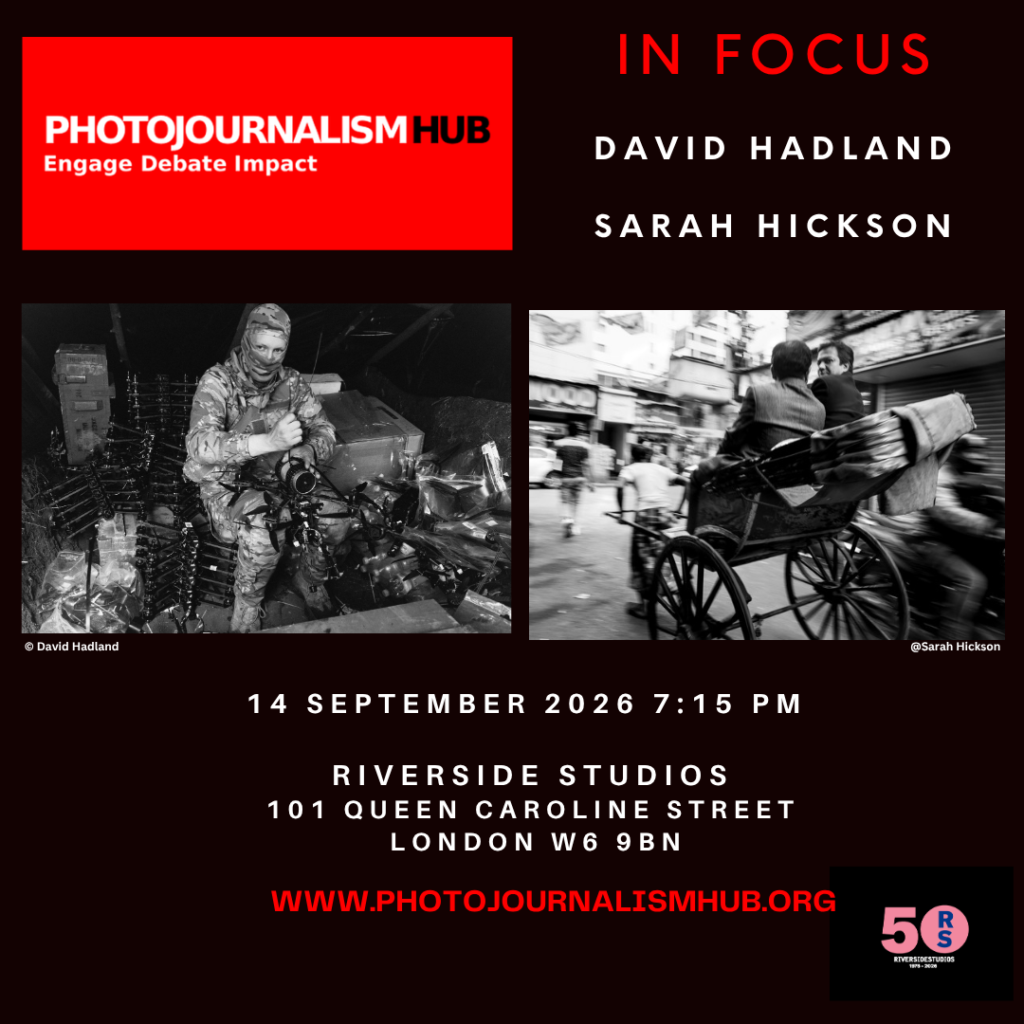
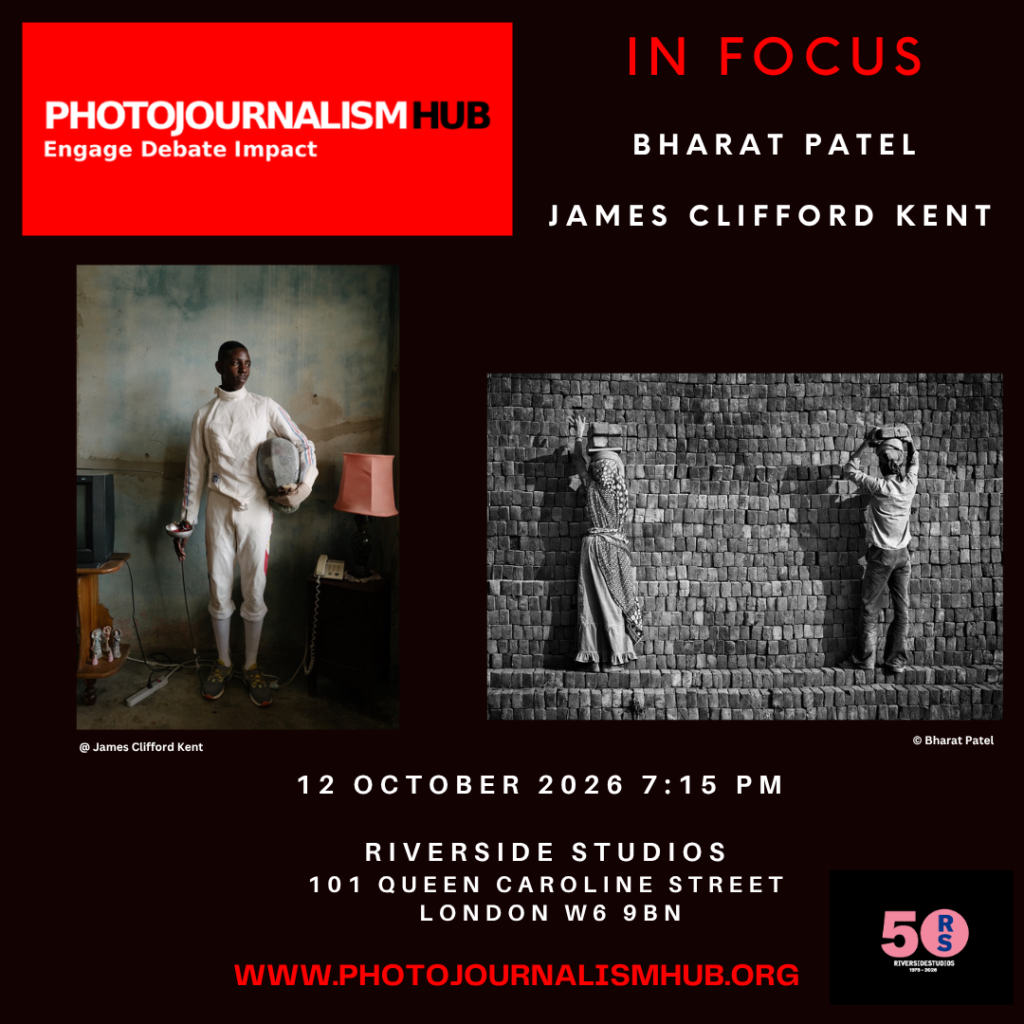
In Focus: James Clifford Kent & Bharat Patel
To join us: Here

For our next In Focus at Riverside Studios on 12 October 2026 at 7:15 pm, we are delighted to welcome documentary photographers James Clifford Kent and Bharat Patel.
Exploring themes of belonging, healthcare and marginalisation, their work spans care environments in Cuba and the UK and the lives of India’s nomadic and de-notified nomadic communities. Kent and Patel will share their approaches to building trust, documenting sensitive human stories, and the role of documentary photography today.

James Clifford Kent is a London-based photographic artist whose research-led practice explores culture, health and social change. Through long-term relationships and sustained image-making, he navigates the space between intimate experience and broader social narratives, focusing on the textures of everyday life and the conditions that shape it. His award-winning work has been exhibited at the National Portrait Gallery and the Royal Academy of Arts, and featured in BBC News, The Guardian and The Times. James is co-founder and creative director of Yuma Studios and holds a PhD from Royal Holloway, University of London, a Fellow of the Royal Photographic Society (FRPS) and a Senior Fellow of the Higher Education Academy (SFHEA). He is the author of Aesthetics and the Revolutionary City and is currently developing his first photobook. 
Central to Kent’s relationship-led practice is listening. His images result from lasting relationships and sustained dialogue with the people he photographs; allowing presence, voice and agency to shape the work. This approach also reflects a sharp awareness of positionality — the limits, responsibilities and ethics of working as an outsider. During his talk “Birth, Death and Everything In between” James will share work, stories and experiences from his long-term, ongoing work in Cuba, his photographs on maternity wards during the pandemic, and his recent work in hospices in the UK.  

Bharat Patel is a documentary photographer using the camera as a tool to connect with people in overlooked, difficult, or marginalised conditions. His work focuses on labour, survival, and human dignity capturing the quiet strength in spaces society often ignores. Through intimate portraits and raw environments, he aims not to evoke pity but to provoke recognition. Even in silence, he wants his images to speak honestly and to make people look where they usually turn away.
He was born in India, raised in Uganda, and later moved to England for higher education. He also spent several years working in Brazil. Living across four continents has given him a deep appreciation for diverse cultures, which continues to shape his perspective and photographic approach.
In 2012, he began what would become a multi-year project to photograph one of the most marginalised groups in India: The Nomadic Tribes and the De-notified Nomadic Tribes. These communities, whose numbers are estimated to be in the tens of millions, face systemic exclusion and hardship. These nomads served as entertainers, singers, dancers, knife sharpeners, snake charmers, gymnasts, acrobats, tightrope walkers, basket makers, grain millers, agricultural labourers, and herbalists—each tribe possessing its own unique set of skills. However, their contribution and lifestyle is now at odds with the demands of modern society. 
The work focuses on the history of these tribes and their subsequent marginalisation in part due to the Criminal Tribes Act of 1871 by the colonial ruler. An act which criminalised many tribes. Remnants of the act still reverberate today.

IN FOCUS is produced by the Photojournalism Hub in collaboration with Riverside Studios to present compelling, thought-provoking, independent and courageous photo storytelling.
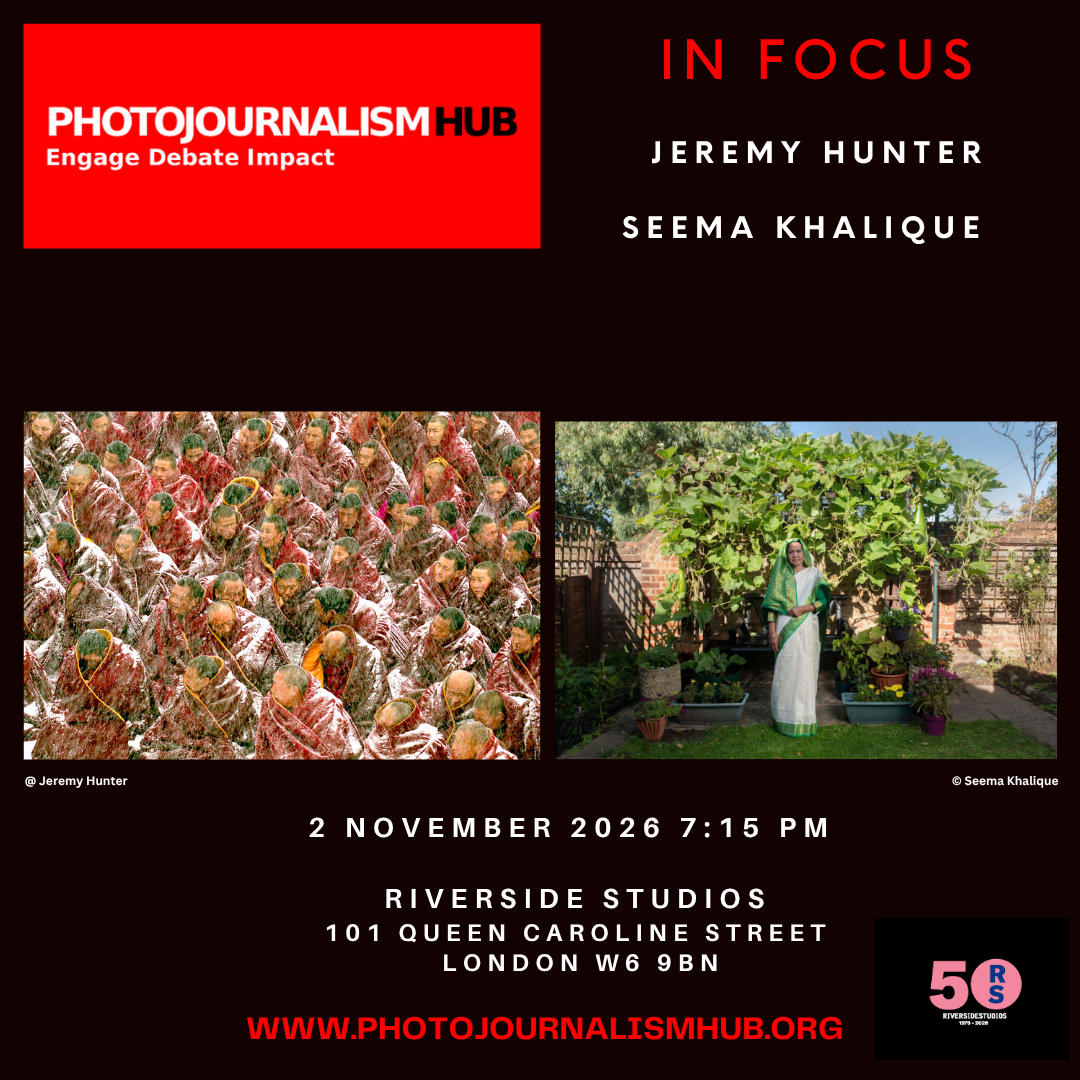
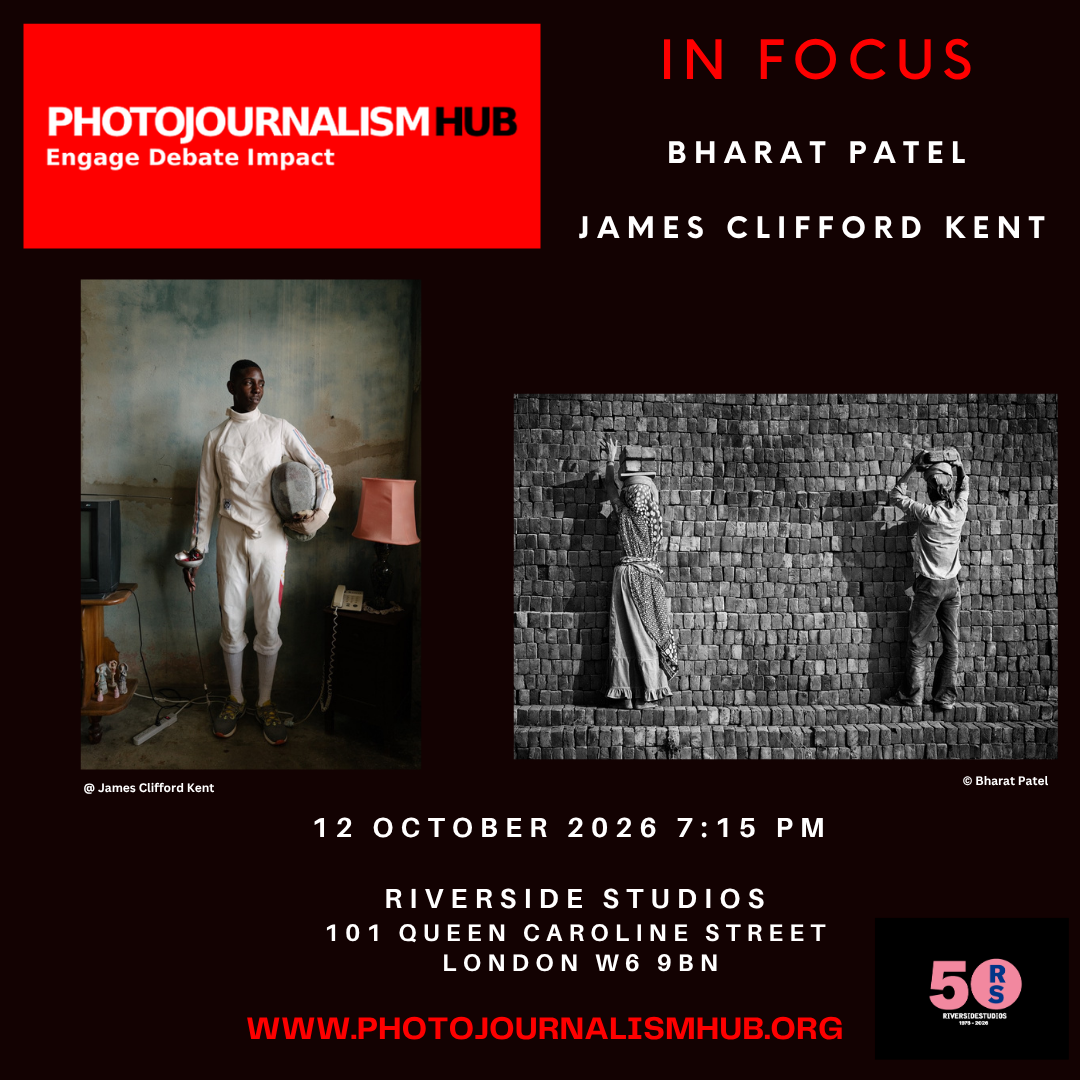
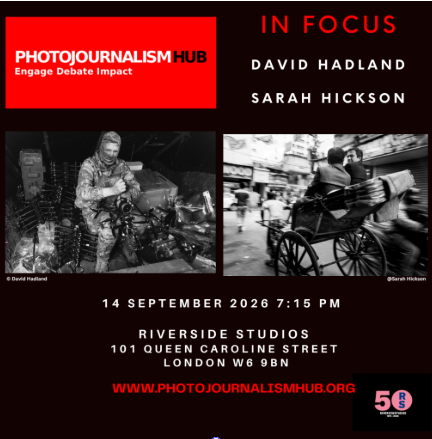
In Focus: David Hadland and Sarah Hickson

Poster IN FOCUS event organised by the Photojournalism Hub

Join us: Here

We are delighted to welcome documentary photographers David Hadland and Sarah Hickson as guests for our next In Focus event at Riverside Studios on 14 September 2026 at 7:15 pm.
In this edition of In Focus, David and Sarah explore the human stories shaped by conflict and displacement. Through their photography, they document lives transformed by crisis from soldiers living on the frontline in Ukraine to refugees navigating loss, uncertainty and the search for a new sense of belonging. Their work reflects on survival, resilience and the enduring connection between people, memory and place.

David Hadland is a documentary and portrait photographer from Luton, U.K. He lived in London for 11 years, where he graduated with a BA in Photography from Kingston University in 2018, and in 2024he graduated with an MA in Documentary Photography and Photojournalism from the London College of Communication. The core themes of David’s photography are identity, memory and the human experience. David is currently based in Kyiv, Ukraine, working on his long-term project documenting the full-scale war. 

Kozak is an ongoing project exploring the lives of Ukrainian soldiers stationed on the frontline. Through portraits and observations of daily life in the combat zone, the work examines how warfare disrupts the connection between people and the places they once called home.
War reshapes more than the landscape itself. Homes, streets, and fields once tied to ordinary life are transformed by conflict, altering how they are experienced and remembered. The soldiers I photograph inhabit dugouts along the frontline, living between the familiarity of home and the instability of war.
The title Kozak reflects a sense of continuity in Ukraine, linking the present to a longer history of resistance, identity, and place. Rather than focusing on spectacle or combat itself, the project centres on the everyday experience of soldiers living through war.

Sarah Hickson is an arts and social documentary photographer, now based in Brighton. Her practice explores the relationship between people, place and environment to create visual narratives that focus on themes of community and belonging, fracture and displacement.

She has worked on photographic commissions, residencies and projects in West and North Africa, India, Europe and around the UK. Sounds Unseen, an exhibition of work documenting a collaborative music project in the ‘Jungle’ refugee camp in Calais, was commissioned by St. Ann’s Warehouse in New York and Galway International Arts Festival. Her photo essay about Kolkata was featured in the book Writing Places, following an artistic residency with the National Centre for Writing in Norwich and Kolkata. Her 200 portraits of participants in the touring theatre project Truth to Power Café, formed an integral part of the theatrical narrative, bearing witness to the participants’ personal testimonies.
It is often the frayed edges of a story that draw Sarah’s attention, where vulnerability and fragility reside alongside hope and resilience. She will present an overview of her work on migration and displacement, referencing projects she has undertaken in Calais, Serbia and Greece, Galway and the UK.

She will also briefly talk about two other projects: her visits to the Taragalte Festival in the Sahara Desert in South Morocco, exploring the endangered environment of M’hamid El Ghizlaine and its historic nomadic culture, and her photo essay about Kolkata, capturing the nuanced and multi-layered nature of daily life in this city, where the past and the present collide. 

IN FOCUS is produced by the Photojournalism Hub in collaboration with Riverside Studios to present compelling, thought-provoking, independent and coraugeous photo storytelling.

IN FOCUS: Citlali Fabian and Jai Toor

To book a place: HERE

IN FOCUS is an event series by the Photojournalism Hub in collaboration with Riverside Studios that presents committed, independent contemporary documentary photography. This edition brings together two visual storytellers whose practices engage deeply with questions of identity, migration, memory, and place. Through distinct yet complementary approaches, Citlali Fabián and Jai Toor use photography to navigate personal and collective histories, examining how images can hold lived experience, cultural inheritance, and emotional truth. Their work moves between documentation and imagination, reflecting on displacement, diaspora, and the meaning of home across generations and geographies.

Citlali Fabian A Yalalteca (indigenous from Mexico) visual storyteller. She uses photography to explore ways of addressing identity and its connections with territory, migration, and community bonds.
Fabián is a  2024 BERTHA FOUNDATION Grantee,  2021 Photography and Social Justice Magnum fellow, a National Geographic Society explorer, with the project “I’m from Yalalag, a photo essay to explore the development of our Zapotec identity.” In 2021, she was awarded by the Art Council of England with a Develop Creative Practice Grant. In 2023 World Press Photo Contest Regional Jury. A 2020 Visura mentee. She was also named one of the Discoveries of the Meeting Place of FotoFest 2018 Biennale.
Her work has been shown in solo and collective exhibitions in Mexico, USA, Spain, and Argentina. Her work has been covered at The New York Times. And also has been appeared in different media like The LA Times, The Guardian, Buzzfeed, Remezcla, Revista Cuartoscuro, and IM Magazine among others. Her Mestiza series was selected as one of the New York Times Lens blog’s “13 Stories That Captured Photography in 2018” and as part of “10 Years of Photography, and Lens”.
She is also a member of Women Photograph and Indigenous Photograph collectives. Her work is part of the INBA/Toledo Collection, the Museum of Contemporary Photography of Chicago, and the Wittliff Collections at Texas State University.  

Jai Toor (b. 1998) is a British-Indian photographer and artist based in the UK. His practice explores the interplay of diaspora and fantasy within the fabric of everyday surroundings. Working across documentary, fashion, and
music, Toor employs a multifaceted approach that integrates research, analogue processes, text, and archival photographs to construct layered visual narratives. Jai Toor’s practice centres around long-form photographic projects that often begin close to home — both literally and emotionally, before expanding outward. As someone who has lived across India and the UK, in many different homes, I’ve never felt a singular sense of place. This transient experience of “home” underpins much of my work, where themes of diaspora, migration, family, loss, and identity recur. He is particularly drawn to overlooked stories, fragments of personal or collective memory that might otherwise go undocumented. Photography, for me, is a way of capturing both presence and absence; a medium that can preserve histories, confront traumas, and evoke longing. He works across documentary, fashion, and music, but his approach remains consistent: research-led and open to intuition.
His projects often begin with reading, writing, and conversations, forming a kind of text-based map that guides me visually. I draw from national archives, interviews, and everyday encounters, weaving together photographs, text, and found materials. He uses analogue and digital photography interchangeably, but shooting on film allows him to slow down and connect more intentionally with the people and places he documents. He sees his work as semi-fictional, a space where documentation, re-imagination, and emotional truth coexist. He leans into ambiguity, allowing the viewer to enter the work without a fixed outcome, but with enough guidance to feel immersed. Collaboration is essential to this process: He often enters personal or communal spaces where trust, exchange, and shared authorship become part of the narrative. Ultimately, he is interested in how photography can hold contradictions, between fact and feeling, history and fantasy, familiarity and displacement, and in how storytelling can honour both the known and the unknowable.

IN FOCUS is presented by the Photojournalism Hub in collaboration with  Riverside Studios, bringing to the public compelling and thought-provoking contemporary documentary photography and photojournalism.

IN FOCUS: Evgeniya Strygina and Tori Ferenc

23rd June 2025, 7:15 pm
Riverside Studios
101 Queen Caroline Street
London W6 9BN

TO BOOK A PLACE: HERE

Photojournalism Hub is delighted to present guest photographers Evgeniya Strygina and Tori Ferenc for the IN FOCUS event on the 23rd June, 7:15 pm, hosted at Riverside Studios.

Both photographers explore themes of place, identity, and belonging from distinct yet complementary perspectives. Strygina’s minimalist landscapes, often void of people, reflect on space, architecture, and the quiet tension between presence and absence. Ferenc focuses on portraiture and documentary work, capturing the nuances of family, community, and our connection to nature. Together, their work forms a thoughtful dialogue on what it means to inhabit a space, physically, emotionally, and collectively.

Evgeniya Strygina (b. 1989) is a lens-based visual artist exploring urbanisation, contemporary landscape, and immigration. She honed her skills at the Fine Art Photography School, Moscow Museum of Modern Art, and PhMuseum. Since relocating to the UK in 2022, her work has been exhibited at Photo|Frome Festival, London Lighthouse Gallery, Cicek Gallery, and LoosenArt Gallery, with publications in Fisheye Magazine, Truth in Photography, Al-Tiba9 Art Magazine, and Artdoc Photography Magazine. Notable awards include the Top 150 MIRA Mobile Prize, MonoVisions Awards, and Photometria Awards judged by Martin Parr. In 2023, she held a solo exhibition after an art residency in Czechia. Her first photobook, Home from Home, is scheduled for release in 2025 with the publisher Ephemere.
As a contemporary photographer with an interest in shooting both urban and natural landscapes, I make a point of keeping my images almost or totally uninhabited as I consider people to be but one part of the world as opposed to being its centre. Even in my pictures of architecture, obviously built by people for other people to use, I am fascinated by the space and its details rather than its occupants. Juxtapositions, interactions and contradictions, rhythms and rhymes – be they intended or otherwise – is what I never stop looking for in nature and cities. In an attempt to make the viewer see aspects of the landscape that routinely go unnoticed, I offer a different perspective on things and deliberately strip down the style of my photographs. Minimalistic and geometric, my pictures are both an experiment in deconstructing reality and a quest for quiet harmony in our noisy existence. Besides exploring the nature of space in my work, I am also keen on studying the notion of home, which could be both a place and a non-place, and portraying a longing for an environment you can call your own. This is probably because, being born in a small town and currently living hundreds of miles away from it, I cannot but wonder where I actually belong.

Tori Ferenc is a portrait and documentary photographer, born in Poland in 1989. In her work, Tori is focusing on the themes of identity, community, family dynamics, and exploring the relationship between humans and nature. Over the years, her projects have been shown at renowned exhibitions such as the Taylor Wessing Photographic Portrait Prize in 2021, the Hamburg Portfolio Review and Prix Virginia in 2022, and Rencontres d’Arles in 2023. She is a member of Women Photograph and Equal Lens. 

IN FOCUS is presented by the Photojournalism Hub in collaboration of Riverside Studios, bringing to the public compelling and thought-provoking contemporary documentary photography and photojournalism,