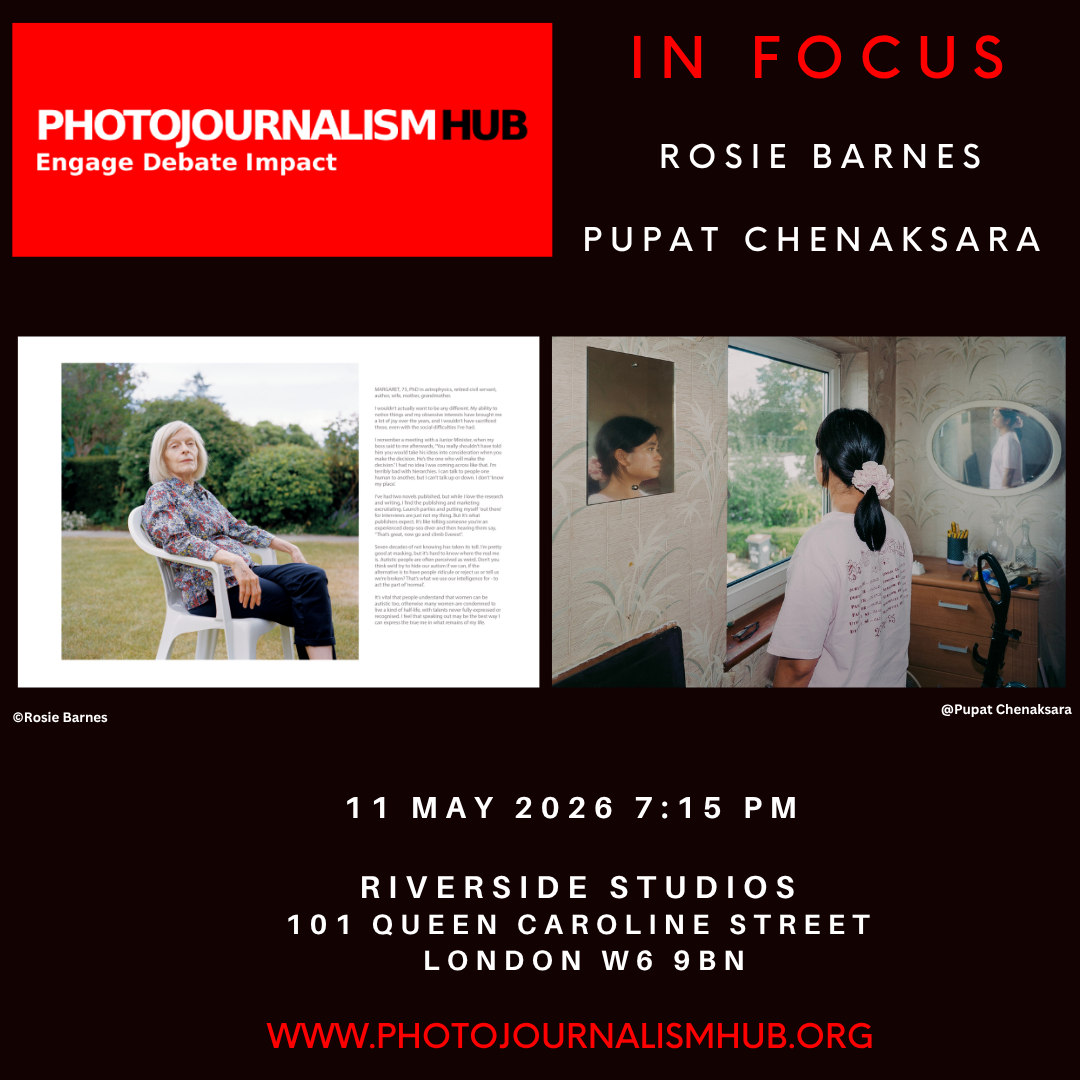
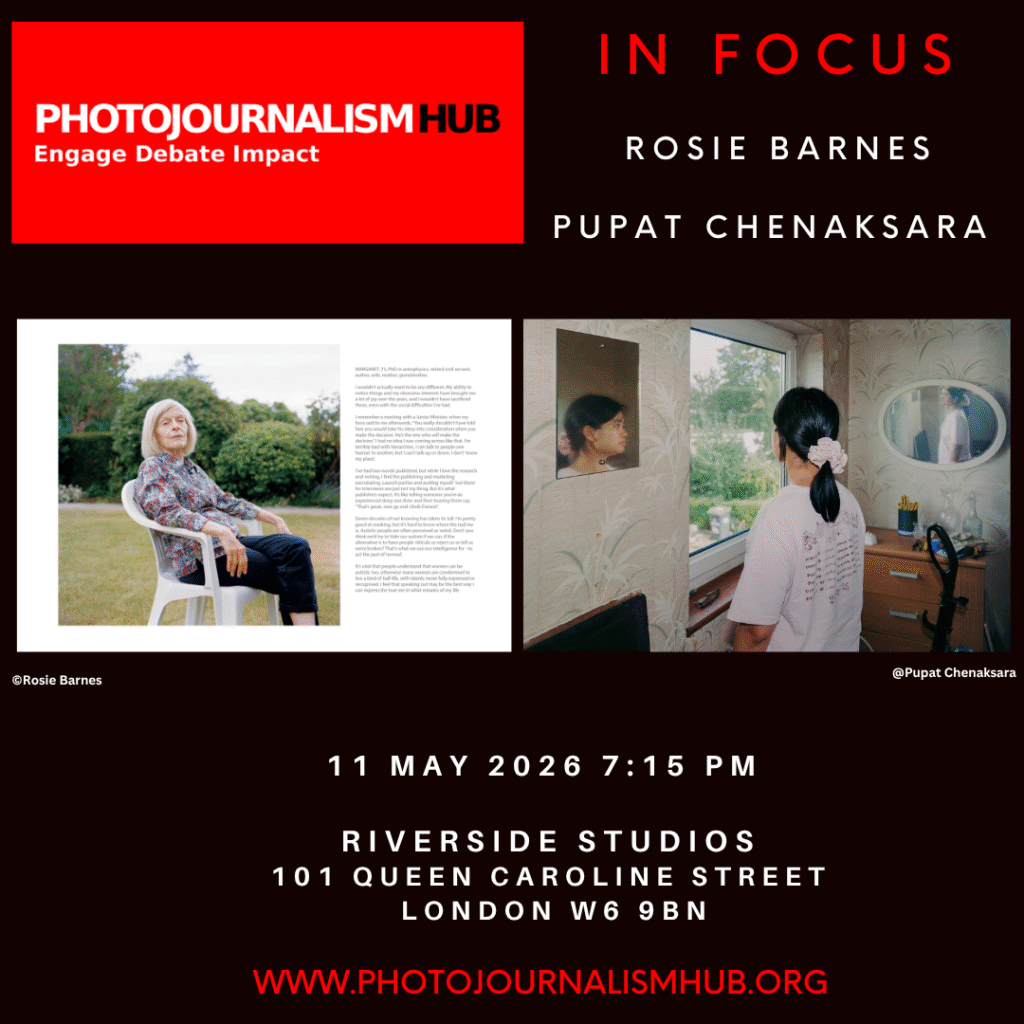
IN FOCUS: Rosie Barnes and Pupat Chenaksara

To book a place: HERE

Join us for an intimate and insightful evening as we explore the intersections of neurodiversity, mental health, and the human condition through the lenses of two profound visual storytellers. We are delighted to welcome Rosie Barnes, a celebrated documentary photographer whose decades of work have reshaped public understanding of autism and the non-human world, alongside Pupat Chenaksara, a rising visual artist who uses photography to navigate the delicate landscapes of anxiety and modern uncertainty. Together, they will share how their personal experiences ranging from caregiving and advocacy to personal healing inform their creative processes, offering a unique look at how the camera can be used to document and heal.

Rosie Barnes is a fine art documentary photographer, living in London.  Her work explores the human condition, neurodiversity, and our relationship with the non-human world. For over thirty years she has developed long-term projects that challenge assumptions, expand public understanding, and give visibility to people and subjects often overlooked. Known for her clarity, direct way of communicating and often humour, she creates work that resonates beyond traditional photographic and art gallery spaces and gives big theme subjects an easy accessibility. She has been commissioned to work on numerous picture stories for the Guardian, FT, Wellcome Collection etc and has exhibited internationally, in China, Japan, the US, Sweden, Greece, Slovakia and within the UK – including at the Centre for British Photography. Rosie is known for her influential work on autism and has published two books on the subject and spoken at the National Galleries of Scotland, having had two portraits from ‘No You’re Not, Yes I Am, a portrait of autistic women’, selected for the prestigious Taylor Wessing Portrait Prize. She is also a carer for one of her adult sons and has also recently set up a CIC – Satsuma Neighbour, to campaign for and build supportive housing communities for independent but vulnerable autistic people.

Pupat Chenaksara (b. Bangkok, Thailand) is a photographer and visual artist based in London, UK. His work grows from a need to understand what it means to live with uncertainty, both personally and collectively. After a personal experience with mental health challenges, he began using his camera to navigate the spaces between fragility and strength. Through still and moving images, Pupat connects with others to explore how we cope, heal, and communicate in times of instability. His projects often start with quiet conversations that unfold into intimate portraits and published works. Pupat holds an MA in Photojournalism and Documentary Photography from University of the Arts London (UAL) and was a finalist at the Abbey Road Music Photography Awards. His work has been featured on BBC News and Rolling Stone. Pupat will be presenting ‘I’m Trying Not to Think About It’, a series exploring the mental states of young people living with anxiety, depression, and other mental health challenges. Through quiet conversations, images, and self-portraits, the project traces how society and capitalism shape emotional life. By participating himself, the artist demonstrates that these experiences are both personal and shared. He observes the fragile, restless state of youth and thesubtle ways steadiness appears.

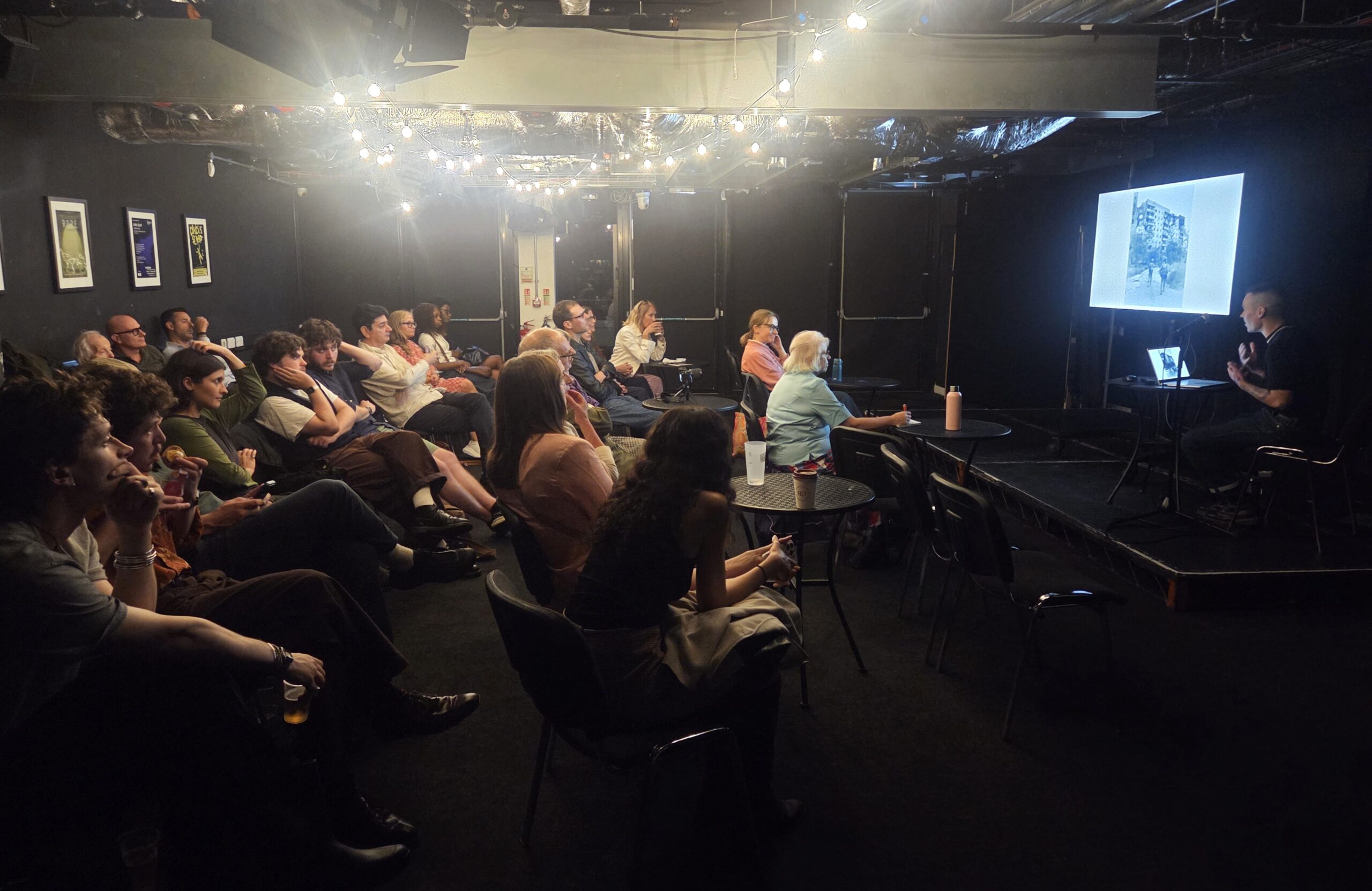
IN FOCUS is presented by the Photojournalism Hub in collaboration with  Riverside Studios, bringing to the public compelling and thought-provoking contemporary documentary photography and photojournalism.

IN FOCUS: Covid-19 & Beyond edition with Chiara Fabbro and Ruth Toda-Nation

To book a place: HERE

Join us for a special edition of the IN FOCUS: a Photography Evening event at Riverside Studios, as part of the exhibitionCovid-19 & Beyond‘. The IN FOCUS features two acclaimed documentary photographers Chiara Fabbro and Ruth Toda-Nation, whose work in the exhibition explores the profound impact of the pandemic on society’s most marginalized and overlooked groups.

Chiara Fabbro is an Italian documentary photographer based in London, whose work focuses on social issues. She has worked in a variety of places, from the suburbs of Kuala Lumpur, in Malaysia, where those who have fled conflict and persecution cannot be granted refugee status and are forced into a life in limbo; to the squats in the Balkans where migrant men, women and children get stuck during their journey towards Europe; to the beaches of the Canary Islands, the destination for thousands of people who every year set off in flimsy boats from the coast of West Africa, facing what is arguably the most dangerous journey to Europe.
Chiara’s work has been published in a range of print and online magazines and newspapers, such as Al Jazeera English, Balkan Insight, Altreconomia, Solomon and El Salto. She has also collaborated with several NGOs for their advocacy and fundraising campaigns. Chiara has won the 2021 Portrait of Humanity award and received an honourable mention in Photography 4 Humanity Global Prize 2020, supported by the UN Human Rights Office. In 2022 she was shortlisted for the Marilyn Stafford FotoReportage Award and she was selected for Earth Photo 2025 Award.

Between Borders: Finding Refuge in a Pandemic – Faces and feet were telling the story of a long journey – hundreds of kilometers on foot, across mountains and rivers. The fear of the pushbacks at the borders, often violent and degrading, was giving way to the relief of finally reaching Italy, mixed with the uncertainty of what lay ahead. 
These young men travelled along the Balkan route of migration in 2020, and arrived in Trieste amidst the pandemic. Access to temporary shelters was limited due to COVID-19 measures, leaving people in transit with no choice but to sleep rough. The pandemic weighed heavily on them, as borders were tightened further and reports of pushbacks increased. It also stirred negative feelings towards migrant people, with some accusing them of spreading the virus. The already unwelcoming climate towards those seeking refuge became even harsher.
Yet the commitment of the volunteers from Linea d’Ombra, caring for those in transit through Trieste, created a small corner of humanity. Every night on the street, then as now, they tend to wounded feet, fill empty stomachs and replace worn-out shoes with new pairs for the road ahead.

Ruth Toda-Nation ’s photographic practice is informed by a nomadic childhood bridging two cultures, Japan and Britain. She began photographing in Liverpool in the 1980s and later in the rural areas of northern Japan. She continues to document the communities where she lives. Her intimate approach interweaves themes navigating family dynamics and community bonds while reflecting on ageing, loneliness, transience, and departure. Ruth often combines images with words drawn from interviews to amplify the voices of communities she documents allowing their stories to unfold.
Her first book, Our Lockdown Garden, was published by The Mindful Editions in 2022. Her recent body of work, Love is a Life Story, received the Royal Photographic Society Documentary Photographer of the Year award in 2023, and portraits from her ongoing project 900 Yards featured in Portrait of Britain 2023.

The projects, Love is a Life Story and Our Lockdown Garden document the pandemic lockdown experience of my father John (91) and his friend and neighbour Mary (97) as residents of a retirement community and care home in Milton Keynes, UK. John and Mary’s friendship and journey through lockdown reflects many of our eldest citizens experiences as friendships replaced family. 
Given their age they were aware that they may never have come out of lockdown, yet their personal voices were lost amongst the incessant news bombarding us with the mortality figures of this very vulnerable group. With no requirement to test discharged patients being sent back into care from hospital, deaths in care homes rose sharply. As a result, it is estimated that a quarter of known coronavirus deaths in Great Britain took place in care homes. 
The invisibility of this generation— The Silent Generation—was amplified during the pandemic, and many spent their last moments alone and deprived of their loved ones. If a society’s humanity is measured by how it treats its most vulnerable members, then I can’t help asking: did we do enough? 

IN FOCUS is presented by the Photojournalism Hub in collaboration with  Riverside Studios, bringing to the public compelling and thought-provoking contemporary documentary photography and photojournalism.

IN FOCUS: A photography evening with Citlali Fabian and Jai Toor

To book a place: HERE

IN FOCUS is an event series by the Photojournalism Hub in collaboration with Riverside Studios that presents committed, independent contemporary documentary photography. This edition brings together two visual storytellers whose practices engage deeply with questions of identity, migration, memory, and place. Through distinct yet complementary approaches, Citlali Fabián and Jai Toor use photography to navigate personal and collective histories, examining how images can hold lived experience, cultural inheritance, and emotional truth. Their work moves between documentation and imagination, reflecting on displacement, diaspora, and the meaning of home across generations and geographies.

Citlali Fabian A Yalalteca (indigenous from Mexico) visual storyteller. She uses photography to explore ways of addressing identity and its connections with territory, migration, and community bonds.
Fabián is a  2024 BERTHA FOUNDATION Grantee,  2021 Photography and Social Justice Magnum fellow, a National Geographic Society explorer, with the project “I’m from Yalalag, a photo essay to explore the development of our Zapotec identity.” In 2021, she was awarded by the Art Council of England with a Develop Creative Practice Grant. In 2023 World Press Photo Contest Regional Jury. A 2020 Visura mentee. She was also named one of the Discoveries of the Meeting Place of FotoFest 2018 Biennale.
Her work has been shown in solo and collective exhibitions in Mexico, USA, Spain, and Argentina. Her work has been covered at The New York Times. And also has been appeared in different media like The LA Times, The Guardian, Buzzfeed, Remezcla, Revista Cuartoscuro, and IM Magazine among others. Her Mestiza series was selected as one of the New York Times Lens blog’s “13 Stories That Captured Photography in 2018” and as part of “10 Years of Photography, and Lens”.
She is also a member of Women Photograph and Indigenous Photograph collectives. Her work is part of the INBA/Toledo Collection, the Museum of Contemporary Photography of Chicago, and the Wittliff Collections at Texas State University.  

Jai Toor (b. 1998) is a British-Indian photographer and artist based in the UK. His practice explores the interplay of diaspora and fantasy within the fabric of everyday surroundings. Working across documentary, fashion, and
music, Toor employs a multifaceted approach that integrates research, analogue processes, text, and archival photographs to construct layered visual narratives. Jai Toor’s practice centres around long-form photographic projects that often begin close to home — both literally and emotionally, before expanding outward. As someone who has lived across India and the UK, in many different homes, I’ve never felt a singular sense of place. This transient experience of “home” underpins much of my work, where themes of diaspora, migration, family, loss, and identity recur. He is particularly drawn to overlooked stories, fragments of personal or collective memory that might otherwise go undocumented. Photography, for me, is a way of capturing both presence and absence; a medium that can preserve histories, confront traumas, and evoke longing. He works across documentary, fashion, and music, but his approach remains consistent: research-led and open to intuition.
His projects often begin with reading, writing, and conversations, forming a kind of text-based map that guides me visually. I draw from national archives, interviews, and everyday encounters, weaving together photographs, text, and found materials. He uses analogue and digital photography interchangeably, but shooting on film allows him to slow down and connect more intentionally with the people and places he documents. He sees his work as semi-fictional, a space where documentation, re-imagination, and emotional truth coexist. He leans into ambiguity, allowing the viewer to enter the work without a fixed outcome, but with enough guidance to feel immersed. Collaboration is essential to this process: He often enters personal or communal spaces where trust, exchange, and shared authorship become part of the narrative. Ultimately, he is interested in how photography can hold contradictions, between fact and feeling, history and fantasy, familiarity and displacement, and in how storytelling can honour both the known and the unknowable.

IN FOCUS is presented by the Photojournalism Hub in collaboration with  Riverside Studios, bringing to the public compelling and thought-provoking contemporary documentary photography and photojournalism.

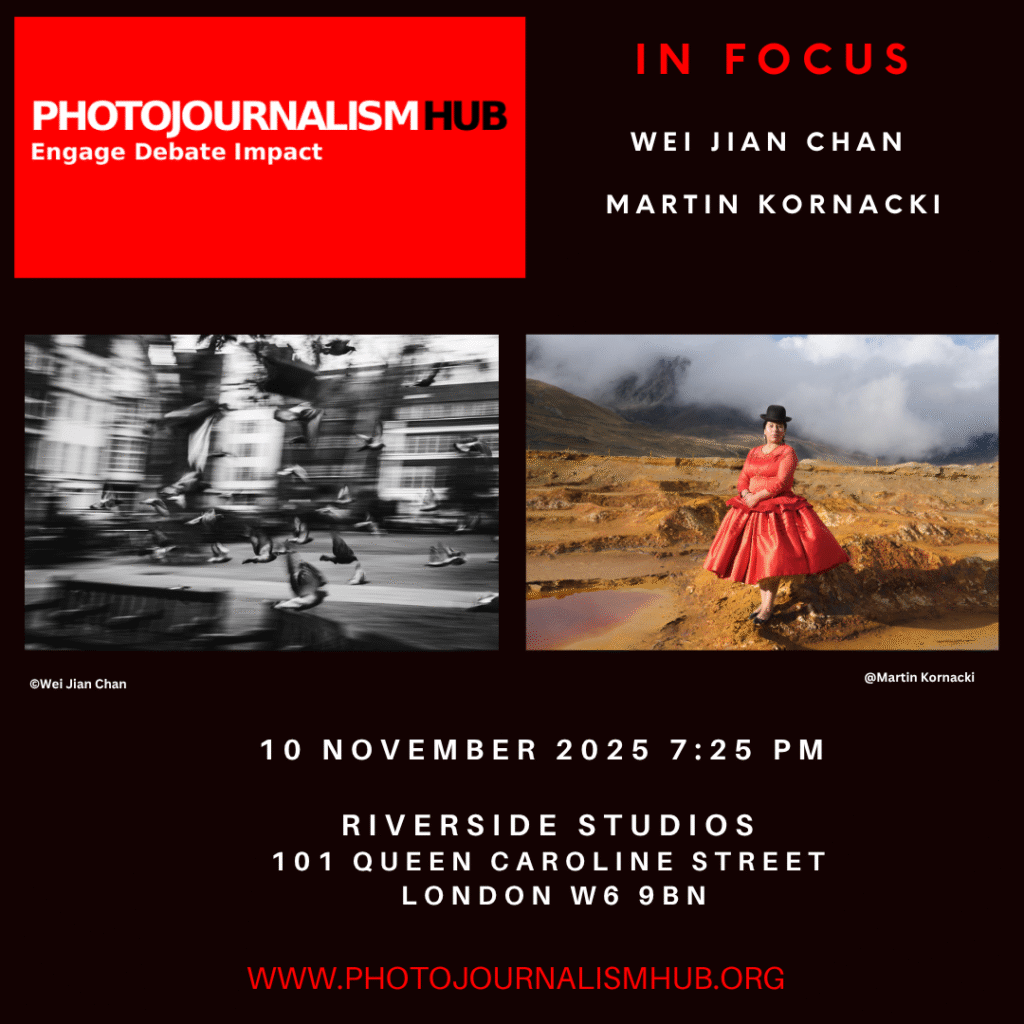
IN FOCUS: Memory, Migration and Conflict with Marcin Kornacki and Wei Jian Chan


To Book a place: HERE


This edition of IN FOCUS brings together two photographers whose practices, while distinct in subject and style, both explore how history, memory, and identity shape lived experience. Marcin Kornacki’s long-term documentary projects in Haiti and Bolivia investigate the legacies of political violence and the endurance of communities in unstable landscapes. In contrast, Wei Jian Chan’s Journey to the West reflects on the personal journey of migration, using the formal language of street photography to evoke dislocation and belonging. Together, their presentations offer powerful insights into working independently in challenging environments, and into photography’s ability to bridge the political and the personal.

Marcin Kornacki
is a London-based documentary photographer and UAL Photojournalism and Documentary Photography MA graduate whose work explores memory, landscape, and the marks of collective history. His practice draws stories to the surface through close attention to place and the unpredictability of encounter. His current projects focus on sites where political violence and colonial legacies remain alive in land and memory.
His ongoing work in Haiti documents its capital Port-au-Prince as it descended into gang control, tracing the layered aftermath of revolution, foreign intervention, and daily survival, documenting both the gangs terrorising the city as well as the people enduring the conflict.
In Bolivia, he photographs the mining communities around La Paz, focusing on Milluni, site of a government-led miners’ massacre in 1965, examining how resistance and political narratives endure and develop across generations.  Grounded in sustained fieldwork and research, Martin’s photography connects personal testimony with broader historical forces. His images invite reflection on how memory is shaped, how trauma is carried, and how communities protect identity in the face of erasure.
His talk aims to focus on the practical aspects of working independently with little training and no official support in conflict zones and politically unstable regions, reflecting in particular on the mistakes he has made, and the lessons he has learnt during his most recent work in Haiti and Bolivia. 

Wei Jian Chan (b.1991) is a Singaporean-born photographer based in London, whose work seeks to find beauty in the chaos of modern life.  Wei Jian first picked up a camera at the age of 14 while growing up in Singapore. Over the years, as he moved to Oxford to attend university and to London for work, the camera has been his constant companion. In his time behind the camera, photography has grown from a pastime into a source of inspiration and a passport to new experiences.  Working primarily in black-and-white, Wei Jian utilises both traditional wet darkroom processes and modern digital techniques in his work. His work frequently incorporates elements of geometry, architecture, and motion.
Wei Jian’s photography has been exhibited in various locations in the UK and Europe, and has been acquired to form part of the permanent collection of the Kiyosato Museum of Photographic Art. His work has also been featured by numerous outlets, including The Guardian, Deutsche Welle and National Geographic.
Wei Jian will be showcasing images from his debut photobook ‘Journey to the West’, published by Setanta Books. This book features his black and white street photography, and seeks to evoke the sense of dislocation and uncertainty that Wei Jian experienced in the early years of moving from Singapore to the UK, during which he set about to integrate into a foreign culture and find his place in the world. The title ‘Journey to the West’ comes from a Ming dynasty Chinese myth about the journey of the Buddhist monk Xuanzang who travelled to the ‘Western Regions’ to obtain Buddhist sacred texts (sutras). 

The event IN FOCUS is presented by the Photojournalism Hub in collaboration with  Riverside Studios, bringing to the public compelling and thought-provoking contemporary documentary photography and photojournalism.

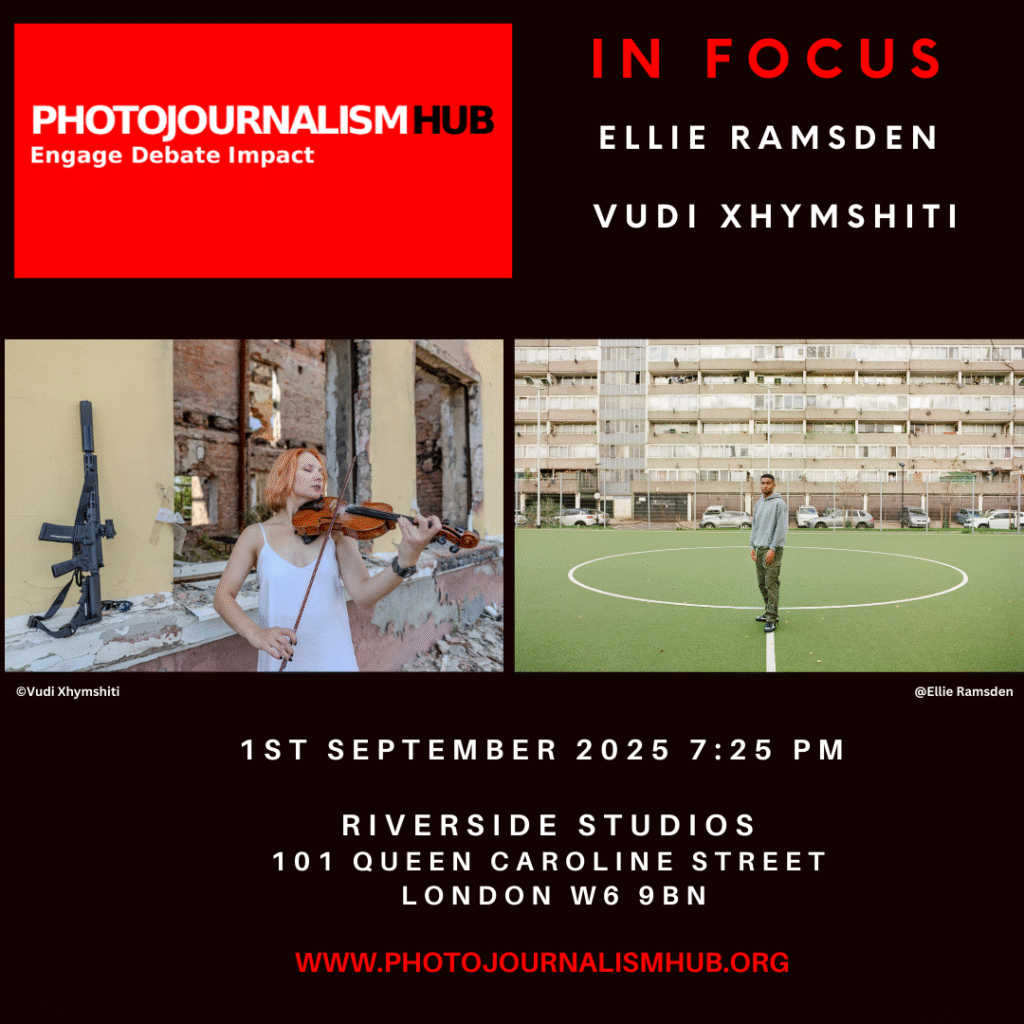
IN FOCUS: From London Streets to War Zones, Two Photographers, One Shared Humanity

1 September 2025, 7:25 pm
Riverside Studios
101 Queen Caroline Street
London W6 9BN

TO BOOK A PLACE: HERE

Ellie Ramsden and Vudi Xhymshiti bring powerful, contrasting perspectives to our next IN FOCUS of 1st September event, revealing stories of identity, resilience, and courage from British subcultures to the frontlines of global conflict.

Ellie Ramsden is a London-based photographic artist whose practice centres on portrait and documentary photography, informed by a deep interest in human behaviour, interaction, and communication. Working primarily with analogue film, she adopts a slower, more considered approach that allows for intimacy and reflection in her work.
Her practice often incorporates elements of co-creation, aiming to foster dialogue, challenge stereotypes, and present alternative perspectives through authentic, collaborative storytelling. Ellie’s personal projects focus on British subcultures and communities, exploring themes such as youth culture, gender equality, collective identity, and resistance to mainstream narratives.
Balancing self-initiated projects with commissioned work, Ellie’s photography has been exhibited internationally and widely featured in the press. Her work is held in the permanent archive of the Museum of Youth Culture.

Vudi Xhymshiti is an investigative journalist, war reporter, and foreign editor based in London, renowned for his fearless reporting on armed conflicts, political corruption, and global power struggles. With a career spanning over 18 years, he has covered some of the world’s most volatile regions, from the Arab Spring and Syria’s civil war to Russian aggression in Ukraine, the Armenian-Azerbaijani conflict, and ongoing tensions in the Balkans.
As the founder and editor-in-chief of The Gunpowder Chronicles – www.thegpc.uk, Xhymshiti delivers in-depth investigative journalism exposing corruption, disinformation warfare, and geopolitical manoeuvring that threaten democracy and human rights. His work has been featured in The New York TimesThe GuardianTIMEThe Washington PostDer SpiegelLe Monde, and La Repubblica, among others.
Vudi’s work seeks to document the human condition in the face of war, occupation, and political oppression, with a focus on the resilience, dignity, and courage of ordinary people living through extraordinary circumstances.
In Ukraine, Vudi has been recording the stories of those who have survived the brutality of the Russian invasion, capturing their lived experiences in the aftermath of atrocities and amidst ongoing destruction. His photographs aim not only to bear witness to suffering but to highlight perseverance, the fight for identity, and the everyday struggles for survival in the shadow of geopolitical violence.

IN FOCUS is presented by the Photojournalism Hub in collaboration of Riverside Studios, bringing to the public compelling and thought-provoking contemporary documentary photography and photojournalism.

Photojournalism Hub x Riverside Studios 28th May

28th May 2025, 7:15 pm
Riverside Studios
101 Queen Caroline Street
London W6 9BN

To join: HERE

We are delighted to announce the next IN FOCUS event at Riverside Studios, featuring guest photographers Denise Felkin and Sabes Sugunasabesan, whose powerful work explores identity, memory, and marginalised lives.
Felkin’s In Site documents a hidden Traveller community in East London, revealing an alternative way of living beneath the arches of the city. Sugunasabesan reflects on the legacy of war in Sri Lanka through a diasporic lens, with Kunkumam tracing memory, loss, and land. Together, their work challenges dominant narratives and brings overlooked voices to the fore.

IN FOCUS will be hosted by documentary photographer/ journalist and Photojournalism Hub’s founder and director Cinzia D’Ambrosi alongside photojournalist Sabrina Merolla. The event includes photography presentations, Q&A sessions, and time to socialise and connect.

Denise Felkin is a UK-based editorial and fine art documentary photographer whose work challenges social taboos to promote values of sustainability, inclusivity, and compassion. She aims to amplify marginalised voices and explore themes of identity and social justice. Her photography has been featured in national press, included in numerous awards, and exhibited nationally and internationally.
In Site (1997–2024) reveals an underground lifestyle rooted in Traveller communities. Under three railway arches and beyond a padlocked gate in East London, an alternative lifestyle was documented. Respect, freedom, truth, and beauty are conveyed through an unpretentious perception of the experience and expression of an urban subculture.
Felkin details an enriched cultural existence within a clan that had found a safe place to sustain their creative lives. The community was innovative and packed with independent souls. Embedded are elements of citizenship and domesticity, offering a strong societal message in contrast to industrialisation and capitalism.
In Site was shortlisted for the British Photography Awards, exhibited in the Polarity exhibition at Photojournalism Hub, as well as selected in the Inequality open call at Photo Frome. Her next exhibition will be at Lambeth Courthouse, 7–8 June 2025.
IG @denisefelkinphotographer
www.denisefelkin.com

Sabes Sugunasabesan is a photographic artist living in England. He migrated from Sri Lanka over four decades ago. At the end of the thirty-year long war in May 2009, in Sri Lanka there were 90.000 widows in the north and east of the country. With the deaths on the army side the numbers would be much higher. During the repression of suspected People’s Liberation Front members (JVP) between 1988-90, 60,000 mothers lost their children in the south of the country.
Sabes works on the theme of war, memory and land from a diasporic point of view. It is a view from distance of time and space. Kunkumam builds on his previous work shown under the title of the Last Walk to the Beach (2018). To prepare for Kunkumam he travelled to Sri Lanka during the August-September 2024 and enacted a performance at Mullivaikkal.
IG @sabessuguna

BECOME A PJH MEMBER
Consider becoming a member of the Photojournalism Hub. Your support will enable us to continue our work promoting photographic work that expose, raise awareness of social justice issues. To learn more how to become a member and the benefits of joining, follow the link HERE

Photojournalism Hub x Riverside Studios 24th March

24th March 2025, 7:15 pm
Riverside Studios
101 Queen Caroline Street
London W6 9BN

To join: HERE

Photojournalism Hub March 2025 In Focus event at Riverside Studios will welcome uniquely experienced and talented photographers Janine Wiedel and Gabrielle Motola. Their presentations will guide us into the world of the documentary photo book from the point of view of visual anthropology and psychological and ethnocultural studies.
The photographers’ works will be available during the evening – some for purchase and others for free (donations to Gabrielle Motola’s photographic bursary will be very welcome).

This event will be hosted by photojournalist Sabrina Merolla and Photojournalism Hub’s founder and director Cinzia D’Ambrosi. The talks will be followed by Q&As and time to socialise and mingle.

Janine Wiedel has been working as a documentary photographer and visual anthropologist since the late 1960s. From the Berkeley Riots and Black Panther Movement in California to the in-depth portrayal of the UK’s main historical protests since the 70s, she always fuelled a lifelong interest in movements and sub-cultures.
Wiedel has persistently reworked her long-term projects, which have become prominent studies, books and exhibitions. She has published zines (Café Royal Books) and historical milestone books such as Vulcan’s Forge, dedicated to the West Midland Industries (1977-79). In-depth projects have focused on Irish Travellers, Baffin Island Inuits, UK Industries, Iran, Protest movements, Urban Squatting, Eco Warriors, the Rastafarian Community, and the Refugee Camps in Northern France. Currently, she is pulling together her book on the Greenham Common Women’s Peace Camp (1983/84). It will soon be followed by a book dedicated to ‘St Agnes Place Squat’ (2003-06), a notorious street in South London squatted by a diverse range of people over 30 years and evicted in 2006.
Web: https://archive.wiedel-photo-library.com/index
Insta: @wiedelphoto


Gabrielle Motola is an award-winning photographer, writer, and photo therapist whose work blends emotional depth with perceptive realism. Her creative process often integrates with solo motorcycle travels leading to portraiture, street, and infrared landscape photography, exploring self-reflection, resilience, and the human connection.
Her photo book, An Equal Difference (2016), is an ethno-photographic exploration of Iceland’s striking contrasts while examining gender dynamics following the 2008 financial crisis. Created over three years, the book centres on dialogues with individuals from diverse walks of life, including politicians, scientists, artists and educators. These conversations go beyond the surface to reveal the complexities of the Icelandic mindset, encouraging a reflection on identity, gender equality, and the societal norms that influence them. Through her workshops, Gabrielle brings a reflective approach, inspiring participants to realise their unique creative potential.
www.anequaldifference.com www.gabriellemotola.com
Gabrielle’s workshops bursary: www.gabriellemotola.com/learn/#bursary
Insta: @anequaldifference & @gmotophotos

BECOME A PJH MEMBER
Consider becoming a member of the Photojournalism Hub. Your support will enable us to continue our work promoting photographic work that expose, raise awareness of social justice issues. To learn more how to become a member and the benefits of joining, follow the link HERE

Photojournalism Hub x Riverside Studios 24th February

24th February 2025, 7 pm
Riverside Studios
101 Queen Caroline Street
London W6 9BN

IN FOCUS brings together two remarkable photographers whose works centre on the themes of community and diaspora, exploring identity, memory, and the cultural landscapes that shape collective experiences.

Myah Asha Jeffers is a Barbadian-British writer, director, photographer and dramaturg. As the previous Literary Associate at the Royal Court Theatre, she was responsible for shaping the works of new and established playwrights. 
Myah’s photographic work has won the Portrait of Britain Prize twice and The Photography Foundation Social Documentary Award. She is the 2024 recipient of the renowned Joan Wakelin Bursary (Royal Photographic Society & The Guardian). 
Her photographs have been featured in publications such as Vogue, The Guardian, The Sunday Times Magazine, ELLE and The Independent amongst others. She has also worked in collaboration with the likes of Tate, Somerset House, ICA, South London Gallery and Whitechapel Gallery.  Myah’s debut short film Bathsheba world premiered at Inside Out (TIFF) and has screened at festivals including New York Shorts, Leeds FF, Norwich FF and Atlanta’s Out on Film, garnering nominations at multiple festivals for Best British Film and Best Director.
Myah’s practice
I am a photographer, writer and director, particularly interested in witnessing and documenting the nuances of daily life within diasporic communities. My practice is conceptually focused on ‘Black Interiority’, where I closely examine themes such as class, cultural identity, queerness, grief, gesture, and truth. Working solely with small & medium format analogue cameras and darkroom-based hand printing processes, the work is particularly concerned with the intersection of “naturalism” and “myth”, through illuminating the magic of rituals, quiet, and connection. With a focus on the (in)tangibility and truth of grief / its relationship with what I call “living abstraction” – where Black folk sculpt or construct versions of themselves as a tool for survival;  I aim to make work that lends itself to abstraction through the experimentation with form, monotone, texture, and structure.
Exclusion Zone.
I’ll be presenting a first preview of my most recent project, Exclusion Zone supported by the Joan Wakelin Bursary and the Visual Studies Workshop Artist Residency. In 1995, a series of seismic Volcanic eruptions rendered two thirds of the island of Montserrat uninhabitable, catalysing a mass exodus. With now only 20% of the island deemed habitable and a current population of just over 4000 people – Montserrat is one of the least populus countries in the world. It also happens to be one of the few remaining British colonies. The uninhabitable 80% of the island is known as the “Exclusion Zone” – a site of buried infrastructure, homes and memories. It is both a graveyard for relics of the past.
This photo series explores the legacy of the natural disaster 30 years on; through the lens of both elders who are nostalgic of what the island was and young people who only know the island for what it is today. 

Paulina Korobkiewicz (b. 1993, Suwałki, Poland) is a London-based photographer and visual artist. Her work explores themes of cultural identity, memory, and the transformation of social spaces. Her projects focus on the visual and cultural landscape of her hometown and region as well as that of her current residence in the UK, documenting everyday scenes and environments with a sense of nostalgia and socio-political commentary, drawing from her own experience of migration. Her practice involves community-based research, conducting workshops, and mentoring. In addition to developing long-form personal projects, Paulina continues to undertake commissions and residencies.
She has participated in several group and solo exhibitions internationally. Her work has been featured in a variety of publications, such as Hapax Magazine, Kajet Journal, Contemporary Lynx, Photomonitor, the BJP, and Creative Review. Paulina is a winner of the Camberwell Book Prize, has been shortlisted and nominated for awards including BarTur Photobook Award, Magnum Graduate Photographers Award and Prix Pictet.

BECOME A PJH MEMBER
Consider becoming a member of the Photojournalism Hub. Your support will enable us to continue our work promoting photographic work that expose, raise awareness of social justice issues. To learn more how to become a member and the benefits of joining, follow the link HERE

Photojournalism Hub x Riverside Studios 13th January

13th January 2025, 7 pm
Riverside Studios
101 Queen Caroline Street
London W6 9BN
To join: HERE


From self-portraiture that reclaims Igbo women’s identities to a collaborative exploration of historic ties to transatlantic slavery, photographers Adaeze Ihebom, Charlotte Woolford, and Mal Woolford confront history’s erasures. Ihebom’s Igbo Woman series challenges colonial narratives and reimagines the strength of pre-colonial Igbo femininity, while the Woolfords’ wet-plate collodion portraits uncover shared ancestry and redefine representation through co-creation. Together, they navigate themes of identity, isolation, and transformation across time and culture.

Adaeze Ihebom is an Italian-Nigerian artist who explores themes of identity and isolation. She has a degree in Digital photography from Ravensbourne University and has a Masters degree in Photography arts from the University of Westminster.
Adaeze will present her Igbo Woman series – This series was inspired by Things Fall Apart by Chinua Achebe which traces the evolution of family identity from pre-colonial, through colonial and post-colonial times. In a series of self-portraits, in which I performativity explore women from various periods of history. As
fictional characters, I construct their identities through costume, performance and the act of naming and dating the images.
The decision to highlight Igbo women is rooted in my belief that she has been grossly misrepresented. To be more precise, I personally feel that history has not portrayed the Igbo woman in her rightful perspective. She is usually shown in images that correspond to a supposed African man’s world and the idea of feminine submissiveness to the man. The series is a way to challenge this mistaken notion and to show how colonialism has further removed feminine freedom from the Igbo woman.
The portraits depict the colonial experience and the effect and impact of Christianity on Igbo women. It shows the female transformation from a virile, half-clad, war-like Igbo damsel to a mundane, all covering and meek-looking woman. This transformation shows both a radical departure and complete alienation from traditional dressing modes. Their lives changed irrevocably when the British invaded the Igboland. Colonization changed not only the religious, social and political institutions. It also enforces policies that diminished the roles and statues of Igbo women making them look like second class citizens.

Charlotte Woolford and Malcolm Woolford Having known each other from the school pickup, Charlotte and Mal discovered by chance that they share the surname: Woolford.
Archival research revealed that they are connected through historic transatlantic chattel slavery and a household of enslavers and enslaved in Georgetown, Guyana. Two hundred years later, they are neighbours.
Charlotte and Mal use the early photographic technique wet-plate collodion to make closely observed portraits not as photographer and model but as co-photographers. They trouble the historic use of photography to explore equal control and representation.

BECOME A PJH MEMBER
Consider becoming a member of the Photojournalism Hub. Your support will enable us to continue our work promoting photographic work that expose, raise awareness of social justice issues. To learn more how to become a member and the benefits of joining, follow the link HERE

Photojournalism Hub x Riverside Studios 25th September

25th September 2024, 7 pm

Riverside Studios
101 Queen Caroline Street
London W6 9BN
To join: HERE

We are thrilled to introduce award-winning photographers Anselm Ebulue and Mark Chapman at the In Focus event on the 25th of September. Both photographers bring a unique perspective to the photographic medium, transitioning from deeply personal, introspective, visceral stories on loss and mourning to powerful, straightforward documentary photography.

Anselm Ebulue is a documentary photographer based in London. He was a winner in the 2018 and 2020 Portrait of Britain award and was awarded a scholarship for the LCC x Magnum Documentary Photography Short Course. He has recently graduated from the MA Photojournalism and Documentary course at UAL. His work has been published in a variety of publications and clients include The Guardian and Observer, The Modern House, Time Out Magazine and Red Bull.

Anselm will be presenting ‘Whims of the Rye’ which is an ongoing documentary series exploring Ebulue’s personal relationship with Peckham, in south east London. Ebulue’s approach is visceral, making pictures of mundane spaces that resonate with his emotive reactions where memory and change intersect. The work expresses a sense of loss, mourning the transformation of an area in a state of rapid flux that is most clearly evidenced by its gentrification. 
Ebulue is particularly interested in the relationship Black communities have with Peckham and through documentation, hopes to highlight the significance of the area to the Black diaspora. Whims of the Rye serves as both a celebration and preservation of the Black communities who have called Peckham home for many decades.

Mark Chapman is an award-winning photographer and film-maker based in Gateshead, North East England and London. His moving-image work has been screened internationally across narrative, documentary and experimental contexts.
Chapman’s debut photobook ‘God’s Promises Mean Everything’ explores isolation and displacement via a long-term study of a hostel resident from Teesside. The book was published by internationally renowned Dewi Lewis Publishing and launched during Photo London at Somerset House in May 2024.
Mark will be speaking about ‘God’s Promises Mean Everything’, an immersive long-term character portrait that extends over seven years, but limits its perspective to a single room. Haunted by the spectre of the family he lost, Derek, a hostel resident from Teesside lives without the social safety nets many of us take for granted. Mark was given unique access to document Derek’s life over several years and the project seeks to elevate a working class story that would otherwise go unacknowledged.
The images are an inseparable mix of the self-aware and spontaneous, candid and constructed. Seeking to explore the boundaries between filmmaking and photography practice, I want to tell urgent contemporary stories that are also rigorous aesthetic constructions. However, my aim is not straightforward realism, but rather to transform. My work moves between naturalism and expressiveness, altering the shape of the real world into something disturbing and mysterious.
This is now the third project in which Derek has appeared (across film and photography): his unifying presence creates a constellation of individual projects across disciplines that have now become an open-ended archive of experience. The Dewi Lewis Publishing website: https://www.dewilewis.com/products/gods-promises-mean-everything