FROM THE INSIDE

Photojournalism Hub welcomes three photographers whose work addresses disabilities and stigmas – of their own or of the others .

28th February 2022 18:30 – 21:00

The Invention Rooms, Imperial College
68 Wood Lane
London
W12 7TA

To join: HERE

©Patricia Lay-Dorsey

Living with one or more chronic conditions is the daily routine of so many people in the world. Nonetheless, the way visible and invisible illnesses are portrayed by media, films, and schoolbooks can be highly frustrating. “The disabled” tend to be portrayed as dependent persons who constantly need help. When they are not, they tend to suddenly become heroes, simply for facing their daily lives. Both views point out that the invisible barrier of unconscious stereotypes and bias on the others’ daily truth is the biggest hurdle for a disabled person. For this reasons, Photojournalism Hub welcomes three photographers whose work addresses disabilities and stigmas – of their own or of the others – in differently unique ways: Patricia Lay-Dorsey, Jameisha Prescod and Sophie Harris Taylor.

©Sophie Harris-Taylor
©Jameisha Prescod

This event will be hosted by Sabrina Merolla. She is a documentary and press photographer, multimedia storyteller and participatory photography facilitator, who has shown her daily routine of “diverse ability” in more than one personal project. www.sabrinamerolla.co.uk

Recognising Women

Laura James

Photojournalism is an industry that is still dominated by men. Suzanne Plunkett, award winning photojournalist, reaffirmed this fact during the Photojournalism Hub’s talk event last Monday. She recounted her impressive career and highlighted that she was always among only a handful of women photographers within a sea of men when working for agencies. Her lived experience can be reflected in the fact that ‘just 18% of the AOP’s accredited photographers and assistant photographers are women.’ (Steven: 2019). Along with the clear gender bias towards employing male photographers, she also touched on issues of sexism from managers in agencies, not being taken as seriously as her male counterparts and the lack of demand for stories that cover important female issues.

Talking about these issues was pertinently timed as International Women’s Day was to be celebrated just 6 days ahead of the talk. The theme of this year’s IWD was Each for Equal – aiming to help create a more equal world where women are always on the same platform as men. Suzanne, along with Chiara Ceolin and Quintina Valero (the two other speakers at the event) are certainly helping to create gender equality by doing such amazing work with women around the world and documenting their stories. They have worked on projects with victims of female genital mutilation, sex trafficking and female prison.

By having more amazing female photojournalists in the industry we are creating a levelled playing field and going against a male centric selection of stories in the media. We need to keep recognising the achievements of female photographers and those who are telling the stories of women to come closer to a world where gender discrimination is a thing of the past.

Reference 

Photojournalism Nights 12th edition

28th April 2021 06:30pm utc Online

Photojournalist Hub twelve edition of the Photojournalism Nights presents an amazing line-up of photographers: Ben Marans David Sládek , Mario Washington Ihieme .

© David Sladek
Thousands of pro-democracy protesters took to the streets on August 18, 2019 in Hong Kong. Despite the huge number of people, the crowd parted quickly to allow an ambulance to get through. © Ben Marans
© Mario W. Ihieme

The Photojournalism Nights is an event that promotes committed and courageous photojournalism and engages the public to social justice and human rights.

To join: HERE

Do We Know About Today’s Youth Crime and Violence?

17th September 2019

Sharing below some photographs from the talk event on youth and crime we held on the 17th September 2019 at the Invention Rooms in White City.

We presented a very diverse group of panellist who shared their experiences and insights on this very important issue: Raheel Butt, who is an ex gang member, Dr.Roger Grimshaw, Research Director of the Centre for Crime and Justice, Rebecca Omonira-Oyekanmi, investigative journalist and photographer Robin Friend. 

The conversations showed different perspectives that included the raw experiences of Raheel Butt, the research of Dr. Grimshaw that points to emotional deprivation and poverty in early years’ link to aggregation to gangs, and Robin’s visual research looking at austerity measures, Brexit and lack of youth provisions as precursors of youth crime.

Once the presentations ended, we asked the public why they came to the event and that was the start of a very powerful sharing of the public’s own experiences, including their own children’ being caught in the fabric of crime, gang membership and radicalisation.

This was a very powerful talk event, matched by a strong feel of wanting to change things in the White City community, a strong fear for the future of children, and a need to connect with each other to look for solutions. The public asked to have their email shared with each other.

Raheel Butt
Robin Friend

‘Helping others through images’: Photojournalism Hub launches at White City

George Hope

Imperial College London | 16 November 2018

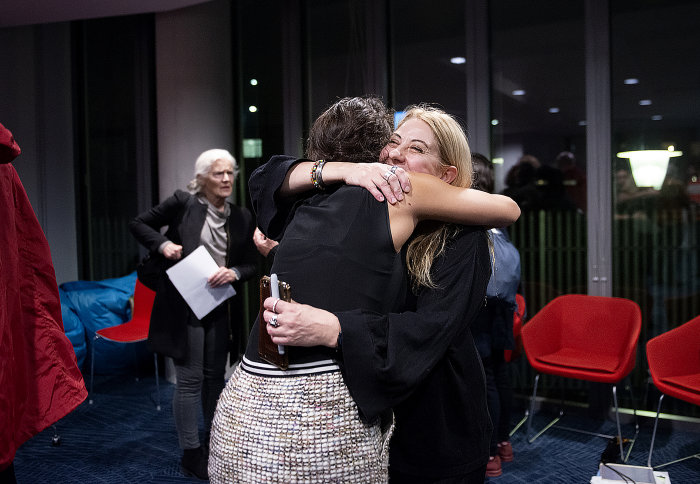
Cinzia D'Ambrosi hugs attendee of photojournalism event

A new community-led Photojournalism Hub launched at Imperial’s White City Incubator this week.

In November 2018, Imperial College London reported on the launch of Photojournalism Hub at its White City Incubator, marking the beginning of a new community-led initiative founded by photographer and journalist Cinzia D’Ambrosi.

Supported by Hammersmith United Charities, the Photojournalism Hub was established with a clear purpose: to use photojournalism to generate positive outcomes for vulnerable communities and individuals, while supporting the development and dissemination of photojournalistic work.

From the outset, the Hub brought together photography, journalism, social justice and community engagement. Its programme was intended to include exhibitions, investigative visual and written content, debates, community-led forums, training and research, creating opportunities for people to engage with important contemporary social justice issues through photography.

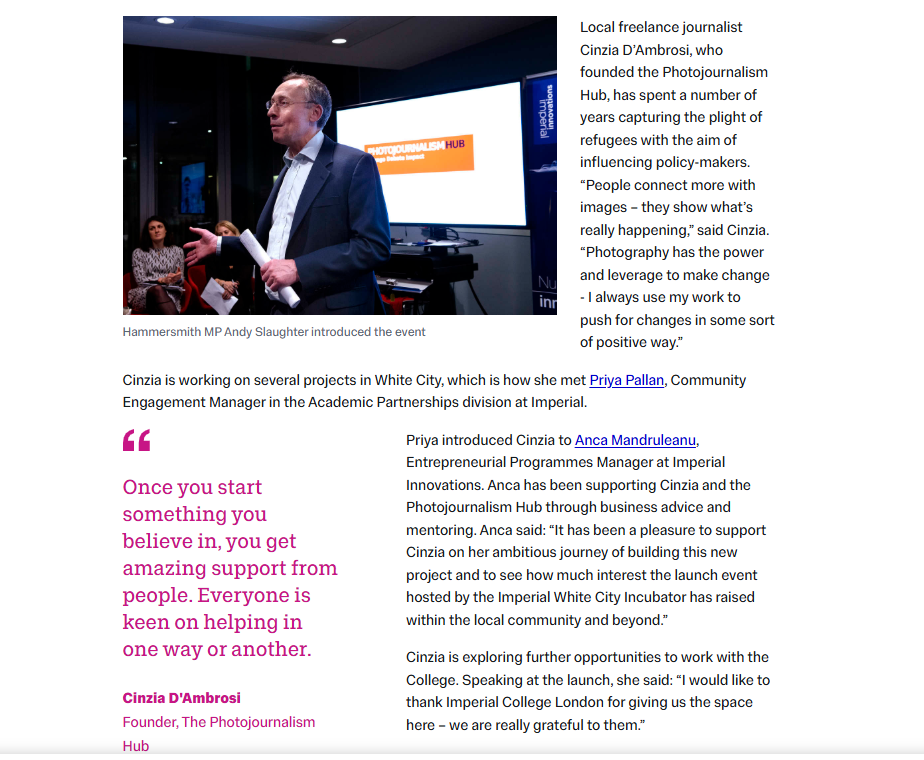
The launch was introduced by Andy Slaughter MP, then MP for Hammersmith, alongside local activists, journalists and photographers. Among the speakers was Daniel Renwick, who presented Failed by the State, his film made following the Grenfell Tower fire. Other contributors included Katie Webb of the Writers’ Union of Italy and veteran photojournalist David Hoffman.

The article also introduced Citizen Visual Journalism, a concept developed by D’Ambrosi through Photojournalism Hub. The idea was to enable community groups and individuals to learn how to tell their own stories through high-quality images and to identify and raise social justice issues that matter to them.

Rather than simply documenting communities, the approach aimed to give people the tools to communicate their experiences and reach those with the power to influence policy and create change.

The launch at White City established the foundations for what Photojournalism Hub continues to develop today: using photography and visual journalism to question injustice, amplify overlooked voices and create opportunities for communities to tell their own stories.

Read the original article on Imperial News:
‘Helping others through images’: Photojournalism Hub launches at White City


Women Photographers Covering Women’s Violence, Trauma and Grief

The Invention Rooms
68 Wood Lane
W12 7TA

02 March 2020   18:30-20:30
©Suzanne Plunkett – Civilian bombing victim Shahpiry, 30, holds her son Hasib, 4, during a therapy session at the Kabul Mental Health Hospital in Kabul, Afghanistan, April 5, 2002. The wages of war are starkly visible across Afghanistan, but the most lasting damage can’t be seen: the wounds to the minds of Afghans, after 23 years of dread punctuated by moments of terror.

Women photographers discuss their challenges, reflections and roles on covering stories of violence against women.

The Photojournalism Hub is very honored to present three great women photojournalist that have worked on some of the most difficult and excruciating modern women stories to share their experiences, insights and challenges.

Suzanne Plunkett, is an award winning photojournalist who has worked as a staff photographer for the Associated Press in New York where she covered the Sept.11 attacks on the World Trade Centre in 2001 and then as the chief photographer for the AP in Jakarta where she covered the 2004 Indian Ocean Tsunami. Based in London since 2006, she has worked as a senior staff photographer for Bloomberg News in London and a staff photographer for Reuters. Currently, she shoots for The New York Times, the RHS, Chatham House and leads the London chapter of Women Photograph which works to elevate the voices of women+ non binary visual storytellers.

Chiara Ceolin, is a documentary photographer who has a background of working for nearly ten years as a psychologist specialised in PTSD and trauma. Chiara has worked extensively with projects in rural Tanzania, Romania and London adopting participatory methods to empower and heal young girls and women through visual storytelling. Currently, Chiara’s work focuses on women who survived trauma as well as contributing to clients such as Thomson Reuters Foundation, Westminster University, The Evening Standard, Magic Me charity, BBC Children in Need, Forward UK and many others.

Quintina Valero, o, is an award-winning photojournalist whose work focuses on human rights, displacement, women and environmental issue. She has a proven passion for bringing important stories often collaborating with local NGOs. Her work has been featured in The Guardian, Sunday Times, Thomson Reuters Foundation, BBC, Stern Magazine and El Pais among others. Her latest projects have taken her to Central America and the Colombian Amazon documenting the different layers of conflict. Her work on sex trafficking and the impact of Chernobyl’s nuclear accident has received international awards including the Lensculture Emerging Talent, Festival della Fotografia Etica (Italy) and the Photo Press Contest Award (Ukraine).

Join this event

Understanding, Confronting and Questioning Notions of Identity

The Invention Rooms
68 Wood Lane
W12 7TA

27 January 2020 18:30-20:30

©Zula Rabikowska

How photography can be used as a tool to address questions of belonging, place and the histories we learn and inherit.

A talk event exploring how experiences of citizenship, nationality and identity can inform notions of identity. The speakers’ powerful work is directly influenced by personal journeying and displacement, and a quest to build understanding around notions of identity. The Photojournalism Hub is very pleased to present:

Zula Rabikowska, photographer, born in Poland, grew up in the UK and worked in France, China, South Africa, India, Palestine and the Caribbean. Citizens of Nowhere is a project about experiences of citizenship, nationality and identity on a political, cultural and social level and is a personal response to the 2016 Brexit referendum where 51.9% of the British population voted to leave the European Union, and the increased racism and xenophobia that followed.

Adam Razvi, documentary photographer, will present work that addresses issues of belonging, and disputes the rose-tinted nostalgia still commonly associated with the British Empire. Adam’s work aims to build understanding of how culture, nationality and the past inform notions of identity, He explains “As a person of mixed-heritage I have become increasingly conscious of a sense of belonging and place, raising a number of questions – often without clear resolutions. At the core of this questioning, visual perceptions, including how British I look and feel and how this impacts everyday interactions and my roles in society.”

Join this event

Photojournalism and Movements of Activism and Protest Today

The Invention Rooms
68 Wood Lane
W12 7TA

16th December 2019 18:30 – 20:30

©Talia Woodin

Exploring today’s form of rebellion, resilience and resistance through photojournalism.

Part of a series of talk events exploring photojournalism as a tool of activism, the Photojournalism Hub presents three photographers whose work is currently actively engaged with documenting and raising awareness of climate change, food waste, women’s rights and forms of protest and resilience.

Angela Christofilou, is half English, half Greek actor, voice artist, photographer and singer/songwriter (Field Trip to the Moon band) living in London. Self taught, she first experimented with street photography in the US while on a theatre tour and then began documenting protests at the end of 2015. She mainly focuses on street, social documentary and protest photography and is often covering major protests for the Independent Angela’s protest photography over the years is currently being archived at the Bishopsgate Institute.

Chris King, is a documentary and portrait photographer and video producer, whose work focuses on the food system. He has documented the issue of food waste for several years, and is now starting an initiative called Documenting Climate Change that aims to mobilise, support and train documentary storytellers of all disciplines to create more engaging, impactful stories on the issue of climate change.

Talia Woodin, is a photographer , activist and works full time as media and messaging coordinator for Extinction Rebellion Youth. Since October 2018, Talia has worked as a photographer for Extinction Rebellion, whom regularly features her work.

Join this event

Photojournalism and Activism in Today’s Forms of Resistance

The Invention Rooms
68 Wood Lane
W12 7TA

19th November 2019 18:30 – 20:30

©Vindhya Buthpitiya

Exploring today’s form of rebellion, resilience and resistance through photojournalism.

Part of a series of talk events exploring photojournalism as a tool of activism in today’s movements and forms of resistance, resilience and rebellion, the Photojournalism Hub present four guest speakers whose work bring testimony and engagement to current moments and events of fortitude and activism.

Alice Marcelino is a London based photographer, born in Luanda, Angola, moved to Portugal at a very early age. She experienced and explored various art forms, from dance to theatre, until adopting photography as her main form of expression. Her images and photo stories explore concepts of identity and sub-cultures, and their meaning in our globalised world.

Pierre Alozie is a Franco-Nigerian photojournalist based in London, whose work spans years covering social, political, cultural issues including the fall of the Berlin Wall, the Velvet Revolution and Kosovo war.

Vindhya Buthpitiya is a PhD candidate in Anthropology at University College London researching the interweaving of conflict, popular photographic practices and political articulation among the Northern Tamil community in postwar Sri Lanka.

Zainab Ravat is a geography graduate who last year won first place in the Royal Geographical Society with the Institute of British Geographers (RGS-IBG ) Social and Cultural Geography Research Group Dissertation Prize for her dissertation entitled ‘Photojournalism: Explorations into the Geographical Witness, Activist and Traveller’.

Join this event

Women Photographers Perspectives on Mental Well-being

The Invention Rooms
68 Wood Lane
W12 7TA

08th October 2019 18:30 – 21:00

How does ethnicity, culture, gender determine the responses and the services experienced?

Three women photographers present their powerful projects on mental well-being opening a discussion on race, austerity, marginalisation and immigration.

Marie Smith presents Whispering for help, a series which consists of annotated portrait project with women of colour aged 18 years and above. The project involves recording women of colour experience with mental health, a mixture of black and white film portraits and hand written texts by the sitter. This project will seek to create a series that explores experiences of mental health services in UK as well as providing a platform for dialogue to dismantle the stigma of mental health in BAME communities.

Nieves Mingueza presents The malady of Suzanne, a poetic documentary project. By combining found archives with her own photography work in Vietnam, she is exploring the story of a Vietnamese female with mental issues in 70’s London. This is an on-going project about the complex relationship between memory, immigration, mental health and human conflicts.

Sue Shorvon, her photo artwork aims to encourage self-exploration of people’s perceptions and assumptions, as a way forward to destigmatizing mental illness in society.

– If people like the music, they will listen to the words.”

To join this event, please book a space here