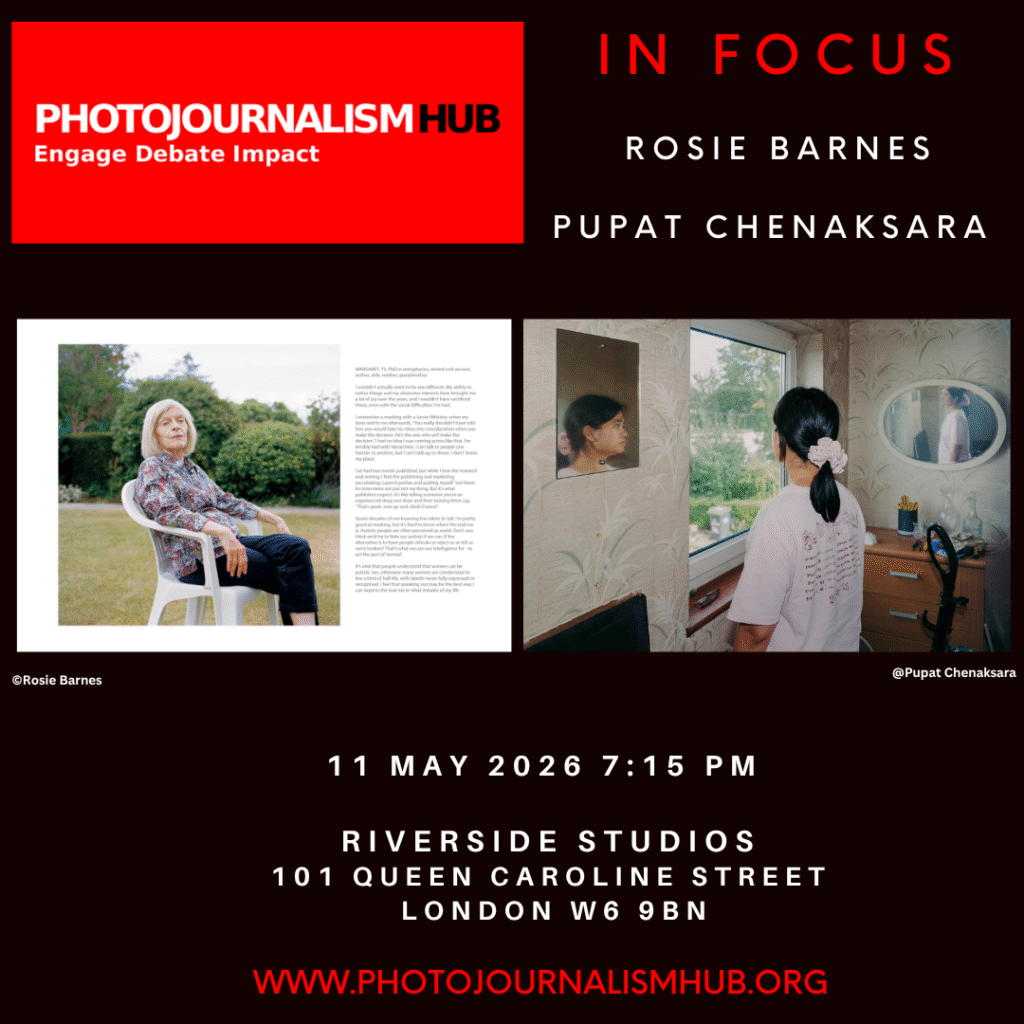
IN FOCUS: Rosie Barnes and Pupat Chenaksara

To book a place: HERE

Join us for an intimate and insightful evening as we explore the intersections of neurodiversity, mental health, and the human condition through the lenses of two profound visual storytellers. We are delighted to welcome Rosie Barnes, a celebrated documentary photographer whose decades of work have reshaped public understanding of autism and the non-human world, alongside Pupat Chenaksara, a rising visual artist who uses photography to navigate the delicate landscapes of anxiety and modern uncertainty. Together, they will share how their personal experiences ranging from caregiving and advocacy to personal healing inform their creative processes, offering a unique look at how the camera can be used to document and heal.

Rosie Barnes is a fine art documentary photographer, living in London.  Her work explores the human condition, neurodiversity, and our relationship with the non-human world. For over thirty years she has developed long-term projects that challenge assumptions, expand public understanding, and give visibility to people and subjects often overlooked. Known for her clarity, direct way of communicating and often humour, she creates work that resonates beyond traditional photographic and art gallery spaces and gives big theme subjects an easy accessibility. She has been commissioned to work on numerous picture stories for the Guardian, FT, Wellcome Collection etc and has exhibited internationally, in China, Japan, the US, Sweden, Greece, Slovakia and within the UK – including at the Centre for British Photography. Rosie is known for her influential work on autism and has published two books on the subject and spoken at the National Galleries of Scotland, having had two portraits from ‘No You’re Not, Yes I Am, a portrait of autistic women’, selected for the prestigious Taylor Wessing Portrait Prize. She is also a carer for one of her adult sons and has also recently set up a CIC – Satsuma Neighbour, to campaign for and build supportive housing communities for independent but vulnerable autistic people.

Pupat Chenaksara (b. Bangkok, Thailand) is a photographer and visual artist based in London, UK. His work grows from a need to understand what it means to live with uncertainty, both personally and collectively. After a personal experience with mental health challenges, he began using his camera to navigate the spaces between fragility and strength. Through still and moving images, Pupat connects with others to explore how we cope, heal, and communicate in times of instability. His projects often start with quiet conversations that unfold into intimate portraits and published works. Pupat holds an MA in Photojournalism and Documentary Photography from University of the Arts London (UAL) and was a finalist at the Abbey Road Music Photography Awards. His work has been featured on BBC News and Rolling Stone. Pupat will be presenting ‘I’m Trying Not to Think About It’, a series exploring the mental states of young people living with anxiety, depression, and other mental health challenges. Through quiet conversations, images, and self-portraits, the project traces how society and capitalism shape emotional life. By participating himself, the artist demonstrates that these experiences are both personal and shared. He observes the fragile, restless state of youth and thesubtle ways steadiness appears.

IN FOCUS is presented by the Photojournalism Hub in collaboration with  Riverside Studios, bringing to the public compelling and thought-provoking contemporary documentary photography and photojournalism.

IN FOCUS: A photography evening with Citlali Fabian and Jai Toor

To book a place: HERE

IN FOCUS is an event series by the Photojournalism Hub in collaboration with Riverside Studios that presents committed, independent contemporary documentary photography. This edition brings together two visual storytellers whose practices engage deeply with questions of identity, migration, memory, and place. Through distinct yet complementary approaches, Citlali Fabián and Jai Toor use photography to navigate personal and collective histories, examining how images can hold lived experience, cultural inheritance, and emotional truth. Their work moves between documentation and imagination, reflecting on displacement, diaspora, and the meaning of home across generations and geographies.

Citlali Fabian A Yalalteca (indigenous from Mexico) visual storyteller. She uses photography to explore ways of addressing identity and its connections with territory, migration, and community bonds.
Fabián is a  2024 BERTHA FOUNDATION Grantee,  2021 Photography and Social Justice Magnum fellow, a National Geographic Society explorer, with the project “I’m from Yalalag, a photo essay to explore the development of our Zapotec identity.” In 2021, she was awarded by the Art Council of England with a Develop Creative Practice Grant. In 2023 World Press Photo Contest Regional Jury. A 2020 Visura mentee. She was also named one of the Discoveries of the Meeting Place of FotoFest 2018 Biennale.
Her work has been shown in solo and collective exhibitions in Mexico, USA, Spain, and Argentina. Her work has been covered at The New York Times. And also has been appeared in different media like The LA Times, The Guardian, Buzzfeed, Remezcla, Revista Cuartoscuro, and IM Magazine among others. Her Mestiza series was selected as one of the New York Times Lens blog’s “13 Stories That Captured Photography in 2018” and as part of “10 Years of Photography, and Lens”.
She is also a member of Women Photograph and Indigenous Photograph collectives. Her work is part of the INBA/Toledo Collection, the Museum of Contemporary Photography of Chicago, and the Wittliff Collections at Texas State University.  

Jai Toor (b. 1998) is a British-Indian photographer and artist based in the UK. His practice explores the interplay of diaspora and fantasy within the fabric of everyday surroundings. Working across documentary, fashion, and
music, Toor employs a multifaceted approach that integrates research, analogue processes, text, and archival photographs to construct layered visual narratives. Jai Toor’s practice centres around long-form photographic projects that often begin close to home — both literally and emotionally, before expanding outward. As someone who has lived across India and the UK, in many different homes, I’ve never felt a singular sense of place. This transient experience of “home” underpins much of my work, where themes of diaspora, migration, family, loss, and identity recur. He is particularly drawn to overlooked stories, fragments of personal or collective memory that might otherwise go undocumented. Photography, for me, is a way of capturing both presence and absence; a medium that can preserve histories, confront traumas, and evoke longing. He works across documentary, fashion, and music, but his approach remains consistent: research-led and open to intuition.
His projects often begin with reading, writing, and conversations, forming a kind of text-based map that guides me visually. I draw from national archives, interviews, and everyday encounters, weaving together photographs, text, and found materials. He uses analogue and digital photography interchangeably, but shooting on film allows him to slow down and connect more intentionally with the people and places he documents. He sees his work as semi-fictional, a space where documentation, re-imagination, and emotional truth coexist. He leans into ambiguity, allowing the viewer to enter the work without a fixed outcome, but with enough guidance to feel immersed. Collaboration is essential to this process: He often enters personal or communal spaces where trust, exchange, and shared authorship become part of the narrative. Ultimately, he is interested in how photography can hold contradictions, between fact and feeling, history and fantasy, familiarity and displacement, and in how storytelling can honour both the known and the unknowable.

IN FOCUS is presented by the Photojournalism Hub in collaboration with  Riverside Studios, bringing to the public compelling and thought-provoking contemporary documentary photography and photojournalism.