The Photojournalism Hub Calendar 2026 showcasing the incredible work of photojournalists and documentary photographers who have contributed to our mission.
Another death at the hands of police brutality and the world goes on fire: enough is enough. People have descended to the streets demanding justice for George Floyd, who died on May 2nd in Minneapolis, Minnesota after white police officer Derek Chauvin knelt on his neck for almost nine minutes while handcuffed and lying face down on the street. The life of another black person so unjustly and mercilessly cut short has touched hearts and angered of millions of people around the world. Large numbers of demonstrations organised by Black Lives Matter and many more globally have demanded justice and the end of police brutality in remembrance for the many who have died because of the colour of their skin.
Paris, 2 June 2020: The demonstration in support of the family of Adama Traoré, a black boy died on 19 July 2016 in the barracks of the “gendarmerie” of Persan ( Val d’Oise), collected more than 20,000 people gathered outside the Court of Paris despite the prohibition of the (Prefecture). An appeal to demonstrate was launched in the previous days by the committee “Justice pour Adama” denouncing a “rejection of justice” in a case that became for its defenders the symbol of the fight against police violence: in four years, three medical investigations have denied the responsibilities of the “gendarmes”, then that a private one ordered by the family of Adama states the opposite.
The demonstration follows the spear in recent days of the hashtag #Moiaussijaipeurdevantlapolice and the assassination of the afro-American George Floyd’s in the US. Assa Traoré, sister of Adama, in an interview with Franceinfo said that the death of Floyd recalls that of Adama relaunching this link in another statement issued to BFMTV where he declares that “the indignation denounced in the United States is the same as what happens in France.” After a peaceful start marked by choruses and applause, the police used force to disperse the huge crowd, causing rioting for hours in the area surrounding the Tribunal.
During the Italian National Republic Day on the 2nd June, a group of women stands in solidarity with the Black Lives Matter movement. The name of the group ‘Rete Donne Migranti e Figlie’, literally translating’ Network of Migrant women and daughters’ organised the protest in a significative place; by the monument that remembers the Italian deaths in the Battle of Dogali in 1887 during the Italian colonisation of Eritrea. On the group’s facebook page the aims of the protest are as follow: ‘June 2nd, 2020- there is nothing to praise. Today we celebrate the Italian Republic based on class, gender and race discrimination and on migrants’ exploitation and criminalization.’
Photojournalism Hub holds the first Photojournalism Nights Event on the 21st May at Elephant West Gallery, London White City!
The first event dedicated purely to photojournalism is the culmination of an ambition of Photojournalism Hub founder and director, Cinzia D’Ambrosi to re-ignite the passion for this form of journalism. The event was a real success with the large gallery full of people, who engaged to high quality photojournalism and Q&A. The public also had the opportunity to win an original print of the guest photojournalists through a raffle ticket, printed with the support of Genesis Imaging. The renowned and respected Photo Archive News supported the event by selecting and publishing the work of one of the guests photographers.
Cinzia, founder/director of the Photojournalism Nights introduces the first guest photographerPhotographer Rob Pinney presents his work Wamaitha wins an original print from guest photographer Tavis BohlingerTavis Bohlinger presents his workThe public engages in a Q&A
Please join the live stream of the Photojournalist Hub tenth edition of the Photojournalism Nights with an amazing line-up of photographers:Edoardo Santangelo, Jagdish Patel, Igor Coko.
Edoardo Santangelo focuses on exposing inequalities and in particular how little or no access to electricity is impacting millions. Around 7 million refugees, the displaced and the most vulnerable communities will access 4 hours or less of electricity a day, left behind in the drive for better energy access. Edoardo’s work shows the realities of communities in refugee camps Rwanda , displaced communities in Nepal as well as documenting the challenges to improve access to energy in displaced settings through the work of the EPSRC funded Humanitarian Engineering and Energy for Displacement (HEED).
Igor Coko uses his camera to capture and explore the sensibility of the street life, its people and life of stigmatized social groups. The story of ‘Living behind bars’ documents the restricted cell block called “5-1”, where prisoners are locked for 22 hours including two hours they can spend outdoor. This photo story is the first in the history of Serbian photography that showcase prison life without censored details, identities. Igor is the editor in chief at Grain magazine that showcase street and documentary photography.
Jagdish Patel ‘s early career was working with homeless people in central London, then for the anti-racist charity, the Monitoring Group where he was the Deputy Director. He worked on research and campaigns, including those of Stephen Lawrence, Ricky Reel, Michael Menson amongst others. Since 2009, Jagdish has been working as a photography-based artist and researcher showing work at the Southbank centre, Wolverhampton Art gallery and the New Art Exchange in Nottingham to name a few. His work is based in communities, usually working-class communities and often involves weaving historical archives into the present. He is one of the founders of the ReFramed Network, a network for Black and Asian photographers across the Midlands, and the Off Centre : the Nottingham centre for Photography and Social Engagement. He is currently working on a research project examining the inter-relationship between anti-racism, socially engaged art and archives at Coventry University.
The Photojournalism Nights is an event that promotes committed and courageous photojournalism and engages the public to social justice and human rights.
As Coronavirus continues to spread throughout the world, it is increasing social injustices and bringing inequalities to the forefront. In the 7th edition of the Journal on “Injustice & Inequalities: Covid-19”, we present the work of three great photographers who share the tremendous challenges of those in the grips of poverty, homelessness. The pandemic has widened social inequalities. And injustices are strongly lived among the most poor hit hard by the pandemic and regulations that do not protect them. The divide is becoming greater. These are issues we need to see, reflect upon and action.
Since the state of alarm ended and the courts reopened, dozens of evictions have been scheduled, of families in vulnerable situations, with women survivors of gender violence, refugee families, young pregnant women, elderly people with health problems. The pandemic has increased inequalities, has further impoverished those most at risk, and institutions are not able to manage this problem, and don´t offer a housing alternative, so these families are forced to occupy empty homes belonging to the bank, sharing a house with many more people -increasing the risk of contagion-, or staying homeless. A decree has recently been approved that prevents evictions due to covid without a housing alternative, but … what happens to families who have been dragging this situation since before this pandemic?
Trabajo docuemntal sobre el proceso de reivindicación y lucha por una alternativa habitacional de Esperanza y su familia tras su desalojo.Documentacion de la vida de EsperanzaHusein y su familia seran desalojados dentro de 4 días por no poder pagar el alquiler abusivo de 750 eur, sin realojo, y siendo familia refugiada de acogida en situación reconocida de vulnerabilidad.Documentación familias en estado de vulnerabilidad que van a ser desahuciadas mañana sin alternativa y en la mayoria de los casos sin notificación previa.
Cris Aznar. 1981. Zaragoza. Photographer. Artivist.Independent communicator. A woman who looks and observes, studies photography to feel and understand, to express in her exhibitions and react to reality with senses and feelings, gray lights and gender colors that shape her involvement as a person in the defense of human rights. His eyes have passed through Europe, Asia, Africa and America. Energy, intention and heart in photography, seeks real reporting, documentary and humanism focused on art as a form of expression and engine of change.
Mompiche is a fishing village located south of the city of Esmeraldas in Ecuador, where I spent two months of quarantine with the local people. This place was affected due to the health emergency caused by the Covid-19 pandemic, since its main source of income is a tourism and artisanal fisheries, reducing its activity between half of March and April. More than 4000 fishermen in the area had to stop working. They have had problems buying food for their family because they are still stranded without being able to fish and more than 70 other fishermen have left the activity in which they have been catching for more than 20 years. The artisanal fishermen are a vulnerable group since they have few labor rights and most have no social security or labor insurance.
After the closure of the borders very little food arrives and its price increases more and more. The limited circumstances lead us to collaborate with the fishermen in their work to obtain our portion of fish, becoming our first activity of the day.
Barbara Traver – I am not from here or there, I was born in Madrid (Spain), but since I was nine years old I have lived in various places in Spain and also outside of Spain. Currently, my base is between Valencia, Spain, where I settled in 2014 to study at the Espai d’art fotogràfic school and finished in 2017 with the Master in Photography: Creation and Production. At the end of 2017, I moved to Madrid to take the course “Creativity and strategies in contemporary photography” at the EFTI school, taught by Javier Vallhonrat. Thanks to this course, I started to develop my project “, te quiere, mamá”, showing it in several festivals like the seminar of photography and photojournalism in Albarracín or in the cultural hall CC Pati Llimona, in Barcelona. I have also been invited as an artist in the project “Un mundo paralelo” (Spain, 2017) curated by Joan Fontcuberta I have also self-published two photobooks, exhibited in different national and international spaces, and giving several talks.
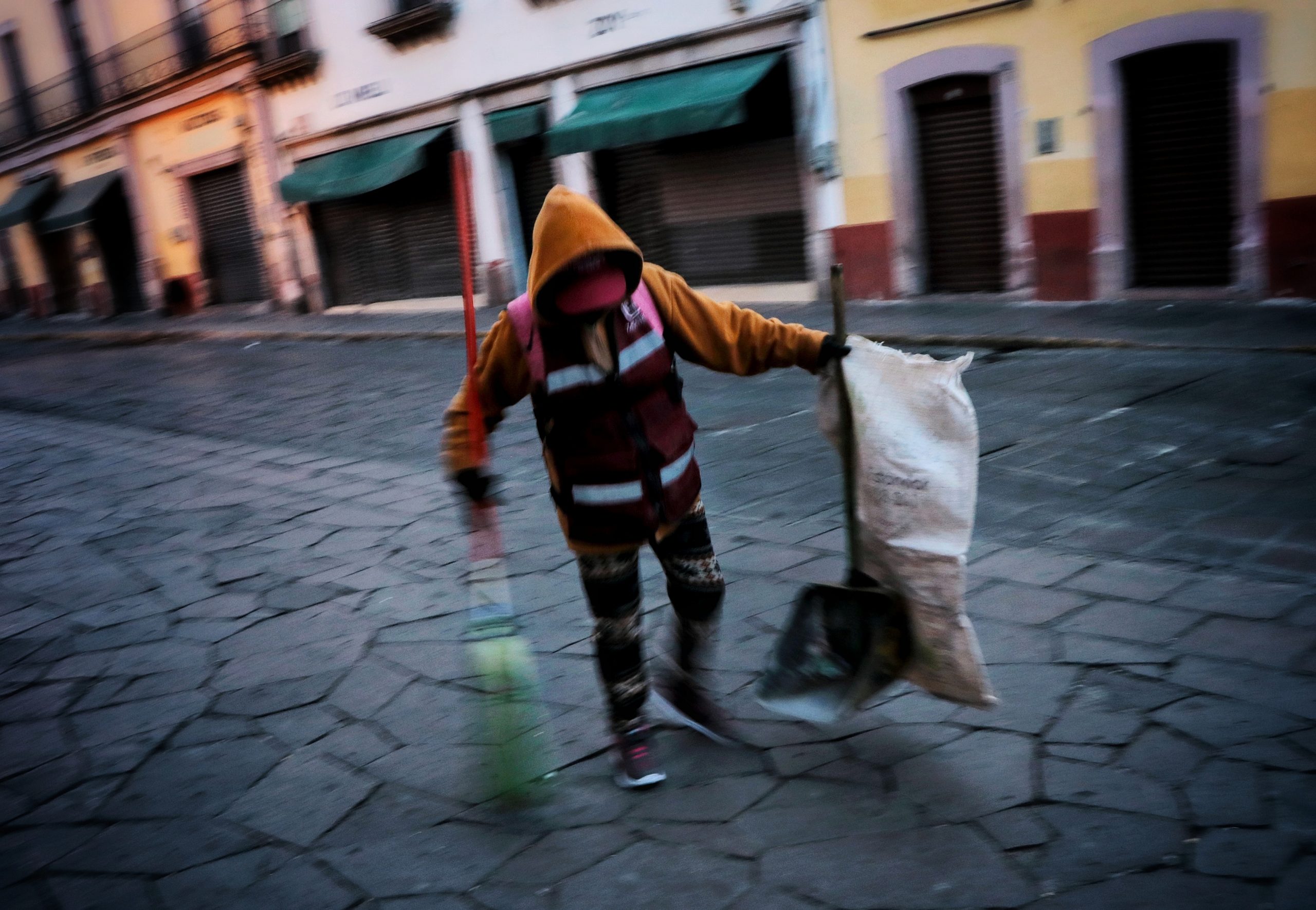
It is early in the streets and the cold of a January morning creeps into the bones and Dona Juana Serrano, who is 63 years old, has already started one more day of work. She is one of the “little ants” who travel the city every day with a broom, sack and dustpan and has done it with pleasure for more than 28 years, she is the person who has worked the longest in the cleaning crew of the city. The pandemic has not slowed down her work or her spirits: “I really like my job, because I had nothing and all I have is thanks to what I do, it is also like cleaning my house, the street is my house and I like to take care of her “- says” Juanita “as the merchants call her who greet her as they pass. Despite her age and the risk that she implies, she continues with her work. 2 months ago one of her colleagues contracted COVID while doing her work and even had to be hospitalized to recover; “I do want to get vaccinated, because I’m always on the street and I don’t want to make anyone sick in my house, I’ve already lost many of my people”, says Juanita, referring to her husband who died of influenza a month ago and her brother died from complications with diabetes a week ago, she lives with her two older children and a one-year-old grandson.
Due to the health crisis, of 100% of the manual sweeping cleaning staff, only 40% is active to avoid contagion, so the workers divide the 32 cleaning areas that make up the historic center. A good strategy would be to prioritize the application of the vaccine among municipal cleaning personnel, due to the nature of their work and the risk it entails.
Women photographers discuss their challenges, reflections and roles on covering stories of violence against women.
The Photojournalism Hub is very honored to present three great women photojournalist that have worked on some of the most difficult and excruciating modern women stories to share their experiences, insights and challenges.
Suzanne Plunkett, is an award winning photojournalist who has worked as a staff photographer for the Associated Press in New York where she covered the Sept.11 attacks on the World Trade Centre in 2001 and then as the chief photographer for the AP in Jakarta where she covered the 2004 Indian Ocean Tsunami. Based in London since 2006, she has worked as a senior staff photographer for Bloomberg News in London and a staff photographer for Reuters. Currently, she shoots for The New York Times, the RHS, Chatham House and leads the London chapter of Women Photograph which works to elevate the voices of women+ non binary visual storytellers.
Chiara Ceolin, is a documentary photographer who has a background of working for nearly ten years as a psychologist specialised in PTSD and trauma. Chiara has worked extensively with projects in rural Tanzania, Romania and London adopting participatory methods to empower and heal young girls and women through visual storytelling. Currently, Chiara’s work focuses on women who survived trauma as well as contributing to clients such as Thomson Reuters Foundation, Westminster University, The Evening Standard, Magic Me charity, BBC Children in Need, Forward UK and many others.
Quintina Valero, o, is an award-winning photojournalist whose work focuses on human rights, displacement, women and environmental issue. She has a proven passion for bringing important stories often collaborating with local NGOs. Her work has been featured in The Guardian, Sunday Times, Thomson Reuters Foundation, BBC, Stern Magazine and El Pais among others. Her latest projects have taken her to Central America and the Colombian Amazon documenting the different layers of conflict. Her work on sex trafficking and the impact of Chernobyl’s nuclear accident has received international awards including the Lensculture Emerging Talent, Festival della Fotografia Etica (Italy) and the Photo Press Contest Award (Ukraine).
How photography can be used as a tool to address questions of belonging, place and the histories we learn and inherit.
A talk event exploring how experiences of citizenship, nationality and identity can inform notions of identity. The speakers’ powerful work is directly influenced by personal journeying and displacement, and a quest to build understanding around notions of identity. The Photojournalism Hub is very pleased to present:
Zula Rabikowska, photographer, born in Poland, grew up in the UK and worked in France, China, South Africa, India, Palestine and the Caribbean. Citizens of Nowhere is a project about experiences of citizenship, nationality and identity on a political, cultural and social level and is a personal response to the 2016 Brexit referendum where 51.9% of the British population voted to leave the European Union, and the increased racism and xenophobia that followed.
Adam Razvi, documentary photographer, will present work that addresses issues of belonging, and disputes the rose-tinted nostalgia still commonly associated with the British Empire. Adam’s work aims to build understanding of how culture, nationality and the past inform notions of identity, He explains “As a person of mixed-heritage I have become increasingly conscious of a sense of belonging and place, raising a number of questions – often without clear resolutions. At the core of this questioning, visual perceptions, including how British I look and feel and how this impacts everyday interactions and my roles in society.”
Exploring today’s form of rebellion, resilience and resistance through photojournalism.
Part of a series of talk events exploring photojournalism as a tool of activism, the Photojournalism Hub presents three photographers whose work is currently actively engaged with documenting and raising awareness of climate change, food waste, women’s rights and forms of protest and resilience.
Angela Christofilou, is half English, half Greek actor, voice artist, photographer and singer/songwriter (Field Trip to the Moon band) living in London. Self taught, she first experimented with street photography in the US while on a theatre tour and then began documenting protests at the end of 2015. She mainly focuses on street, social documentary and protest photography and is often covering major protests for the Independent Angela’s protest photography over the years is currently being archived at the Bishopsgate Institute.
Chris King, is a documentary and portrait photographer and video producer, whose work focuses on the food system. He has documented the issue of food waste for several years, and is now starting an initiative called Documenting Climate Change that aims to mobilise, support and train documentary storytellers of all disciplines to create more engaging, impactful stories on the issue of climate change.
Talia Woodin, is a photographer , activist and works full time as media and messaging coordinator for Extinction Rebellion Youth. Since October 2018, Talia has worked as a photographer for Extinction Rebellion, whom regularly features her work.