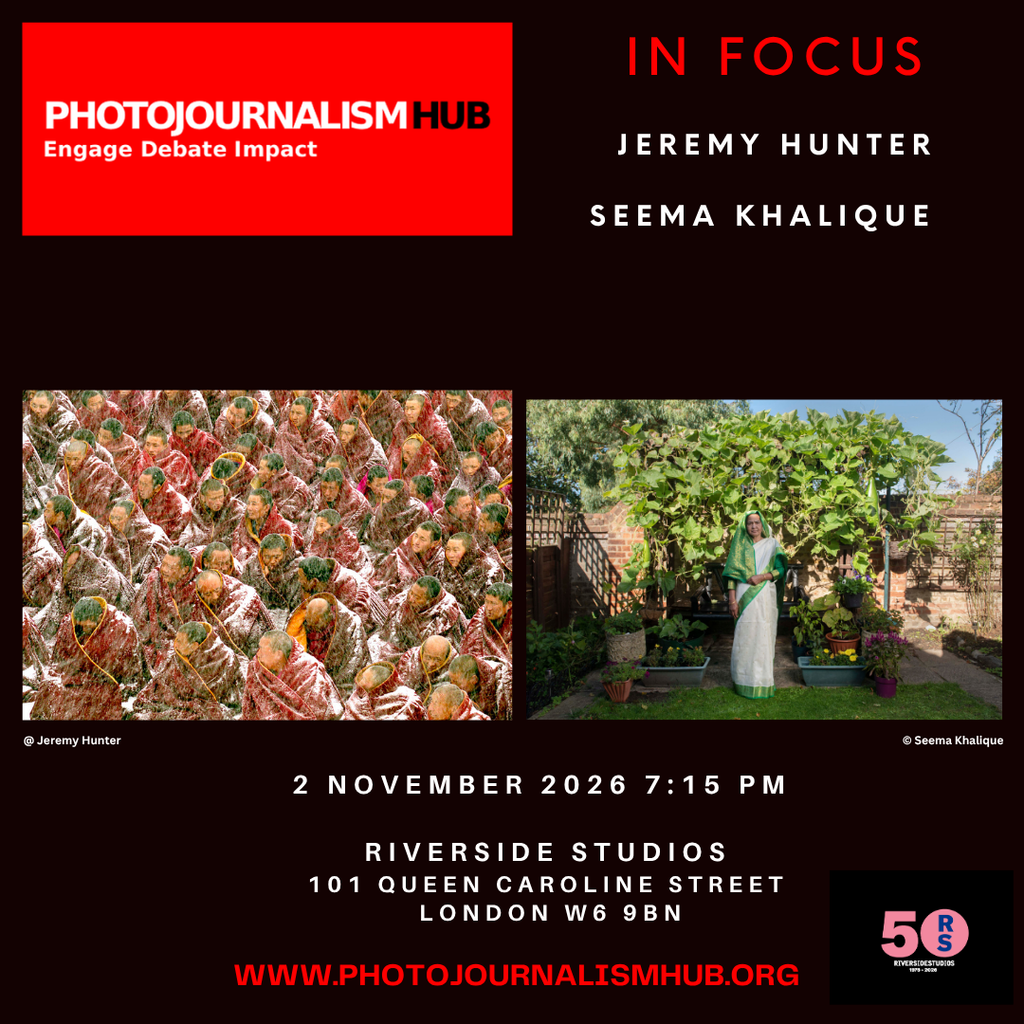
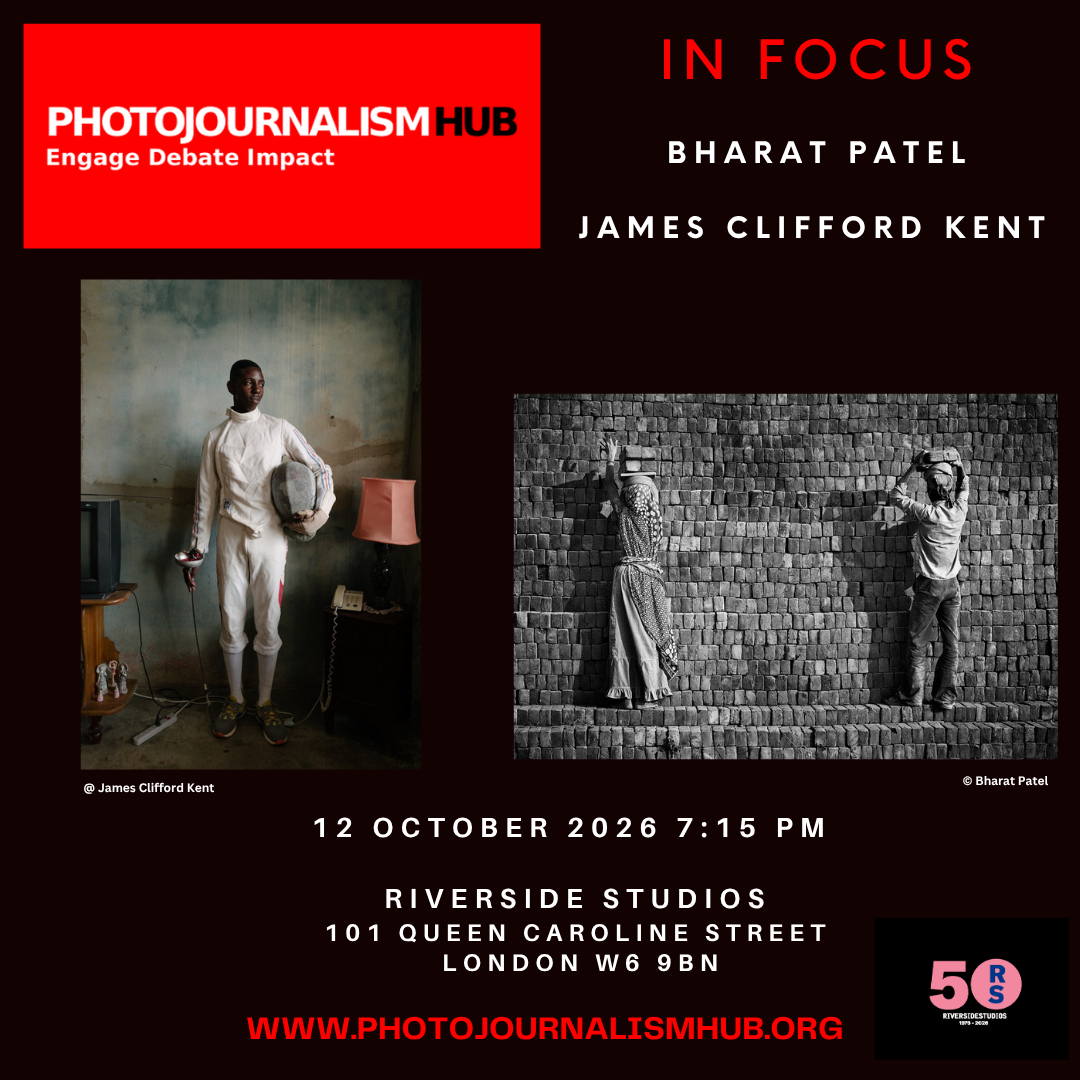
In Focus: Jeremy Hunter & Seema Khalique
To join us: Here


In this edition of IN FOCUS, Photojournalism Hub brings together two photographers exploring very different perspectives on culture, identity and belonging. Jeremy Hunter draws on decades of international reporting to document rituals, traditions and societies, including his extensive work in North Korea. Seema Khalique explores memory, migration and identity through photography, moving image and personal histories, giving visibility to stories that have helped shape multicultural Britain.


Jeremy Hunter
is a UNESCO award-winning British investigative photojournalist, television producer, writer and broadcaster whose career has taken him across more than 70 countries and five continents.
Beginning his career in advertising and television, Jeremy subsequently moved into broadcast journalism, reporting from politically sensitive and historically significant locations, including Lebanon during the civil war, India following the assassination of Indira Gandhi, and Portugal during its transition to democracy. He later worked with major British broadcasters, including the BBC and Granada Television.

His photography has focused particularly on festivals, rituals, religious traditions and culturally distinctive communities. His work has received UNESCO/HPA recognition, including a Documentary Award in 2011 for his work in Nagaland, alongside awards for his photography from the Sunday Telegraph, Daily Telegraph and BBC News.
Jeremy is also known for his extensive photographic work in North Korea, where he documented the country’s monumental Arirang performance, propaganda and aspects of everyday life. His illustrated presentation, North Korea Exposed – Daily Life in the Hermit Kingdom, has been delivered internationally to audiences at cultural institutions, universities and venues including the Palace of Westminster, UNESCO, NATO and the Royal Geographical Society.

His books include Sacred Festivals, published in English, French and German, and his photographs have appeared in publications including The Sunday Times, The Guardian, GEO, Stern and Condé Nast Traveller. His work has been exhibited internationally, including at Paris Photo and the Annenberg Space for Photography in Los Angeles.
Drawing on decades of first-hand reporting and photographic documentation, Jeremy uses visual storytelling to explore cultural identity, religion, politics, propaganda and the ways societies represent themselves.

Seema Khalique is a photography and moving-image artist, curator and producer whose practice explores memory, identity and personal history through documentary and portraiture. Her socially engaged practice centres around marginalised communities, using creative practices to give voice to their stories and develop new forms of community engagement.

Khalique curated About Then, a group exhibition for the Stephen Lawrence Gallery which was reviewed by the British Journal of Photography. She was also curator for Migration Quest, an immersive and interactive art exhibition at the Kobi Nazrul Centre. Khalique is Artist and curator of Londoni Memoirs which exhibited at Four Corner.
Khalique is currently exhibiting at Brighton Photo Fringe 2026. She is a Photoworks Photography Champion for Medway and a Board Member at Four Corners. 

Londoni Memoirs is a collection of portraits, curated ephemera, artifacts, heirlooms and video-interviews of 12 Bangladeshi migrants from 1950s-70s, documenting their exodus from genocide during the 1971 liberation war and watching their motherland’s independence from afar while making UK their home. The project grew from Seema’s own search for a family history that had largely remained undocumented, especially of her late father’s early life in the UK. He arrived in Britain in 1956, followed by her mother in 1973 after the Bangladesh Liberation War, both in search of a better life. At the heart of Londoni Memoirs is the experience of a generation caught between two defining moments: escaping genocide during the Bangladesh Liberation War and establishing a new life in an unfamiliar foreign country. The project considers how these experiences helped shape not only British Bangladeshi identity, but also the country as a whole through the generations born in Britain afterwards.
Londoni Memoirs seeks to honour a generation whose contribution was pivotal in the development of the multicultural society that exists in the UK today.

IN FOCUS is produced by the Photojournalism Hub in collaboration with Riverside Studios to present compelling, thought-provoking, independent and courageous photo storytelling.
In Focus: James Clifford Kent & Bharat Patel

To join us: Here

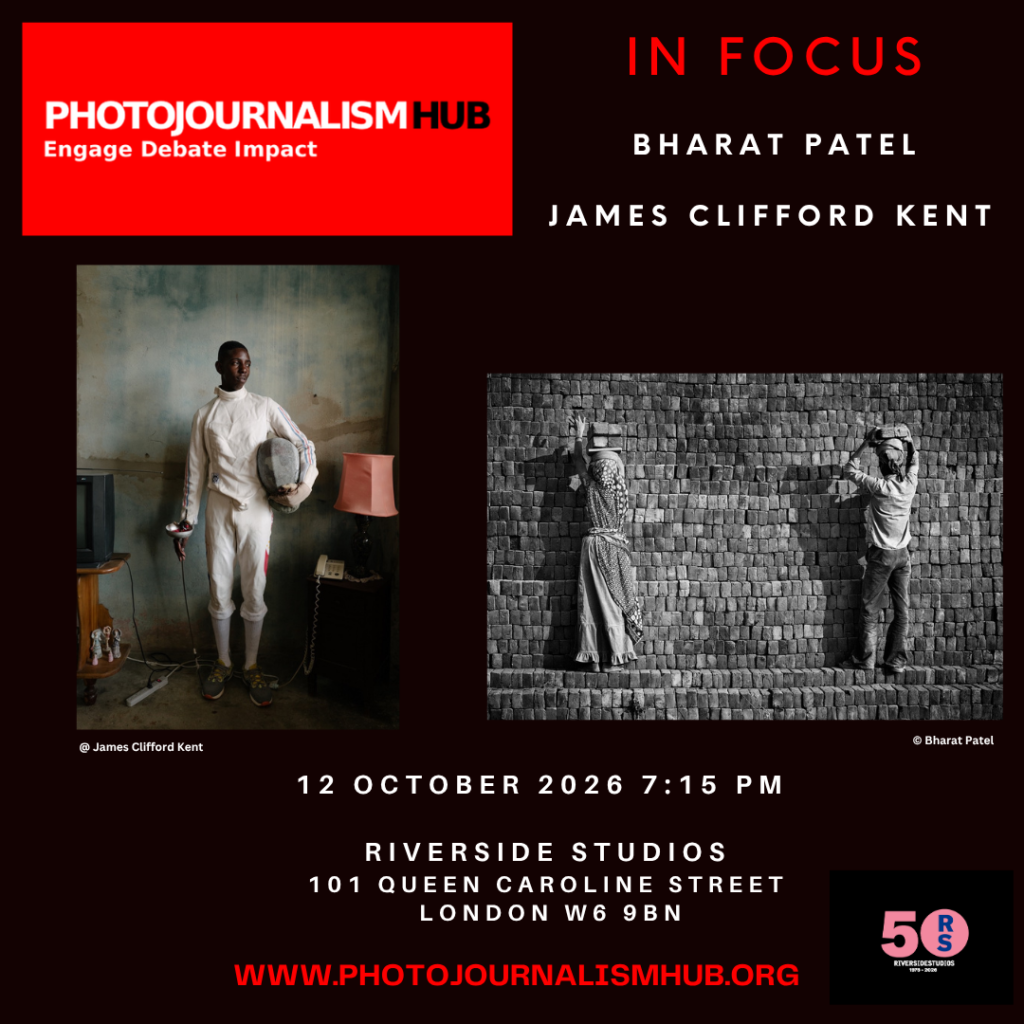
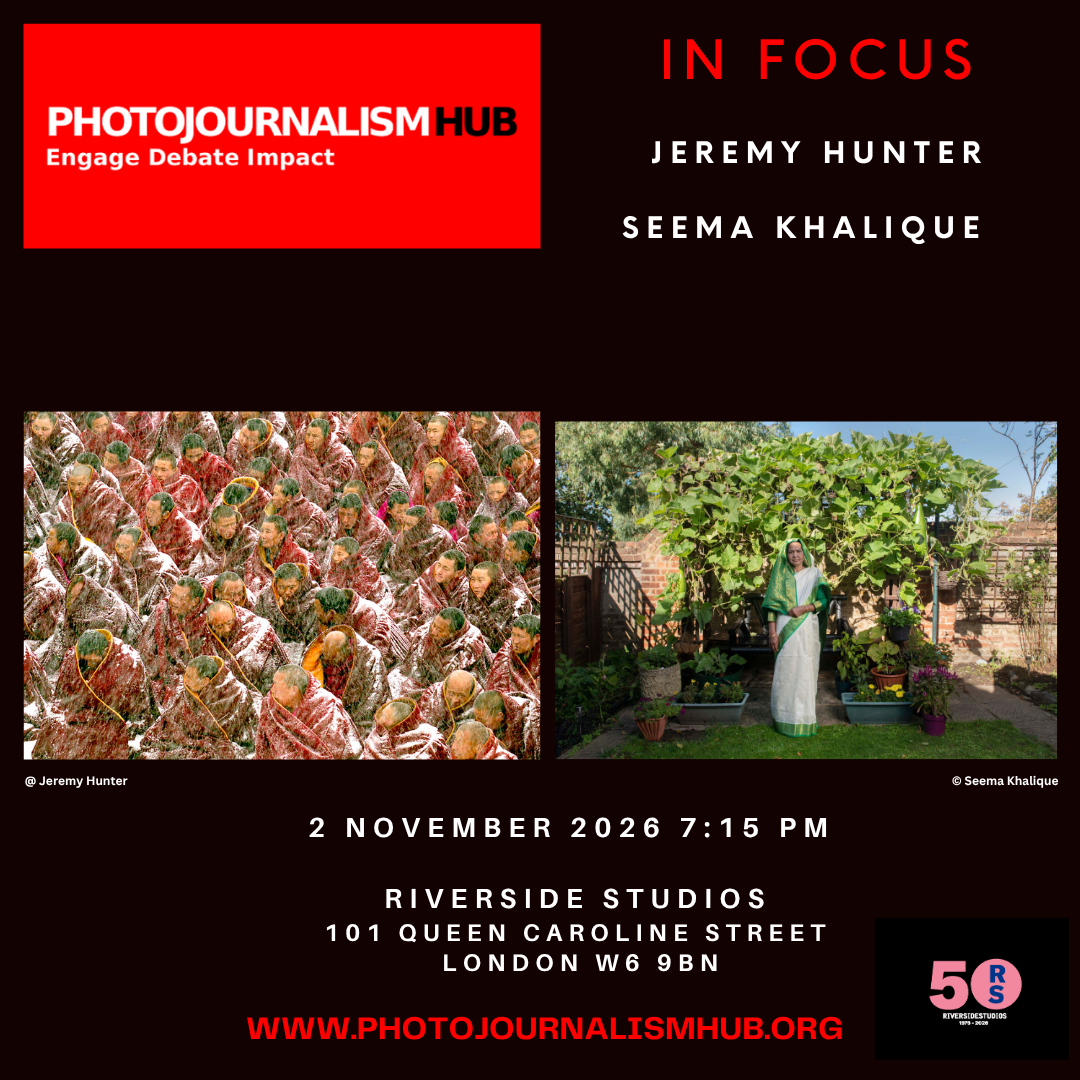
For our next In Focus at Riverside Studios on 12 October 2026 at 7:15 pm, we are delighted to welcome documentary photographers James Clifford Kent and Bharat Patel.
Exploring themes of belonging, healthcare and marginalisation, their work spans care environments in Cuba and the UK and the lives of India’s nomadic and de-notified nomadic communities. Kent and Patel will share their approaches to building trust, documenting sensitive human stories, and the role of documentary photography today.

James Clifford Kent is a London-based photographic artist whose research-led practice explores culture, health and social change. Through long-term relationships and sustained image-making, he navigates the space between intimate experience and broader social narratives, focusing on the textures of everyday life and the conditions that shape it. His award-winning work has been exhibited at the National Portrait Gallery and the Royal Academy of Arts, and featured in BBC News, The Guardian and The Times. James is co-founder and creative director of Yuma Studios and holds a PhD from Royal Holloway, University of London, a Fellow of the Royal Photographic Society (FRPS) and a Senior Fellow of the Higher Education Academy (SFHEA). He is the author of Aesthetics and the Revolutionary City and is currently developing his first photobook. 
Central to Kent’s relationship-led practice is listening. His images result from lasting relationships and sustained dialogue with the people he photographs; allowing presence, voice and agency to shape the work. This approach also reflects a sharp awareness of positionality — the limits, responsibilities and ethics of working as an outsider. During his talk “Birth, Death and Everything In between” James will share work, stories and experiences from his long-term, ongoing work in Cuba, his photographs on maternity wards during the pandemic, and his recent work in hospices in the UK.  

Bharat Patel is a documentary photographer using the camera as a tool to connect with people in overlooked, difficult, or marginalised conditions. His work focuses on labour, survival, and human dignity capturing the quiet strength in spaces society often ignores. Through intimate portraits and raw environments, he aims not to evoke pity but to provoke recognition. Even in silence, he wants his images to speak honestly and to make people look where they usually turn away.
He was born in India, raised in Uganda, and later moved to England for higher education. He also spent several years working in Brazil. Living across four continents has given him a deep appreciation for diverse cultures, which continues to shape his perspective and photographic approach.
In 2012, he began what would become a multi-year project to photograph one of the most marginalised groups in India: The Nomadic Tribes and the De-notified Nomadic Tribes. These communities, whose numbers are estimated to be in the tens of millions, face systemic exclusion and hardship. These nomads served as entertainers, singers, dancers, knife sharpeners, snake charmers, gymnasts, acrobats, tightrope walkers, basket makers, grain millers, agricultural labourers, and herbalists—each tribe possessing its own unique set of skills. However, their contribution and lifestyle is now at odds with the demands of modern society. 
The work focuses on the history of these tribes and their subsequent marginalisation in part due to the Criminal Tribes Act of 1871 by the colonial ruler. An act which criminalised many tribes. Remnants of the act still reverberate today.

IN FOCUS is produced by the Photojournalism Hub in collaboration with Riverside Studios to present compelling, thought-provoking, independent and courageous photo storytelling.
Photojournalism Nights

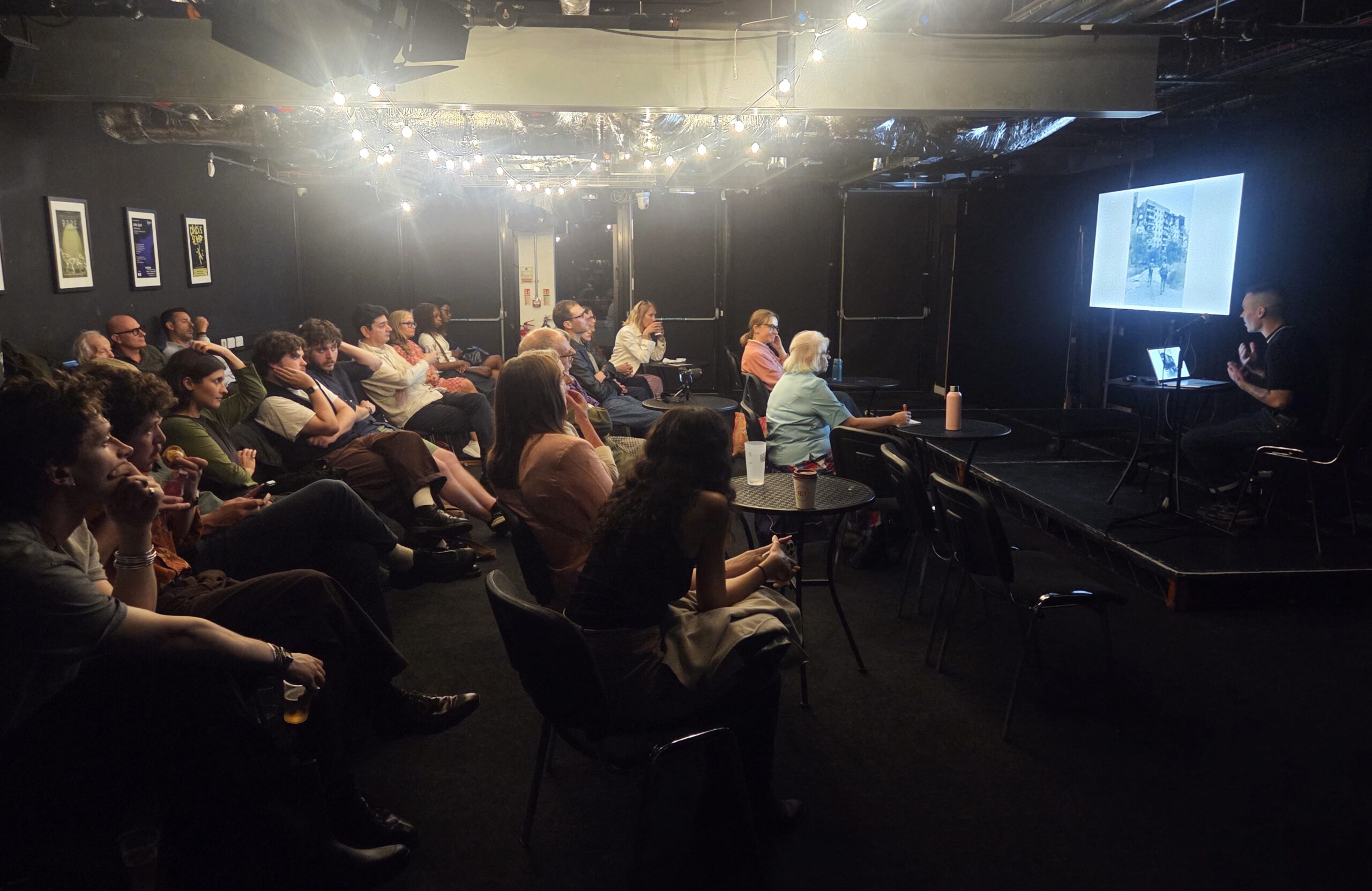
Photojournalism Nights are photography events hosted by the Photojournalism Hub, bringing together guest photojournalists and documentary photographers to share their work, ideas and experiences. The events create opportunities for audiences to engage with photojournalism and explore how photography can contribute to social justice, public debate and social change.

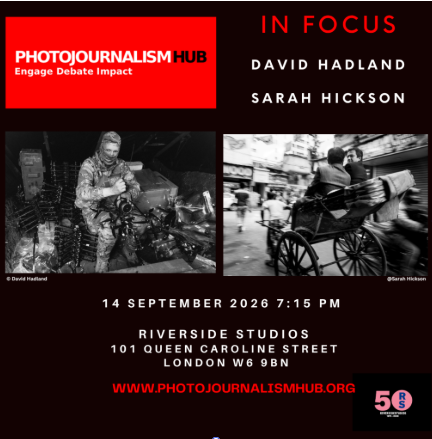
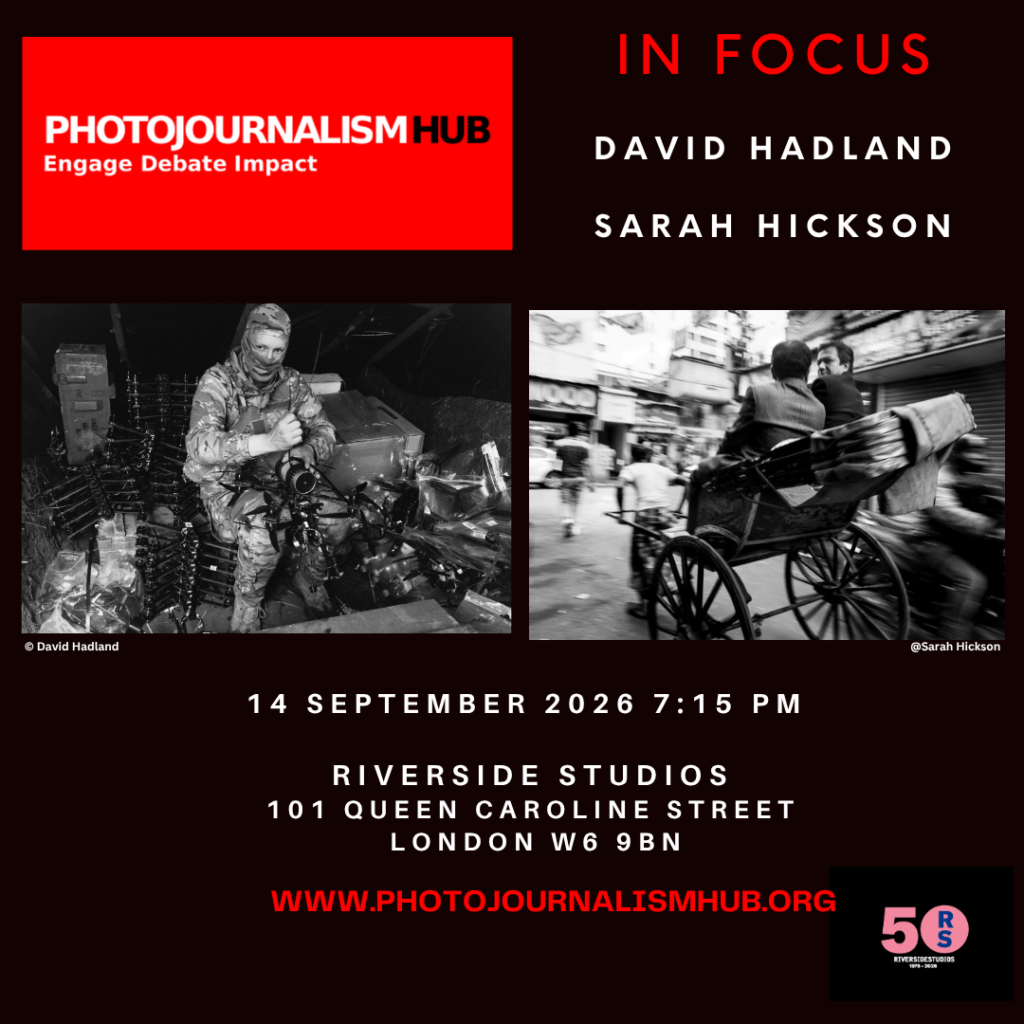
In Focus: David Hadland and Sarah Hickson

Poster IN FOCUS event organised by the Photojournalism Hub

Join us: Here

We are delighted to welcome documentary photographers David Hadland and Sarah Hickson as guests for our next In Focus event at Riverside Studios on 14 September 2026 at 7:15 pm.
In this edition of In Focus, David and Sarah explore the human stories shaped by conflict and displacement. Through their photography, they document lives transformed by crisis from soldiers living on the frontline in Ukraine to refugees navigating loss, uncertainty and the search for a new sense of belonging. Their work reflects on survival, resilience and the enduring connection between people, memory and place.

David Hadland is a documentary and portrait photographer from Luton, U.K. He lived in London for 11 years, where he graduated with a BA in Photography from Kingston University in 2018, and in 2024he graduated with an MA in Documentary Photography and Photojournalism from the London College of Communication. The core themes of David’s photography are identity, memory and the human experience. David is currently based in Kyiv, Ukraine, working on his long-term project documenting the full-scale war. 

Kozak is an ongoing project exploring the lives of Ukrainian soldiers stationed on the frontline. Through portraits and observations of daily life in the combat zone, the work examines how warfare disrupts the connection between people and the places they once called home.
War reshapes more than the landscape itself. Homes, streets, and fields once tied to ordinary life are transformed by conflict, altering how they are experienced and remembered. The soldiers I photograph inhabit dugouts along the frontline, living between the familiarity of home and the instability of war.
The title Kozak reflects a sense of continuity in Ukraine, linking the present to a longer history of resistance, identity, and place. Rather than focusing on spectacle or combat itself, the project centres on the everyday experience of soldiers living through war.

Sarah Hickson is an arts and social documentary photographer, now based in Brighton. Her practice explores the relationship between people, place and environment to create visual narratives that focus on themes of community and belonging, fracture and displacement.

She has worked on photographic commissions, residencies and projects in West and North Africa, India, Europe and around the UK. Sounds Unseen, an exhibition of work documenting a collaborative music project in the ‘Jungle’ refugee camp in Calais, was commissioned by St. Ann’s Warehouse in New York and Galway International Arts Festival. Her photo essay about Kolkata was featured in the book Writing Places, following an artistic residency with the National Centre for Writing in Norwich and Kolkata. Her 200 portraits of participants in the touring theatre project Truth to Power Café, formed an integral part of the theatrical narrative, bearing witness to the participants’ personal testimonies.
It is often the frayed edges of a story that draw Sarah’s attention, where vulnerability and fragility reside alongside hope and resilience. She will present an overview of her work on migration and displacement, referencing projects she has undertaken in Calais, Serbia and Greece, Galway and the UK.

She will also briefly talk about two other projects: her visits to the Taragalte Festival in the Sahara Desert in South Morocco, exploring the endangered environment of M’hamid El Ghizlaine and its historic nomadic culture, and her photo essay about Kolkata, capturing the nuanced and multi-layered nature of daily life in this city, where the past and the present collide. 

IN FOCUS is produced by the Photojournalism Hub in collaboration with Riverside Studios to present compelling, thought-provoking, independent and coraugeous photo storytelling.

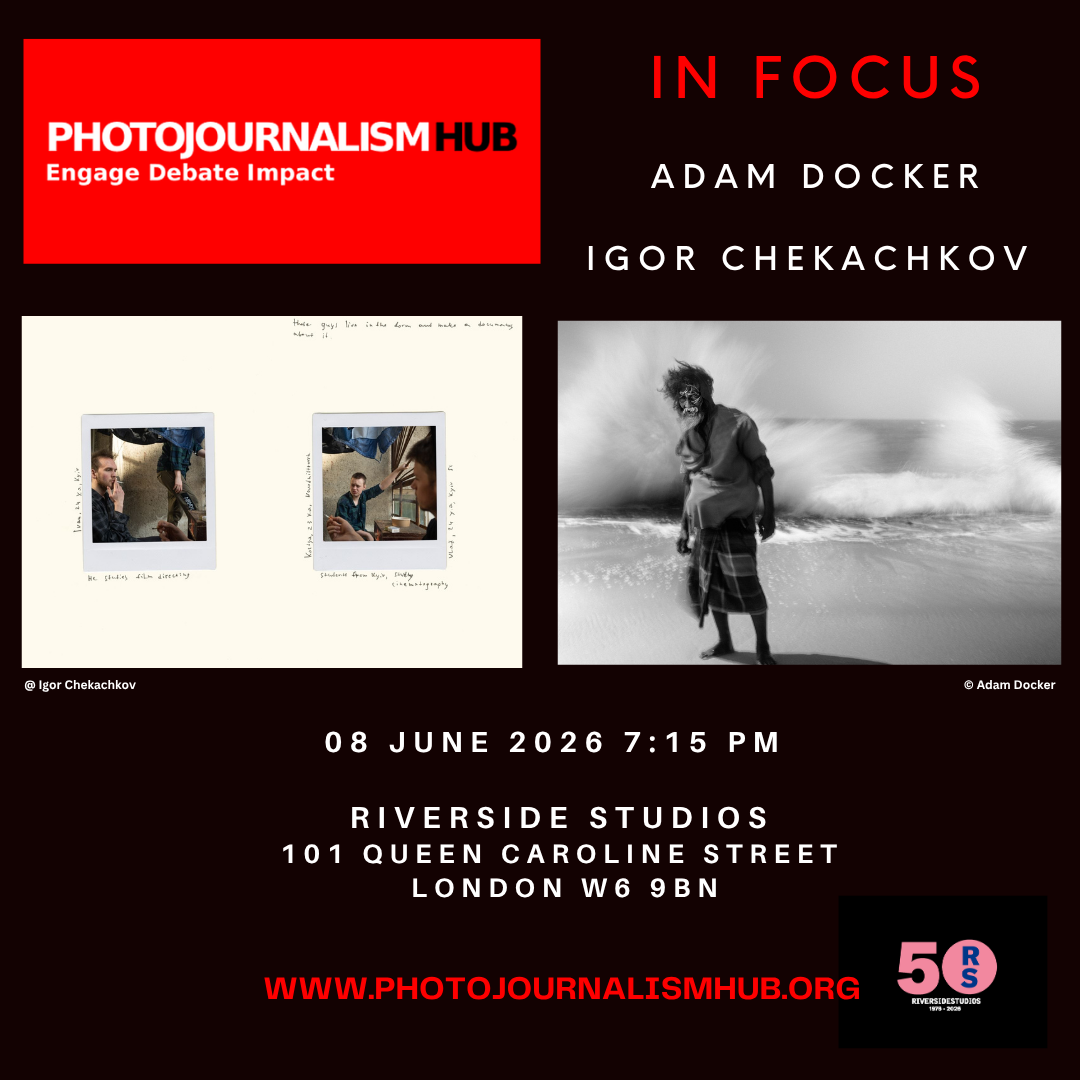
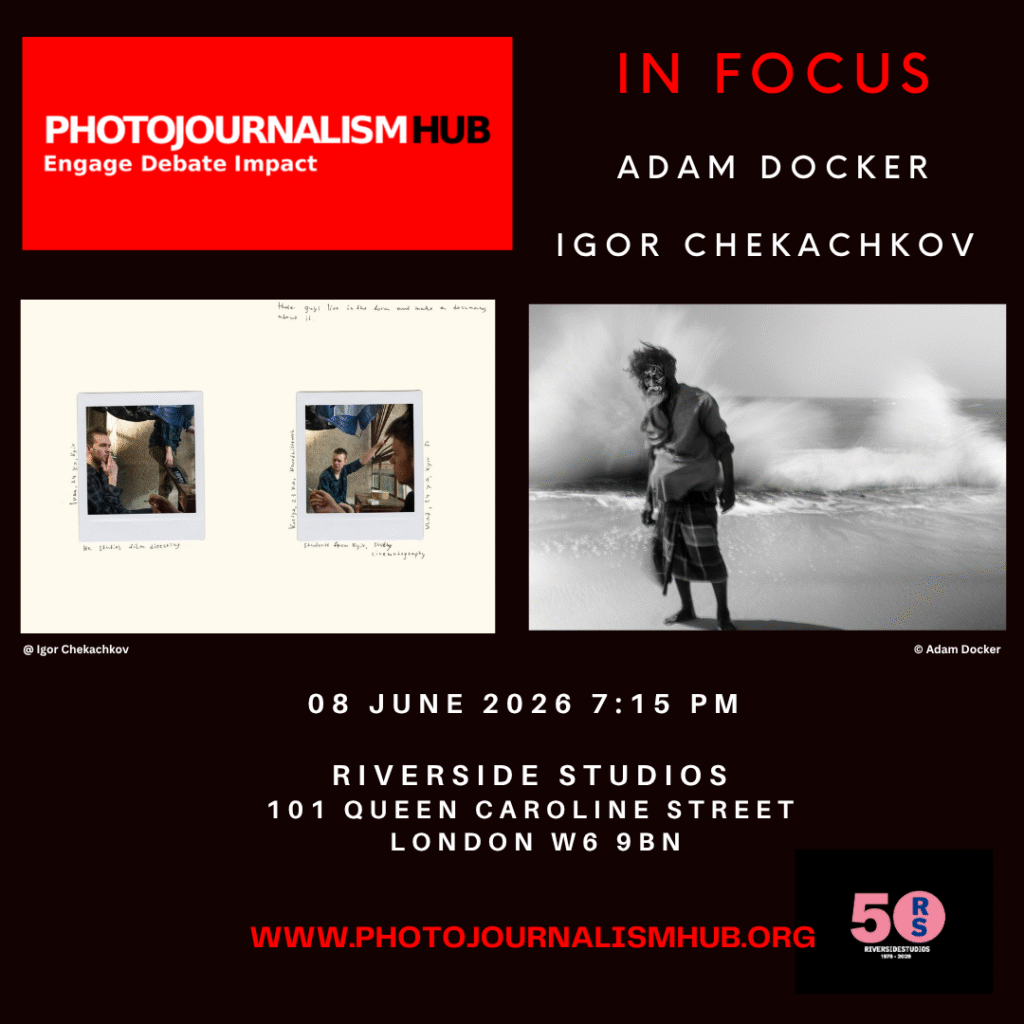
IN FOCUS: Adam Docker and Igor Chekachkov

To book a place: HERE

This June, as part of Refugee Week, IN FOCUS brings together two photographers whose work explores what it means to endure displacement, uncertainty, and survival and the human stories that exist beyond the headlines.
Join us at In FOCUS with Igor Chekachkov and Adam Docker, two photographers documenting lives shaped by conflict, movement, and resilience from deeply personal and unexpected perspectives. Through his powerful project 100 Days of War, Igor documents the emotional reality of war in Ukraine, capturing fragments of daily life, fear, tenderness, and survival during moments of upheaval. His images move beyond reportage, revealing the psychological weight of living through conflict and the fragile humanity that persists within it. Alongside this work, Adam Docker will present photographs made while travelling through refugee camps in Kenya with veterinary teams working on the frontlines of humanitarian aid. His work uncovers a rarely seen aspect of displacement: the vital relationship between people and animals in refugee communities, and how protecting livestock and pets can mean protecting livelihoods, health, dignity, and hope.
Though working in different environments, both photographers ask urgent questions about care, survival, and connection in times of crisis. Together, their work reminds us that stories of displacement are never abstract, they are intimate, layered, and deeply human.

Adam Docker – is a photographer and cinematographer working across fine art, documentary, and portrait. His work is shaped by a cinematic eye, grounded in instinct, light, and human connection. Based in london but shaped by journeys through more than 90 countries, his photography captures striking human stories, intimate moments, and evocative landscapes from around the world.
For Adam Docker, photography is not merely a visual medium; it is a profound exploration of humanity and culture. his images are a testament to his understanding of composition, storytelling and emotion. Adam grew up between London and Rome, deeply influenced by his italian roots and a large extended family. His father was tragically shot dead when Adam was just ten years old. although they never met, his father’s legacy left a deep imprint and instilled in adam a deep sense of resilience, justice, and identity. these themes form the foundation of his creative work. Fuelled by a childlike curiosity and an insatiable desire for knowledge, Adam has always been fascinated by other cultures, histories, and the ever-changing landscapes that unfold beyond a window. this constant sense of wonder drives him to seek out the unfamiliar, to observe, to listen, and to translate what he discovers into imagery that feels both intimate and universal. “I want to catch something in the act and see how it becomes something else.”
Adam is a two-time winner of the British Journal of Photography’s Portrait of Britain award (2021 and 2025), and recipient of the Portrait of Humanity award (2021 and 2023). His work has also been recognised by LensCulture and The Independent Photographer.

Igor Chekachkov – When Russia invaded Ukraine in February 2022, I was forced to leave my hometown, Kharkiv and go to the West of the country. From the very first day, I began to put together photographs and notes in a small notebook, creating a personal record of war and displacement from the inside. What originally stemmed from an intuitive desire to document my experience of war and uncertainty, developed into something broader: a reflection on the notions of home, identity, and displacement. Whilst the work literally describes the sudden evacuation of my family and the consequences of a brutal Russian attack, it also seeks to question the language of photography itself, and its limitations in documenting, representing and affecting conflict.
This deeply personal visual chronicle became 100 Days of War, a project that explores the tension between memory and documentation, the limits of photographic truth, and the search for meaning in the face of destruction

IN FOCUS is presented by the Photojournalism Hub in collaboration with  Riverside Studios, bringing to the public compelling and thought-provoking contemporary documentary photography and photojournalism.

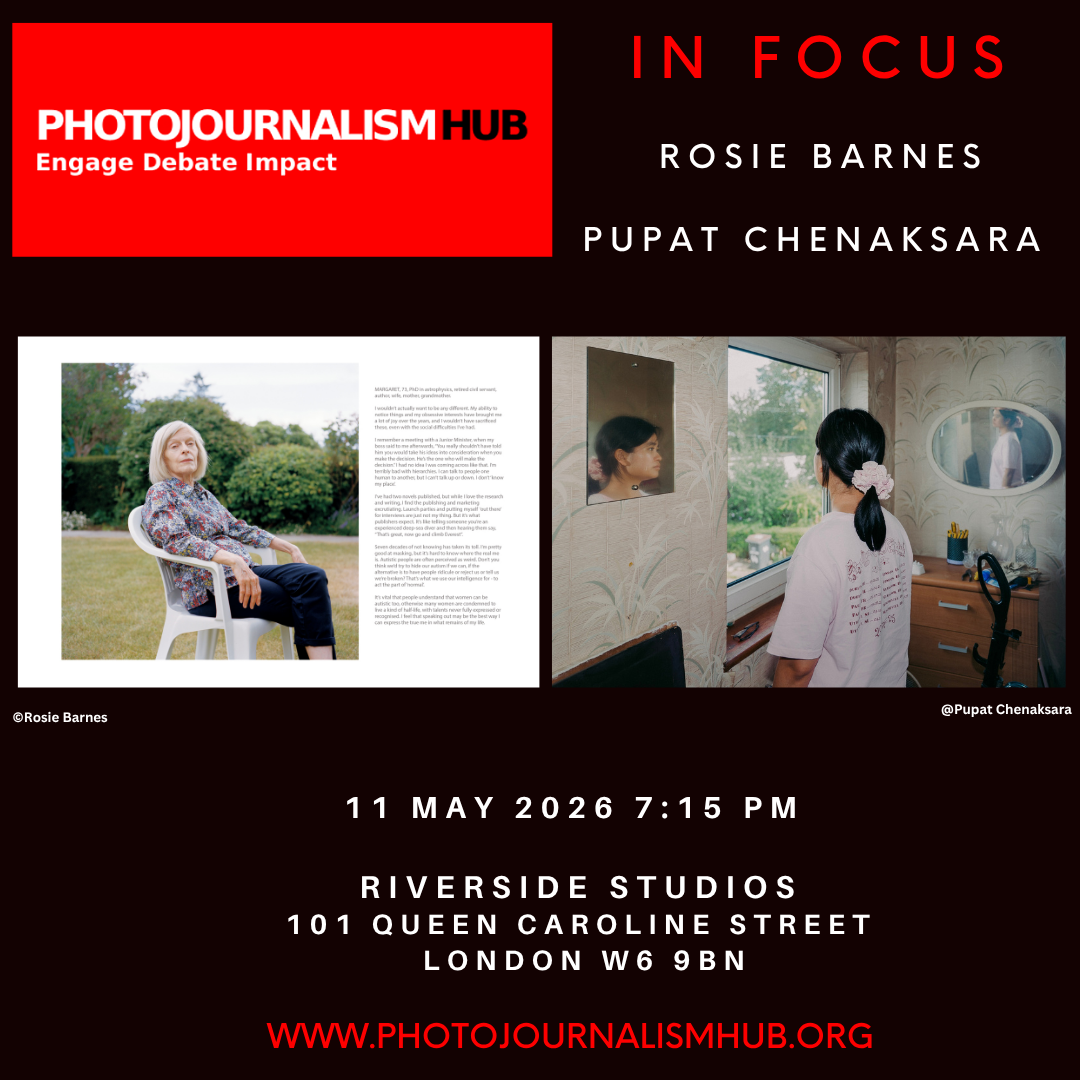
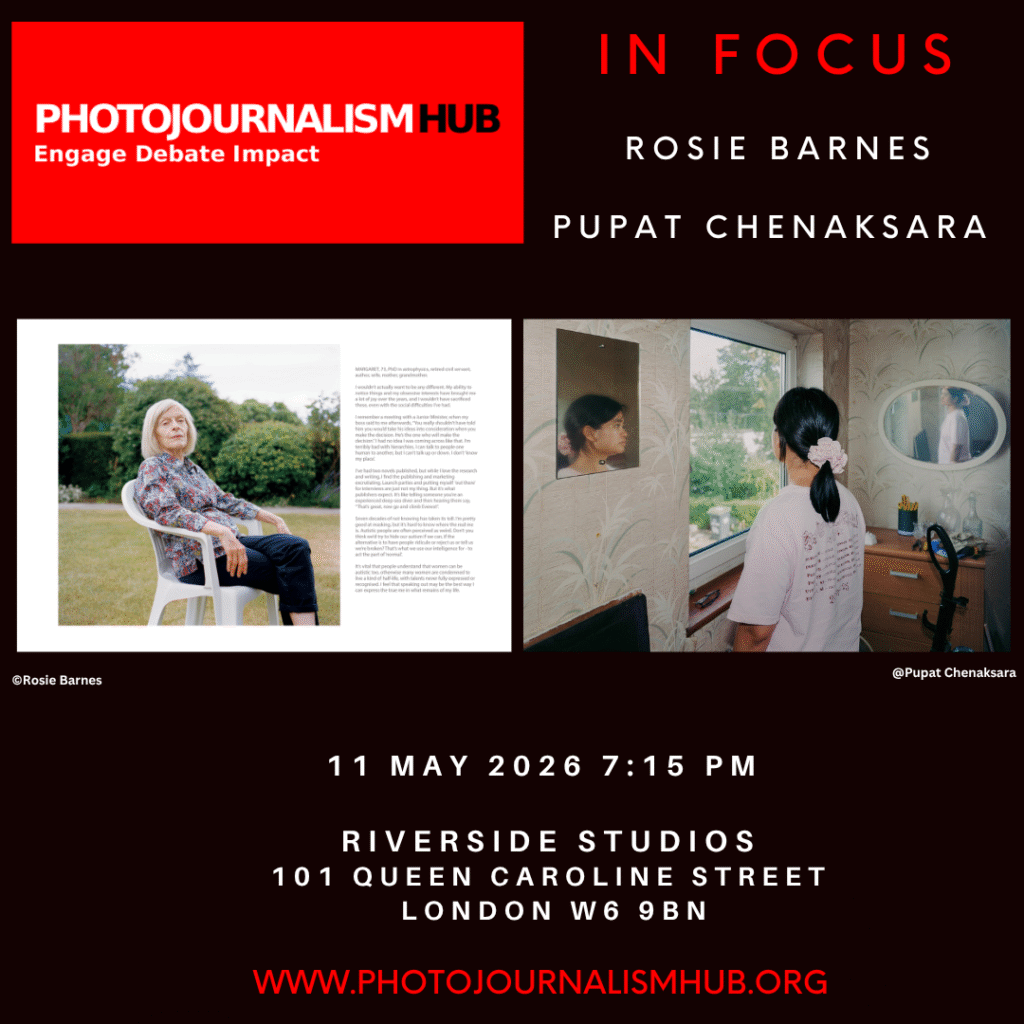
IN FOCUS: Rosie Barnes and Pupat Chenaksara

To book a place: HERE

Join us for an intimate and insightful evening as we explore the intersections of neurodiversity, mental health, and the human condition through the lenses of two profound visual storytellers. We are delighted to welcome Rosie Barnes, a celebrated documentary photographer whose decades of work have reshaped public understanding of autism and the non-human world, alongside Pupat Chenaksara, a rising visual artist who uses photography to navigate the delicate landscapes of anxiety and modern uncertainty. Together, they will share how their personal experiences ranging from caregiving and advocacy to personal healing inform their creative processes, offering a unique look at how the camera can be used to document and heal.

Rosie Barnes is a fine art documentary photographer, living in London.  Her work explores the human condition, neurodiversity, and our relationship with the non-human world. For over thirty years she has developed long-term projects that challenge assumptions, expand public understanding, and give visibility to people and subjects often overlooked. Known for her clarity, direct way of communicating and often humour, she creates work that resonates beyond traditional photographic and art gallery spaces and gives big theme subjects an easy accessibility. She has been commissioned to work on numerous picture stories for the Guardian, FT, Wellcome Collection etc and has exhibited internationally, in China, Japan, the US, Sweden, Greece, Slovakia and within the UK – including at the Centre for British Photography. Rosie is known for her influential work on autism and has published two books on the subject and spoken at the National Galleries of Scotland, having had two portraits from ‘No You’re Not, Yes I Am, a portrait of autistic women’, selected for the prestigious Taylor Wessing Portrait Prize. She is also a carer for one of her adult sons and has also recently set up a CIC – Satsuma Neighbour, to campaign for and build supportive housing communities for independent but vulnerable autistic people.

Pupat Chenaksara (b. Bangkok, Thailand) is a photographer and visual artist based in London, UK. His work grows from a need to understand what it means to live with uncertainty, both personally and collectively. After a personal experience with mental health challenges, he began using his camera to navigate the spaces between fragility and strength. Through still and moving images, Pupat connects with others to explore how we cope, heal, and communicate in times of instability. His projects often start with quiet conversations that unfold into intimate portraits and published works. Pupat holds an MA in Photojournalism and Documentary Photography from University of the Arts London (UAL) and was a finalist at the Abbey Road Music Photography Awards. His work has been featured on BBC News and Rolling Stone. Pupat will be presenting ‘I’m Trying Not to Think About It’, a series exploring the mental states of young people living with anxiety, depression, and other mental health challenges. Through quiet conversations, images, and self-portraits, the project traces how society and capitalism shape emotional life. By participating himself, the artist demonstrates that these experiences are both personal and shared. He observes the fragile, restless state of youth and thesubtle ways steadiness appears.

IN FOCUS is presented by the Photojournalism Hub in collaboration with  Riverside Studios, bringing to the public compelling and thought-provoking contemporary documentary photography and photojournalism.

IN FOCUS: Chiara Fabbro and Ruth Toda-Nation

To book a place: HERE

Join us for a special edition of the IN FOCUS: a Photography Evening event at Riverside Studios, as part of the exhibition ‘Covid-19 & Beyond‘. The IN FOCUS features two acclaimed documentary photographers Chiara Fabbro and Ruth Toda-Nation, whose work in the exhibition explores the profound impact of the pandemic on society’s most marginalized and overlooked groups.

Chiara Fabbro is an Italian documentary photographer based in London, whose work focuses on social issues. She has worked in a variety of places, from the suburbs of Kuala Lumpur, in Malaysia, where those who have fled conflict and persecution cannot be granted refugee status and are forced into a life in limbo; to the squats in the Balkans where migrant men, women and children get stuck during their journey towards Europe; to the beaches of the Canary Islands, the destination for thousands of people who every year set off in flimsy boats from the coast of West Africa, facing what is arguably the most dangerous journey to Europe.
Chiara’s work has been published in a range of print and online magazines and newspapers, such as Al Jazeera English, Balkan Insight, Altreconomia, Solomon and El Salto. She has also collaborated with several NGOs for their advocacy and fundraising campaigns. Chiara has won the 2021 Portrait of Humanity award and received an honourable mention in Photography 4 Humanity Global Prize 2020, supported by the UN Human Rights Office. In 2022 she was shortlisted for the Marilyn Stafford FotoReportage Award and she was selected for Earth Photo 2025 Award.

Between Borders: Finding Refuge in a Pandemic – Faces and feet were telling the story of a long journey – hundreds of kilometers on foot, across mountains and rivers. The fear of the push-backs at the borders, often violent and degrading, was giving way to the relief of finally reaching Italy, mixed with the uncertainty of what lay ahead. 
These young men travelled along the Balkan route of migration in 2020, and arrived in Trieste amidst the pandemic. Access to temporary shelters was limited due to COVID-19 measures, leaving people in transit with no choice but to sleep rough. The pandemic weighed heavily on them, as borders were tightened further and reports of push-backs increased. It also stirred negative feelings towards migrant people, with some accusing them of spreading the virus. The already unwelcoming climate towards those seeking refuge became even harsher.
Yet the commitment of the volunteers from Linea d’Ombra, caring for those in transit through Trieste, created a small corner of humanity. Every night on the street, then as now, they tend to wounded feet, fill empty stomachs and replace worn-out shoes with new pairs for the road ahead.

Ruth Toda-Nation ’s photographic practice is informed by a nomadic childhood bridging two cultures, Japan and Britain. She began photographing in Liverpool in the 1980s and later in the rural areas of northern Japan. She continues to document the communities where she lives. Her intimate approach interweaves themes navigating family dynamics and community bonds while reflecting on ageing, loneliness, transience, and departure. Ruth often combines images with words drawn from interviews to amplify the voices of communities she documents allowing their stories to unfold.
Her first book, Our Lockdown Garden, was published by The Mindful Editions in 2022. Her recent body of work, Love is a Life Story, received the Royal Photographic Society Documentary Photographer of the Year award in 2023, and portraits from her ongoing project 900 Yards featured in Portrait of Britain 2023.

The projects, Love is a Life Story and Our Lockdown Garden document the pandemic lockdown experience of my father John (91) and his friend and neighbour Mary (97) as residents of a retirement community and care home in Milton Keynes, UK. John and Mary’s friendship and journey through lockdown reflects many of our eldest citizens experiences as friendships replaced family. 
Given their age they were aware that they may never have come out of lockdown, yet their personal voices were lost amongst the incessant news bombarding us with the mortality figures of this very vulnerable group. With no requirement to test discharged patients being sent back into care from hospital, deaths in care homes rose sharply. As a result, it is estimated that a quarter of known coronavirus deaths in Great Britain took place in care homes. 
The invisibility of this generation— The Silent Generation—was amplified during the pandemic, and many spent their last moments alone and deprived of their loved ones. If a society’s humanity is measured by how it treats its most vulnerable members, then I can’t help asking: did we do enough? 

IN FOCUS is presented by the Photojournalism Hub in collaboration with  Riverside Studios, bringing to the public compelling and thought-provoking contemporary documentary photography and photojournalism.

IN FOCUS: Citlali Fabian and Jai Toor

To book a place: HERE

IN FOCUS is an event series by the Photojournalism Hub in collaboration with Riverside Studios that presents committed, independent contemporary documentary photography. This edition brings together two visual storytellers whose practices engage deeply with questions of identity, migration, memory, and place. Through distinct yet complementary approaches, Citlali Fabián and Jai Toor use photography to navigate personal and collective histories, examining how images can hold lived experience, cultural inheritance, and emotional truth. Their work moves between documentation and imagination, reflecting on displacement, diaspora, and the meaning of home across generations and geographies.

Citlali Fabian A Yalalteca (indigenous from Mexico) visual storyteller. She uses photography to explore ways of addressing identity and its connections with territory, migration, and community bonds.
Fabián is a  2024 BERTHA FOUNDATION Grantee,  2021 Photography and Social Justice Magnum fellow, a National Geographic Society explorer, with the project “I’m from Yalalag, a photo essay to explore the development of our Zapotec identity.” In 2021, she was awarded by the Art Council of England with a Develop Creative Practice Grant. In 2023 World Press Photo Contest Regional Jury. A 2020 Visura mentee. She was also named one of the Discoveries of the Meeting Place of FotoFest 2018 Biennale.
Her work has been shown in solo and collective exhibitions in Mexico, USA, Spain, and Argentina. Her work has been covered at The New York Times. And also has been appeared in different media like The LA Times, The Guardian, Buzzfeed, Remezcla, Revista Cuartoscuro, and IM Magazine among others. Her Mestiza series was selected as one of the New York Times Lens blog’s “13 Stories That Captured Photography in 2018” and as part of “10 Years of Photography, and Lens”.
She is also a member of Women Photograph and Indigenous Photograph collectives. Her work is part of the INBA/Toledo Collection, the Museum of Contemporary Photography of Chicago, and the Wittliff Collections at Texas State University.  

Jai Toor (b. 1998) is a British-Indian photographer and artist based in the UK. His practice explores the interplay of diaspora and fantasy within the fabric of everyday surroundings. Working across documentary, fashion, and
music, Toor employs a multifaceted approach that integrates research, analogue processes, text, and archival photographs to construct layered visual narratives. Jai Toor’s practice centres around long-form photographic projects that often begin close to home — both literally and emotionally, before expanding outward. As someone who has lived across India and the UK, in many different homes, I’ve never felt a singular sense of place. This transient experience of “home” underpins much of my work, where themes of diaspora, migration, family, loss, and identity recur. He is particularly drawn to overlooked stories, fragments of personal or collective memory that might otherwise go undocumented. Photography, for me, is a way of capturing both presence and absence; a medium that can preserve histories, confront traumas, and evoke longing. He works across documentary, fashion, and music, but his approach remains consistent: research-led and open to intuition.
His projects often begin with reading, writing, and conversations, forming a kind of text-based map that guides me visually. I draw from national archives, interviews, and everyday encounters, weaving together photographs, text, and found materials. He uses analogue and digital photography interchangeably, but shooting on film allows him to slow down and connect more intentionally with the people and places he documents. He sees his work as semi-fictional, a space where documentation, re-imagination, and emotional truth coexist. He leans into ambiguity, allowing the viewer to enter the work without a fixed outcome, but with enough guidance to feel immersed. Collaboration is essential to this process: He often enters personal or communal spaces where trust, exchange, and shared authorship become part of the narrative. Ultimately, he is interested in how photography can hold contradictions, between fact and feeling, history and fantasy, familiarity and displacement, and in how storytelling can honour both the known and the unknowable.

IN FOCUS is presented by the Photojournalism Hub in collaboration with  Riverside Studios, bringing to the public compelling and thought-provoking contemporary documentary photography and photojournalism.

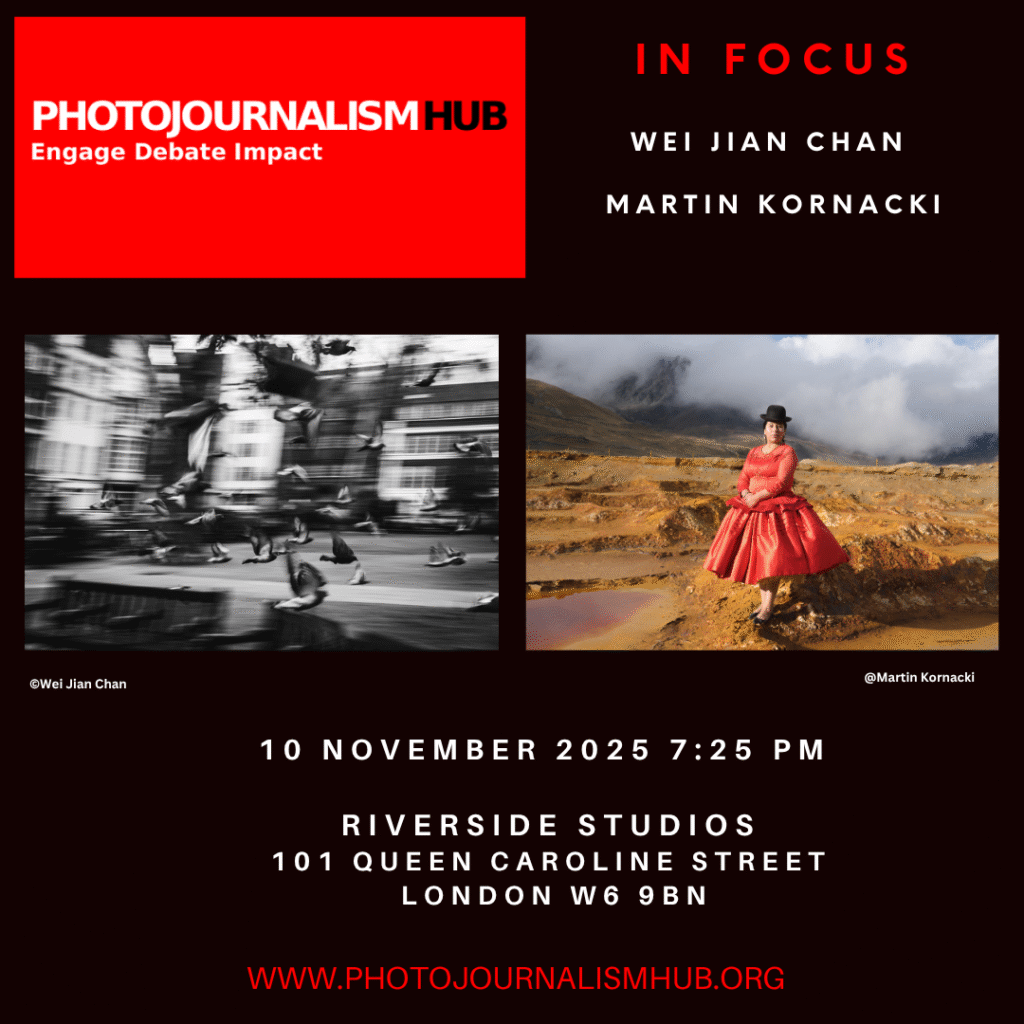
IN FOCUS: Marcin Kornacki and Wei Jian Chan


To Book a place: HERE

This edition of IN FOCUS brings together two photographers whose practices, while distinct in subject and style, both explore how history, memory, and identity shape lived experience. Marcin Kornacki’s long-term documentary projects in Haiti and Bolivia investigate the legacies of political violence and the endurance of communities in unstable landscapes. In contrast, Wei Jian Chan’s Journey to the West reflects on the personal journey of migration, using the formal language of street photography to evoke dislocation and belonging. Together, their presentations offer powerful insights into working independently in challenging environments, and into photography’s ability to bridge the political and the personal.

Marcin Kornacki
is a London-based documentary photographer and UAL Photojournalism and Documentary Photography MA graduate whose work explores memory, landscape, and the marks of collective history. His practice draws stories to the surface through close attention to place and the unpredictability of encounter. His current projects focus on sites where political violence and colonial legacies remain alive in land and memory.
His ongoing work in Haiti documents its capital Port-au-Prince as it descended into gang control, tracing the layered aftermath of revolution, foreign intervention, and daily survival, documenting both the gangs terrorising the city as well as the people enduring the conflict.
In Bolivia, he photographs the mining communities around La Paz, focusing on Milluni, site of a government-led miners’ massacre in 1965, examining how resistance and political narratives endure and develop across generations.  Grounded in sustained fieldwork and research, Martin’s photography connects personal testimony with broader historical forces. His images invite reflection on how memory is shaped, how trauma is carried, and how communities protect identity in the face of erasure.
His talk aims to focus on the practical aspects of working independently with little training and no official support in conflict zones and politically unstable regions, reflecting in particular on the mistakes he has made, and the lessons he has learnt during his most recent work in Haiti and Bolivia. 

Wei Jian Chan (b.1991) is a Singaporean-born photographer based in London, whose work seeks to find beauty in the chaos of modern life.  Wei Jian first picked up a camera at the age of 14 while growing up in Singapore. Over the years, as he moved to Oxford to attend university and to London for work, the camera has been his constant companion. In his time behind the camera, photography has grown from a pastime into a source of inspiration and a passport to new experiences.  Working primarily in black-and-white, Wei Jian utilises both traditional wet darkroom processes and modern digital techniques in his work. His work frequently incorporates elements of geometry, architecture, and motion.
Wei Jian’s photography has been exhibited in various locations in the UK and Europe, and has been acquired to form part of the permanent collection of the Kiyosato Museum of Photographic Art. His work has also been featured by numerous outlets, including The Guardian, Deutsche Welle and National Geographic.
Wei Jian will be showcasing images from his debut photobook ‘Journey to the West’, published by Setanta Books. This book features his black and white street photography, and seeks to evoke the sense of dislocation and uncertainty that Wei Jian experienced in the early years of moving from Singapore to the UK, during which he set about to integrate into a foreign culture and find his place in the world. The title ‘Journey to the West’ comes from a Ming dynasty Chinese myth about the journey of the Buddhist monk Xuanzang who travelled to the ‘Western Regions’ to obtain Buddhist sacred texts (sutras). 

The event IN FOCUS is presented by the Photojournalism Hub in collaboration with  Riverside Studios, bringing to the public compelling and thought-provoking contemporary documentary photography and photojournalism.