Vudi Xhymshiti: Empowering Ukrainian Scholars Through Photojournalism Education

Inspiring Voices Amidst Ukraine’s Struggle for Justice

Date: June 10, 2023

Renowned photojournalist Vudi Xhymshiti empowers Ukrainian scholars through his groundbreaking education program, emphasising metadata mastery and ethical principles. Inspiring voices amidst Ukraine’s struggle for justice.

Renowned Kosovar-British photojournalist and educator, Vudi Xhymshiti, embarks on the third week of his journey, dedicated to educating fifteen Ukrainian scholars who have been awarded scholarships in his groundbreaking photojournalism educational program. Over the course of this Thursday and Friday, the scholars engaged in enlightening discussions on the paramount importance of mastering metadata and adhering to the ethical principles of photojournalism.

Following an extensive year of reporting in Ukraine throughout 2022, Xhymshiti recognized the dire need to extend support to the Ukrainian people. Moved by the plight of voiceless men, women, and children, who have suffered the harrowing atrocities inflicted by the Russian military aggression since the full-scale invasion launched by Russian President Putin on February 24, 2022, Xhymshiti made it his mission to share his wealth of knowledge in photojournalism. By doing so, he aimed to equip the scholars with the necessary skills to become the unwavering voice of Ukraine.
In today’s digital age, photojournalists face a myriad of challenges when it comes to showcasing and monetizing their work. One aspect often overlooked, yet crucial, is the meticulous handling of metadata and captioning. This vital information not only assists photographers in organising their collections but also plays a pivotal role in capturing the attention of editors and potential clients. 

During an exclusive conversation with Photojournalism HUB in London, Vudi Xhymshiti expressed his unwavering dedication to promoting high-quality journalism worldwide. He shared insights into his education programs, which are specifically designed to elevate the skills of emerging professionals and students from diverse backgrounds. Through the provision of scholarships and access to valuable resources, Xhymshiti aims to empower individuals, enabling them to become leaders in their respective fields and share their unique perspectives with the global audience.

In discussing his educational initiatives, Xhymshiti emphasised his role in guiding fellow professionals away from ignorance. Recognizing that traditional forms of education can often perpetuate narrow viewpoints, he is committed to offering programs that foster critical thinking, creativity, and diverse thought. His ultimate vision is to contribute to the advancement of journalism and the democratisation of public narrative, inspiring the next generation of journalists to strive for excellence and create a better world through their impactful work.
Furthermore, Xhymshiti’s conversation highlighted the paramount importance of mastering metadata in the field of photojournalism. With his expertise and experience as an esteemed instructor, he shed light on the profound influence that metadata mastery can have on the career prospects of aspiring photojournalists. By stressing the significance of this aspect, Xhymshiti aims to equip his students with the necessary skills to thrive in their professional journeys.

Xhymshiti, with his unrivalled expertise, highlights the indispensable connection between accurate metadata and professional success. He asserts, “Without proper metadata, no news editor, whether in London, New York, Paris, or elsewhere, will consider your photographs. The absence of this crucial information hampers editors’ ability to comprehend the contextual significance of an image.“

According to Xhymshiti, countless talented photographers miss out on lucrative assignments simply because they neglect to master the art of metadata and captioning. He explains, “Editors are unwilling to take the risk of hiring someone who lacks these essential skills. The absence of metadata and captions can lead to confusion and disrupt the seamless progress of a project. Editors would rather replace you with someone who understands the significance of these vital details.“

Furthermore, Xhymshiti unveils a startling truth about the scarcity of formal education concerning metadata in photography programs. He notes, “Unfortunately, universities rarely impart these critical skills to aspiring photographers. Furthermore, some professional photographers who offer courses intentionally withhold this information due to their own self-doubts and fears of competition.“

Xhymshiti’s comprehensive course aims to bridge this knowledge gap and equip students with the indispensable skills required to excel in the industry. He emphasises the importance of regularly practising metadata mastery and captioning, asserting that these tasks should become as routine as brushing one’s teeth in the morning. By instilling these practices early on, students can confidently collaborate with editors and significantly increase their chances of securing coveted assignments.

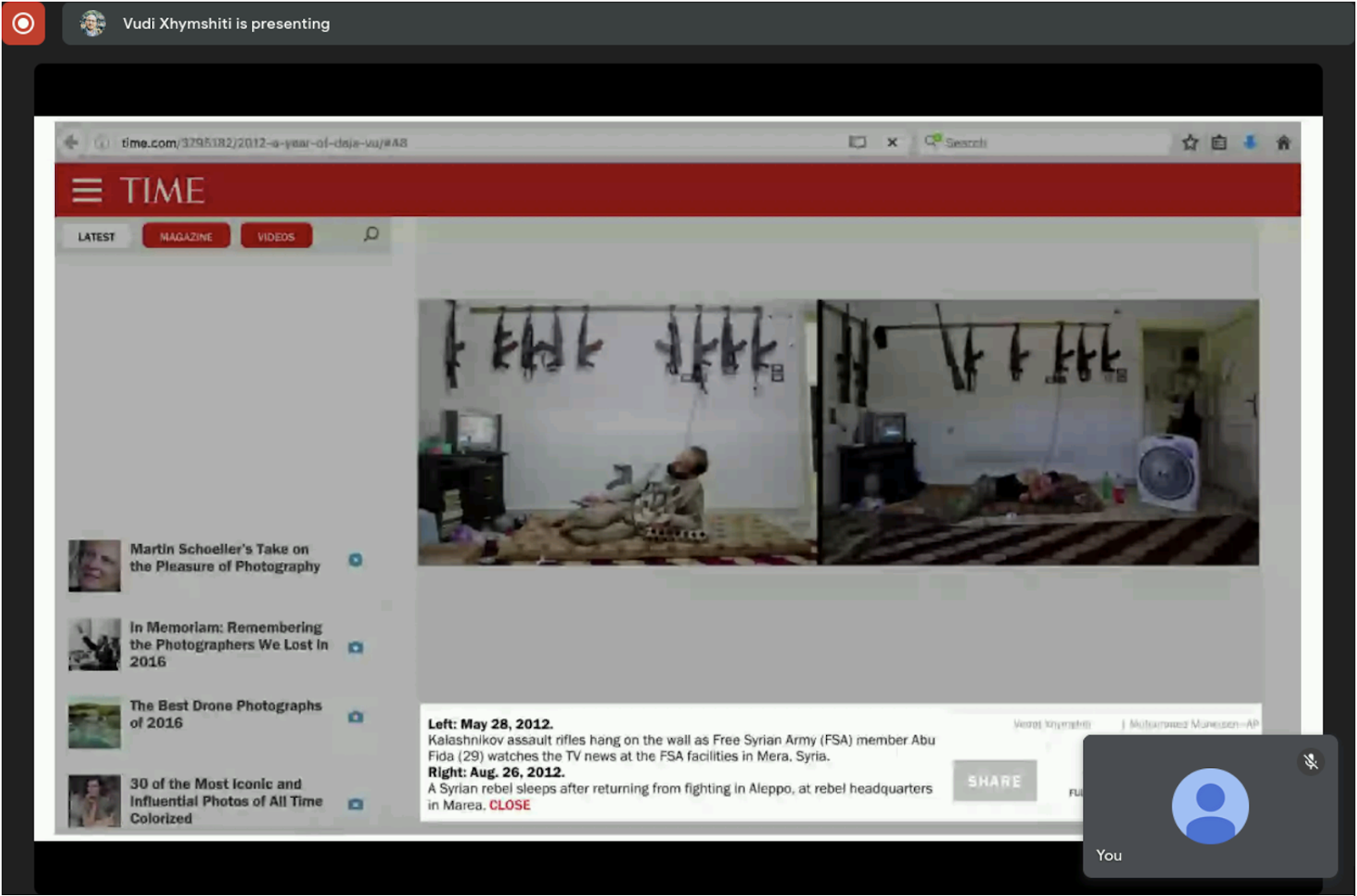
One of the intriguing topics raised during the course revolves around the use of watermarks on photographs. Xhymshiti clarifies that watermarks play a vital role in protecting copyrighted work when selling images on certain platforms. However, he advises against using watermarks on websites or portfolios intended to attract potential clients. By allowing clients to view high-quality, unmarked images, photographers heighten their chances of securing paid work.

To illustrate his points effectively, Xhymshiti showcases his own websites, featuring both watermarked and unmarked images. He emphasises the importance of presenting pristine, high-quality images to potential clients, enabling them to accurately assess a photographer’s skills and capabilities.

Throughout the course, students actively engage in discussions, sharing their personal experiences and challenges. Xhymshiti fosters an environment of open dialogue, encouraging the exchange of ideas and the cultivation of growth.

By shedding light on the profound significance of metadata mastery and ethical considerations in photojournalism, this exclusive course offers aspiring photojournalists invaluable knowledge. It equips them with the skills necessary to navigate the fiercely competitive industry, ensuring they are prepared to meet the demands of professional assignments. Xhymshiti’s unwavering dedication to empowering his students and safeguarding them from exploitation shines through, making this course an extraordinary and priceless opportunity within the realm of photography education.

Join us on June 21, 2023, for an upcoming online edition of Photojournalism Nights, where we are thrilled to have Vudi Xhymishiti as our guest speaker. Discover the incredible work of this renowned photojournalist and educator by joining us via our ticketing system. HERE.

Photojournalism Hub x Frontline Club

Displacement by War

21 April 2022 7pm
Frontline Club
13 Norfolk Place
London W2 1QJ
To join: HERE

Powerful photography, insights and experiences of documenting wars and displacement.

The consequences and legacy of wartime persecution and displacement are reflected in the work of photojournalists and documentary photographers, who have played a pivotal role in exposing, be of a testimony and witness of these ordeals. Displacement has always been hand in hand with war and conflict, as people flee for safety and security. Photographers have recorded not only the physical displacement but also have conferred through their stories and photographs the extent of emotional, psychological trauma that these experiences cause. An extent that goes over time and sometimes will never heal. In recent years up to today, as we are witnessing one of the largest exodus of people forced to leave their homes in Ukraine, the scale of population displacement by war has been an incredibly stark reality. The reverberations are immense with thousands whose lives are in limbo, experiencing the impact of trauma and loss.

We have invited a group of photographers, whose work and courage have closely documented these realities. Their accounts and photos have contributed to important documentation as well as vital historical and accountability documentation.

We are incredibly honoured to present to you all our guests photographers George Nickels, Quintina Valero, Ed Ram and Ines Gil, who will share their powerful photography, insights and experiences on war displacement.

Ed Ram is a photojournalist and reporter with an interest in conflict, security, and climate change. He has been based in East Africa for for nearly three years, reporting from countries including Kenya, Mozambique, DRC, Sudan, Somaliland and Uganda. Ed works on personal photography projects and for European and US news organisations including newspapers, photo agencies and broadcasters. Most recently, he has been covering the conflict in Ukraine for the Guardian and PBS Newshour. Before working freelance, Ed spent 8 years working as a filmmaker, journalist and senior producer for BBC News.

George Nickels is a freelance photojournalist and has been working in South East Asia and Europe since 2011. The primary focus of his work is covering social conflict and humanitarian issues. Currently based in the United Kingdom, he is a member of The Frontline Freelance Register. Born in Oxfordshire, England in 1982, he is a self-taught photographer, with work published in leading newspapers, magazines and media outlets worldwide.

Ines Gil is a French freelance journalist currently based in Lebanon, after having worked in Israel and the Palestinian territories for two years (Feb. 2018 to Apr. 2020). In August 2017, she travelled to Mosul to cover the developments in Iraq in the aftermath of the war against the so-called Islamic State. More recently, she covered the Beirut port explosion (August 2020) and the war over Nagorno-Karabakh (October 2020). She covered the situation in Afghanistan after the Taliban took power (November-December 2021). She has covered the war in Ukraine since the start of the Russian invasion. Writer and passionate about photography, she works on several media supports. 

Quintina Valero is a Spanish freelance press and documentary photographer. Quintina moved to London in 2001 where she studied photojournalism at the University of the Arts and has since worked for London newspapers as The Archant Group, South London Press, Ham & High, Hackney Gazette, and as a stringer at Getty Images, and lately for the night digital editions of the Telegraph Media Group. Her long-term projects focus on documenting the lives of people affected by conflict, violence and poverty pursuing stories about human rights and social issues. Her work about migration, sex trafficking and the impact of Chernobyl’s nuclear accident have received international awards and featured in The Guardian, Sunday Times, Thomson Reuter Foundation, Stern Magazine, Internationale, BBC, and El País among others. She has exhibited in the UK, Spain, Ukraine, Germany, Italy, Peru, Colombia and Brazil. She is passionate about cultural exchange collaborating often with international artists to produce art and educational projects. In June 2021, The History Press published her book “London’s Record Shops” in collaboration with writer Garth Cartwright.

Valentina Sinis is a documentary photographer and the moderator of the event. She is based in China and the Middle East. Valentina’s projects gravitate toward the quirky and unusual, and portray offbeat realities and people on the margins, they show a deep bond with he subjects. Her photos are a thorough but delicate insight into idiosyncrasies, hidden meanings, and all those little gestures that are either taken for granted or sensationalized — but rarely investigated. Fluent in Chinese , she started by working for European Pressphoto Agency, EPA, in China. Her pictures have been published in major newspapers and magazines worldwide; TIME, The Guardian, La Repubblica, among others. Her works have been exhibited in Europe and China. Among the recognitions and awards, Valentina was selected as one of the 6X6 Europe Talents, by World Press Photo, 2019. The following year, Valentina was the winner of Female in Focus 2020 by British Journal of Photography and she was recognised with the Award of Excellence for Issue Reporting Picture Story in POY 2021. https://www.valentinasinis.com

This event is co-organised with Frontline Club and hosted at Frontline Club in Paddington.

PHOTOJOURNALISM NIGHTS 4th EDITION

16th June 2020 – 18:30 -20:30 Online Event

©Felipe Paiva
Injured and sick civilians are treated at a makeshift field clinic set up inside an abandoned store on the edge of Mosul’s Old City as the fighting continues to liberate the remaining ISIS-held territory, on July 4, 2017. ©Claire Thomas
Looking at a migrant’s rest stop with Grupo Beta, (Mexico’s Border Patrol). Grupo Beta works as a humanitarian organization, whose main functions are to patrol the border and help migrants with food, water and information. Many times, they have to rescue injured, lost and dehydrated migrants. According to humanitarian groups working in the region, rapists hang women’s undergarments from trees and bushes along the way, as “trophies.” ©Encarni Pindado

Please join the live stream of the Photojournalist Hub fourth edition of the Photojournalism Nights with an amazing line-up of photographers: Claire Thomas, Encarni Pindado, Felipe Paiva.

Free event. A donation is very appreciated.
To join here.

Interview with Clare Thomas, Photojournalism Nights guest speaker

This image has an empty alt attribute; its file name is CT_Iraq_04JULY17_8108-1024x684.jpg
©Claire Thomas – Injured and sick civilians are treated at a makeshift field clinic set up inside an abandoned store on the edge of Mosul’s Old City as the fighting continues to liberate the remaining ISIS-held territory, on July 4, 2017.

Claire Thomas is a photographer and photojournalist from Wales, UK, currently based between London and New York. Her photojournalism work focuses on issues relating to global political and military conflicts, human rights, and humanitarian and environmental crises. During her extraordinary career, Claire has produced compelling and timely images and has been extensively covering frontlines battles in ISIS in Iraq.

Q. How did you end up going to Iraq?

In December 2016, I decided to travel to Iraq independently with the goal of focusing on stories related to the military offensive to liberate the city of Mosul and the humanitarian crisis of people displaced by ISIS. Before that, I was based in Greece covering the refugee crisis where I met Kurdish and Iraqi families who had been displaced by ISIS. Hearing their stories, I wanted to better understand the horror that was driving people to flee their homes and risk their lives trying to reach the safety of European shores. As there was a lot of media attention on the war against ISIS in Mosul at the time, I decided to head to Erbil, the capital of the Kurdistan region of Iraq, and an entry point to Mosul.

Q. How long were you there for in total? Will you go back? 

My first visit to Iraq was for just 2 weeks, but I returned a few weeks later and ended up living in northern Iraq for two and a half years. I’ve been back for a few short trips since I left in June last year, and I hope to return later this year or next year. Erbil was my home for a long time, and I became very fond of the place and the people, so I think I’ll always go back whenever the opportunity arises. There’s certainly no shortage of stories to cover in the country, and I’m particularly interested to follow the progress of rebuilding the city of Mosul, which was heavily bombed during the battle against ISIS.

Q. This is very traumatic work, what do you do to decompress after a trip like this? How do you look after your mental health while working? 

I was lucky to have a great support network in Iraq, among other photographers and journalists, the medics I embedded with in Mosul, and also local friends and fixers. My way of decompressing is simply to talk about the situation, which helps me process my own thoughts and feelings, and I was glad that I had a lot of people I could talk to in Iraq.

I think it’s important to be aware of the emotional impact of doing this kind of work, and also to keep in mind that, as outsiders, it’s our choice to be there and we’re extremely lucky to be able to leave the war zone and go back to the safety of our homes at any time.

Of course, being confronted by violence and death is challenging and disturbing, and even more so is seeing people suffering the terror, pain and loss of war. The images that stick in my mind are of mothers crying over the bodies of their children, of soldiers wailing uncontrollably over a fallen comrade, of proud fathers broken by the loss of their loved ones, and the tearless look of shock on the faces of traumatised children. However, I try to focus my thoughts and energy on the incredible strength and resilience of the survivors and the people who helped them survive.

Q. I’m new to photojournalism – self teaching at the moment. How did you get started and did you go through formal means? And how did you get to work in Iraq? Did you pitch to someone as an independent? Would be great to know how it all works. 

I’m also self-taught with no formal training in photojournalism. I studied Politics at University, and after I graduated I spent several years travelling and working overseas. During that time, I developed my interest and skills in photography, and eventually started doing some freelance photography work for my local newspaper in Wales. After a few assignments in Wales I travelled to Palestine where I began producing photo essays about life in the occupied West Bank, which I pitched to several mainstream media outlets.

As a freelancer, I really appreciate having the flexibility and freedom to choose which countries I work in and which stories I cover. Of course, that flexibility comes with the necessity for extreme self-motivation, self-discipline and organisation, as well as the financial burden of paying our own expenses in the hope of selling the work afterwards.

My decision to go to Iraq was one I made independently – I wasn’t sent there by any media outlet. Once I arrived in Erbil, I spoke with a lot of other journalists and fixers to better understand the context and get an idea of stories I could cover that weren’t as widely covered as the military operation in Mosul. In the beginning, I captured the content needed for the story I wanted to cover – photos and interviews – and then sent a pitch with a small sample of images to media outlets. Once editors got to know me and my work, I started to get more commissioned assignments, often working alongside a writer.

It took me a long time to understand how the industry works for freelancers. For me, the most difficult part about being a freelance photojournalist is not the photography or journalism work itself but finding ways to get the attention of editors and my work published. I’m still learning myself, and the best advice I can give is to be persistent and determined, and get to know the publications you want to contribute to.

Clare Thomas
www.clairethomasphotography.com
https://www.instagram.com/claire_thomas_photography/