In Focus: Jeremy Hunter & Seema Khalique
To join us: Here


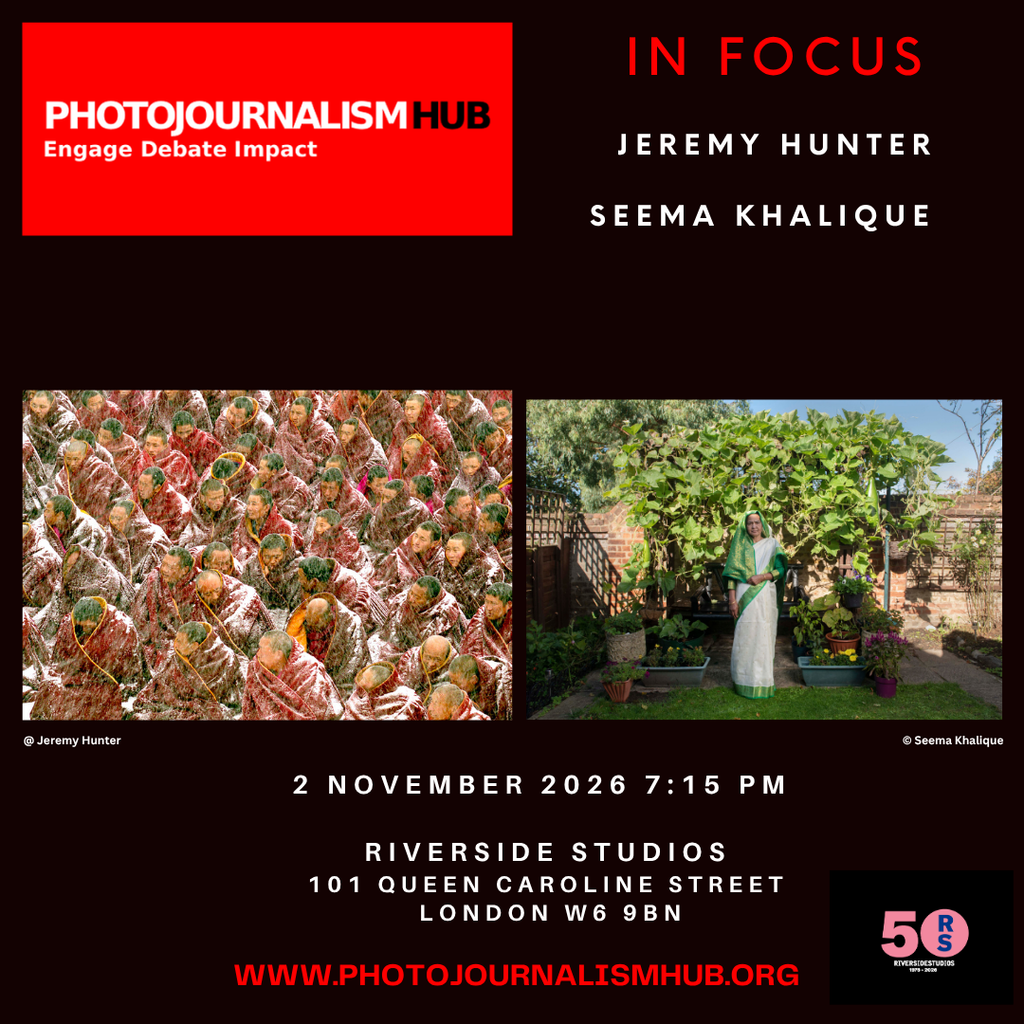
In this edition of IN FOCUS, Photojournalism Hub brings together two photographers exploring very different perspectives on culture, identity and belonging. Jeremy Hunter draws on decades of international reporting to document rituals, traditions and societies, including his extensive work in North Korea. Seema Khalique explores memory, migration and identity through photography, moving image and personal histories, giving visibility to stories that have helped shape multicultural Britain.


Jeremy Hunter
is a UNESCO award-winning British investigative photojournalist, television producer, writer and broadcaster whose career has taken him across more than 70 countries and five continents.
Beginning his career in advertising and television, Jeremy subsequently moved into broadcast journalism, reporting from politically sensitive and historically significant locations, including Lebanon during the civil war, India following the assassination of Indira Gandhi, and Portugal during its transition to democracy. He later worked with major British broadcasters, including the BBC and Granada Television.

His photography has focused particularly on festivals, rituals, religious traditions and culturally distinctive communities. His work has received UNESCO/HPA recognition, including a Documentary Award in 2011 for his work in Nagaland, alongside awards for his photography from the Sunday Telegraph, Daily Telegraph and BBC News.
Jeremy is also known for his extensive photographic work in North Korea, where he documented the country’s monumental Arirang performance, propaganda and aspects of everyday life. His illustrated presentation, North Korea Exposed – Daily Life in the Hermit Kingdom, has been delivered internationally to audiences at cultural institutions, universities and venues including the Palace of Westminster, UNESCO, NATO and the Royal Geographical Society.

His books include Sacred Festivals, published in English, French and German, and his photographs have appeared in publications including The Sunday Times, The Guardian, GEO, Stern and Condé Nast Traveller. His work has been exhibited internationally, including at Paris Photo and the Annenberg Space for Photography in Los Angeles.
Drawing on decades of first-hand reporting and photographic documentation, Jeremy uses visual storytelling to explore cultural identity, religion, politics, propaganda and the ways societies represent themselves.

Seema Khalique is a photography and moving-image artist, curator and producer whose practice explores memory, identity and personal history through documentary and portraiture. Her socially engaged practice centres around marginalised communities, using creative practices to give voice to their stories and develop new forms of community engagement.

Khalique curated About Then, a group exhibition for the Stephen Lawrence Gallery which was reviewed by the British Journal of Photography. She was also curator for Migration Quest, an immersive and interactive art exhibition at the Kobi Nazrul Centre. Khalique is Artist and curator of Londoni Memoirs which exhibited at Four Corner.
Khalique is currently exhibiting at Brighton Photo Fringe 2026. She is a Photoworks Photography Champion for Medway and a Board Member at Four Corners. 

Londoni Memoirs is a collection of portraits, curated ephemera, artifacts, heirlooms and video-interviews of 12 Bangladeshi migrants from 1950s-70s, documenting their exodus from genocide during the 1971 liberation war and watching their motherland’s independence from afar while making UK their home. The project grew from Seema’s own search for a family history that had largely remained undocumented, especially of her late father’s early life in the UK. He arrived in Britain in 1956, followed by her mother in 1973 after the Bangladesh Liberation War, both in search of a better life. At the heart of Londoni Memoirs is the experience of a generation caught between two defining moments: escaping genocide during the Bangladesh Liberation War and establishing a new life in an unfamiliar foreign country. The project considers how these experiences helped shape not only British Bangladeshi identity, but also the country as a whole through the generations born in Britain afterwards.
Londoni Memoirs seeks to honour a generation whose contribution was pivotal in the development of the multicultural society that exists in the UK today.

IN FOCUS is produced by the Photojournalism Hub in collaboration with Riverside Studios to present compelling, thought-provoking, independent and courageous photo storytelling.
In Focus: James Clifford Kent & Bharat Patel

To join us: Here

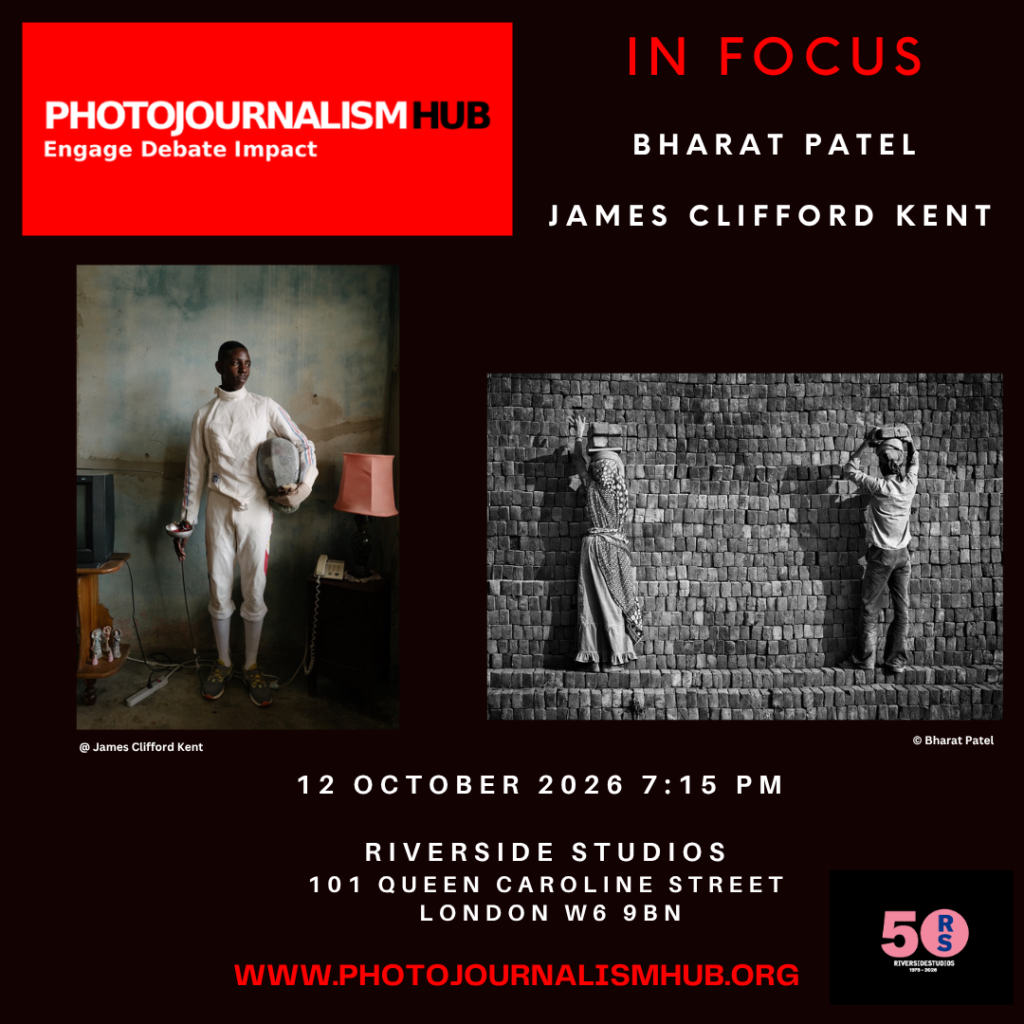
For our next In Focus at Riverside Studios on 12 October 2026 at 7:15 pm, we are delighted to welcome documentary photographers James Clifford Kent and Bharat Patel.
Exploring themes of belonging, healthcare and marginalisation, their work spans care environments in Cuba and the UK and the lives of India’s nomadic and de-notified nomadic communities. Kent and Patel will share their approaches to building trust, documenting sensitive human stories, and the role of documentary photography today.

James Clifford Kent is a London-based photographic artist whose research-led practice explores culture, health and social change. Through long-term relationships and sustained image-making, he navigates the space between intimate experience and broader social narratives, focusing on the textures of everyday life and the conditions that shape it. His award-winning work has been exhibited at the National Portrait Gallery and the Royal Academy of Arts, and featured in BBC News, The Guardian and The Times. James is co-founder and creative director of Yuma Studios and holds a PhD from Royal Holloway, University of London, a Fellow of the Royal Photographic Society (FRPS) and a Senior Fellow of the Higher Education Academy (SFHEA). He is the author of Aesthetics and the Revolutionary City and is currently developing his first photobook. 
Central to Kent’s relationship-led practice is listening. His images result from lasting relationships and sustained dialogue with the people he photographs; allowing presence, voice and agency to shape the work. This approach also reflects a sharp awareness of positionality — the limits, responsibilities and ethics of working as an outsider. During his talk “Birth, Death and Everything In between” James will share work, stories and experiences from his long-term, ongoing work in Cuba, his photographs on maternity wards during the pandemic, and his recent work in hospices in the UK.  

Bharat Patel is a documentary photographer using the camera as a tool to connect with people in overlooked, difficult, or marginalised conditions. His work focuses on labour, survival, and human dignity capturing the quiet strength in spaces society often ignores. Through intimate portraits and raw environments, he aims not to evoke pity but to provoke recognition. Even in silence, he wants his images to speak honestly and to make people look where they usually turn away.
He was born in India, raised in Uganda, and later moved to England for higher education. He also spent several years working in Brazil. Living across four continents has given him a deep appreciation for diverse cultures, which continues to shape his perspective and photographic approach.
In 2012, he began what would become a multi-year project to photograph one of the most marginalised groups in India: The Nomadic Tribes and the De-notified Nomadic Tribes. These communities, whose numbers are estimated to be in the tens of millions, face systemic exclusion and hardship. These nomads served as entertainers, singers, dancers, knife sharpeners, snake charmers, gymnasts, acrobats, tightrope walkers, basket makers, grain millers, agricultural labourers, and herbalists—each tribe possessing its own unique set of skills. However, their contribution and lifestyle is now at odds with the demands of modern society. 
The work focuses on the history of these tribes and their subsequent marginalisation in part due to the Criminal Tribes Act of 1871 by the colonial ruler. An act which criminalised many tribes. Remnants of the act still reverberate today.

IN FOCUS is produced by the Photojournalism Hub in collaboration with Riverside Studios to present compelling, thought-provoking, independent and courageous photo storytelling.

In Focus: David Hadland and Sarah Hickson

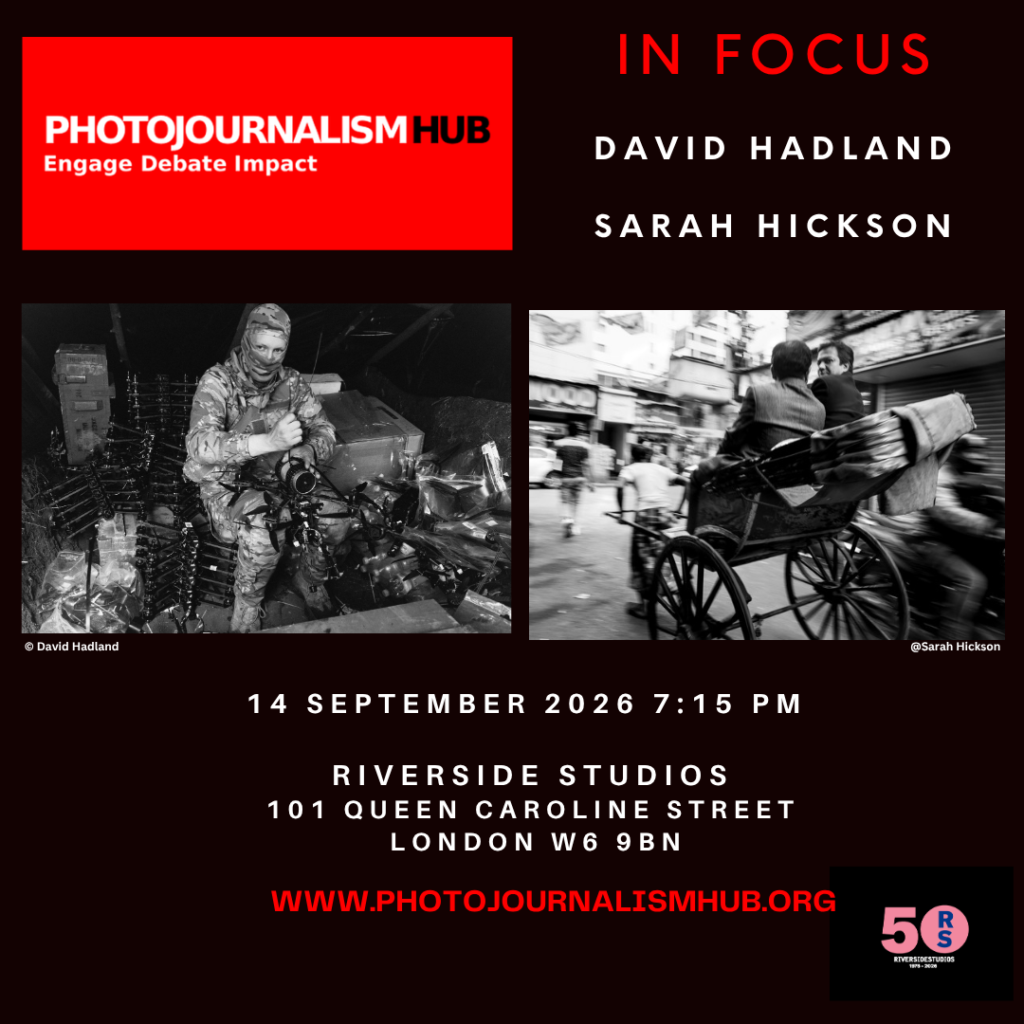
Poster IN FOCUS event organised by the Photojournalism Hub

Join us: Here

We are delighted to welcome documentary photographers David Hadland and Sarah Hickson as guests for our next In Focus event at Riverside Studios on 14 September 2026 at 7:15 pm.
In this edition of In Focus, David and Sarah explore the human stories shaped by conflict and displacement. Through their photography, they document lives transformed by crisis from soldiers living on the frontline in Ukraine to refugees navigating loss, uncertainty and the search for a new sense of belonging. Their work reflects on survival, resilience and the enduring connection between people, memory and place.

David Hadland is a documentary and portrait photographer from Luton, U.K. He lived in London for 11 years, where he graduated with a BA in Photography from Kingston University in 2018, and in 2024he graduated with an MA in Documentary Photography and Photojournalism from the London College of Communication. The core themes of David’s photography are identity, memory and the human experience. David is currently based in Kyiv, Ukraine, working on his long-term project documenting the full-scale war. 

Kozak is an ongoing project exploring the lives of Ukrainian soldiers stationed on the frontline. Through portraits and observations of daily life in the combat zone, the work examines how warfare disrupts the connection between people and the places they once called home.
War reshapes more than the landscape itself. Homes, streets, and fields once tied to ordinary life are transformed by conflict, altering how they are experienced and remembered. The soldiers I photograph inhabit dugouts along the frontline, living between the familiarity of home and the instability of war.
The title Kozak reflects a sense of continuity in Ukraine, linking the present to a longer history of resistance, identity, and place. Rather than focusing on spectacle or combat itself, the project centres on the everyday experience of soldiers living through war.

Sarah Hickson is an arts and social documentary photographer, now based in Brighton. Her practice explores the relationship between people, place and environment to create visual narratives that focus on themes of community and belonging, fracture and displacement.

She has worked on photographic commissions, residencies and projects in West and North Africa, India, Europe and around the UK. Sounds Unseen, an exhibition of work documenting a collaborative music project in the ‘Jungle’ refugee camp in Calais, was commissioned by St. Ann’s Warehouse in New York and Galway International Arts Festival. Her photo essay about Kolkata was featured in the book Writing Places, following an artistic residency with the National Centre for Writing in Norwich and Kolkata. Her 200 portraits of participants in the touring theatre project Truth to Power Café, formed an integral part of the theatrical narrative, bearing witness to the participants’ personal testimonies.
It is often the frayed edges of a story that draw Sarah’s attention, where vulnerability and fragility reside alongside hope and resilience. She will present an overview of her work on migration and displacement, referencing projects she has undertaken in Calais, Serbia and Greece, Galway and the UK.

She will also briefly talk about two other projects: her visits to the Taragalte Festival in the Sahara Desert in South Morocco, exploring the endangered environment of M’hamid El Ghizlaine and its historic nomadic culture, and her photo essay about Kolkata, capturing the nuanced and multi-layered nature of daily life in this city, where the past and the present collide. 

IN FOCUS is produced by the Photojournalism Hub in collaboration with Riverside Studios to present compelling, thought-provoking, independent and coraugeous photo storytelling.

IN FOCUS: Mariusz Smiejek & Roland Ramanan

Mariusz Śmiejek is an independent photographer, visual storyteller, and educator with over 20 years of experience specializing in capturing the raw narratives of human and social conditions. Renowned for documenting a wide range of subjects including post-conflict communities, refugee crises, child slavery, human trafficking, and systemic abuse. Recipient of prestigious awards in international photography competitions, his work has been exhibited globally and featured in renowned publications globally including The New York Times, National Geographic, and the British Journal of Photography, among many others. www.mariuszsmiejek.com

Not Surrendering tells a visual story specifically about the struggle of loyalists to shape a distinct identity in post-conflict Northern Ireland. The documentary narrative introduces us to the daily lives of the local British working-class as well as members of its illegal paramilitary groups. Recognised as terrorist organizations until recently, these associations still carry weight, sow fear, and control Northern Ireland’s Ulster.
By focusing on the spaces which the book’s subjects inhabit, aspects of their daily lives, and the particularities of their neighbourhoods separated by ominous ‘peace walls,’ the photography brings to the fore the psychological state of siege which permeates working-class districts in Northern Ireland. The story also spotlights the atmosphere of despair which accompanies each successive generation – trapped socially and mentally in unprocessed traumas from which it cannot escape.
The aim of the Not Surrendering is to increase awareness and knowledge about processes of reconciliation in post-conflict societies that are divided territorially, politically, nationally, and religiously.
The story this volume highlights the difficulties NGO and other grassroots projects face while working with difficult youth from families deeply involved in the conflict.
The photographic images illustrate the tensions arising during celebrations of national identity, during which especially members of paramilitary groups openly fan the flames of hatred towards their neighbours. This directly affects the indoctrination of the youngest who actively participate in numerous events of this type, leading often to recruitment of young people into paramilitary associations or organised criminal groups.
This has been a personal, individual project from the very beginning to the end (2010-2020); partly supported at the very end stage by Artists Emergency Programme grant from the Arts Council of Northern Ireland and The National Lottery.

Roland Ramanan is a London based documentary photographer, born in 1966 with a background in music and education. He developed a passion for photography around 2010, initially through street photography. In 2012 he started a long term documentary project on a vulnerable group of people who gravitate towards a corner of east London called Gillett Square which is to be published by Dewi Lewis as the book “Dominoes”. This work has been featured in Vice magazine among others and has won various awards including being shortlisted for the Royal Photographic Society documentary awards 2023. In 2022 he was one of the finalists in the Portrait of Britain awards. Roland’s current project focuses on the London roller skate scene and its relationship to black culture. https://rolandramanan.com/

Dominoes is a unique and vibrant mosaic of the lives that float in and around a particular corner of Hackney in London’s East End. The book is populated by intimate pictures of people who have experienced addiction and pain as well as the deep joys of the community of which they are a part. Gillett Square was derelict and underdeveloped for years until, in the 1990s it became an experiment in urban regeneration. Like the Dominoes they play in the square, those lives are often precarious. For ten years from 2012 I was privileged to be allowed into the lives and homes of some of those I have met, to photograph their fights and struggles; their families and their lovers. Some of these people are now my friends and some are no longer with us. The participants I am closest to form the heart of the book and I’m sure that bond will continue. The work gives us honest glimpses into lives that we may often turn away from but always with a sense of hope. Dominoes touches on universal themes of love, death, hope and the evolution of urban communities.

BECOME A PJH MEMBER
Consider becoming a member of the Photojournalism Hub and receive the benefits of free access to events, resources, premier editorial content, portfolio reviews, and discounts on entry to our photography exhibitions, training and in our shop, whilst you will be supporting our work advocating, advancing social justice and human rights, amplifying community voices and enhance access to media to those facing social, economic and structural challenges. If there were ever a time to join us, it is now. Support the Photojournalism Hub from as little as £1 every month. If you can, please consider supporting us with a regular amount each month. Thank you. JOIN US HERE

Photojournalism Nights: Aidan Brooks and Andrew Blowers

We’re delighted to welcome Aidan Brooks and Andrew Blowers to the 36th edition of the Photojournalism Nights.

Both photographers use the tool of photography as a means to connect with others in an authentic, raw and meaningful way whether through exploring encounters with strangers or documenting the street around them.

Photojournalism Nights is an event that invites photojournalists and documentary photographers to share their powerful, committed photography dedicated to social justice and human rights causes. Photojournalism Nights event is an opportunity for the public to ask questions, found out how to be involved and learn insights behind the powerful photos stories that are helping advance social justice and human rights around the world. After the presentations, the audience and the guest photographers can continue conversations and socialising in Riverside Studios bar and coffee lounge area.

Aidan Brooks
I am a community photographer and visual storyteller, with the goal of capturing individuals in an authentic and meaningful way. I use my camera to initiate conversations and discover how people feel in the moment. My passion for photography began during my childhood as a shy boy growing up in Wirral, Merseyside. Instead of asking direct questions, I found comfort behind the camera, which gave me confidence and security when interacting with people. This experience has taught me to challenge my judgments, approach things with courage and curiosity, and be a good listener. I believe in the power of being present for people and providing a safe and empathetic environment where they can express themselves freely. Aidan will be presenting selected images/stories to talk about why “talking to strangers is important for us all.”
www.aidanbrooks.co.uk
@aidan_brooks

Andrew Blowers
Having first picked up a camera after growing tired of taking phone snapshots, Andrew spent £50 on a film SLR in 2017, and was hooked. Alongside photography, Andrew is also an accomplished semi-professional bass player and during the COVID pandemic and lockdown of 2020 he found himself without a creative outlet and his enjoyment of street photography turned into documenting the world around him. 
Exclusively shooting black and white, he greatly favours the use the old ways of film and the darkroom, only utilising digital when needs must. His style is honest and open, empathetic and devoid of visual trickery. 
He is a member of documentary collective New Exit Group @newexitgroup where copies of collaborative debut zine Bardo are available. The project based on blues in Soho is being sequenced and designed, available soon. Darkroom prints from projects are available on request.
@andyblowers
@newexitgroup

To book a place HERE

Photojournalism Nights 30th edition

©Samira Oulaillah
©Natisha Mallick

25th January 2023, 18:30 – 21:30 
The Invention Rooms
Imperial College Door C
68 Wood Lane
London W12 7T

More info, and to book HERE

Photojournalism Hub presents Natisha Mallick and Samira Oulaillah to the 30th edition of the Photojournalism Nights event at The Invention Rooms, Imperial College London.

Both award winning photographers work on under-reported topics that need incredible courage and access to be able to tell, including Natisha’ stories on Muslim men being falsely implicated in terror cases and the challenges of child birth in India, and Samira’s project ‘Breaking the Silence’, exploring the testimonies of former Israeli soldiers who quit the army to join an organization called “Breaking the Silence” – founded in 1995 by former soldiers- who decided to testify against their own actions in the occupied territories.

Natisha Mallick is a computer engineer by education and a documentary photographer who focused her work on under-reported stories in India. She hopes that her images contribute to the public enhancement of unbalanced situations. Her work has been published in Spiegel Online, The Wire, The Quint, Fountain Ink Magazine, The Irish Times, Scroll, Catch News, Private Photo Review and L’ oeil de la photographie. Shortlisted twice for the Marilyn Stafford Foto Reportage Award in 2018 & 2017 for her work on Muslim Men falsely implicated in terror cases. Natisha’s work on Child Births in Rural India was awarded the Child Survival Media Award by National Foundation for India and Save the children and was also shortlisted for the Photocrati Fund. She was the recipient of the Neel Dongre Grant by India Photo Archive Foundation and the Oslo University College Grant. Interested in Data Stories, Natisha is transitioning into the tech/data space and presently working towards her Masters in Big Data Science from Queen Mary University of London. http://natishamallick.com/

Samira Oulaillah, a French filmmaker and documentary photographer, has extensively worked in the last ten years on global issues related to war, refugees, gender issues, child poverty and racial discrimination, producing numerous documentaries for international cable television and presenting documentary photography for various media outlets and NGOs. She has widely travelled across the world to shoot hard-hitting documentaries and immersive photographic reportages that give a voice to the voiceless and a face to the forgotten. Samira holds an MA in Documentary Photography & Photojournalism (UAL London College of Communication) and an MA in Social History (Winchester University). She is currently preparing a PhD with the Sorbonne University in Paris and working on the impact of white colonial photography in West Africa on the representation of native people and the revival of African identity and collective memory through the work of contemporary Malian photographer Malick Sidibé and Senegalese photographer Oumar Ly. https://samira.photoshelter.com/

BECOME A PJH MEMBER
Consider becoming a member of the Photojournalism Hub and receive the benefits of free access to events, Photojournalism Hub resources, premier editorial content, portfolio reviews, photography exhibitions, discounts on our courses and training, whilst you will be supporting our work advocating, advancing social justice and human rights. If there were ever a time to join us, it is now. Support the Photojournalism Hub from as little as £1 every month. If you can, please consider supporting us with a regular amount each month. Thank you. JOIN US HERE

REPORTING OF WAR, AWAY FROM THE FRONTLINES

The Invention Rooms, Imperial College
Door C, 68 Wood Lane
London
W12 7TA

To join HERE

Russia invaded Ukraine on 24 February 2022, escalating the Russo-Ukrainian War which had begun in 2014. During the past eleven weeks, photographers and journalists have reported from field, many of the images have captured the deadly events that have taken place.

We have invited a group of photographers, whose work have contributed to the ongoing documentation, with photographs that unearth stories away from the frontlines, such as the displaced within the country and events at the borders. Carolina Rapezzi , one of the guest photographers, explains: according to the latest IOM report (17 April 2022) there are 7,707,000 Internally displaced people in Ukraine. 2,850,000 of this are in West Ukraine. Chernivtsi, the last Ukrainian city before the Romanian border, has become a refuge for roughly over 100,000 displaced Ukrainians, 33,341 are children and 82,340 are now officially registered with IDP status. These are stories I found between Chernivtsi and Siret, the first Romanian city after the Ukrainian border, that has instead become a crossroads, for the ones leaving the country.

We are incredibly honoured to present to you all our guests photographers Carolina Rapezzi, Hether Ng and Natalia Campos who have been covering the war in Ukraine and will be sharing their powerful photography, insights and stories from within the war ravaged country.

Carolina Rapezzi is an Italian freelance photographer based in London who works on social, humanitarian and environmental issues. She started working on migration issues in 2015, documenting the welcoming systems for minors arriving from Libya on the Sicilian coasts (“Minors on the Move” September 2015) and, after a few months, began a project that lasted eight months covering the eviction of the refugee camp of Calais, France (“The Eviction” March-October 2016). Moved to London in 2013, she photographs various protest movements, including those on the Brexit Referendum and the more recent Black Lives Matter. In 2017 she begins a long-term project on identity and gender (“It was meant to be” April 2017 – 2020).In since 2018 and 2019 she started working on environmental issues with a focus on electronic waste and disposal systems (“Burning Dreams” October 2018 – November 2019). In May 2020 she covered the Covid19 pandemic in London, documenting from a homeless hostel and since 2019 she has been working on a project on knife crime and its social roots in London.

Yuen Ching (Hesther) Ng, a London-based Hong Kong photographer who was born in 1992. Currently, she is studying to be a photojournalist from the University of the Arts London (UAL). Her press works are mainly focusing on breaking news and protests. They can be found in various national and international media outlets such as The Guardian, Forbes, BBC, The Times, Metro, and Yahoo! News, CNN, the Wall Street Journal etc. Being born and raised in different countries, she develops a keen interest in documenting the displacement of people and cultures around the world through her lenses. Apart from photography, she is a qualified clinical pharmacist practising in London and an independent journalist from HK Feature.

Natalia Campos is a self-taught freelance photographer originally from Rio de Janeiro, Brazil but based for the past six years in Dublin, Ireland. In her three years as a photographer she has documented protests, news events, and everyday life in countries such as Northern Ireland, Portugal, Turkey, and Georgia. She has recently reported on the humanitarian crisis in Ukraine as a result of the Russian invasion. She is interested in social and political concerns and has collaborated with non-governmental organizations that promote minority rights, equality, and human rights.

Photos from left to right: ©Carolina Rapezzi, ©Yuen Ching (Hesther) Ng, ©Natalia Campos.

Photojournalism Nights 18th edition

Photojournalism Hub eighteenth edition of the Photojournalism Nights presents a superb line-up of guest photographers: Susannah Ireland, Jermaine Francis, Sabrina Merolla.

25th November 18:30 PM

The Invention Rooms
68 Wood Lane
London
W12 7TA

To Join: HERE

Rumi Munawar, former Miss Pakistan for UAE 2015 pictured in Sharjah, United Arab Emirates, 14th October 2016. Photo Credit: Susannah Ireland
Credit: Jermaine Francis
City, Country, Date DD MMM YYYY

Susannah Ireland, is a freelance photojournalist and documentary photographer based in London, UK but working internationally as well. She began her photojournalism career on a local news agency in Birmingham in 2006, graduating to London the following year to work principally for The Times and Independent newspapers. Following a brief stint working in India, Susannah moved back to London and now undertakes news, features and portraits assignments for a variety of international clients such as NBC News, The New York Times and NRC Handelsblad. She is a member of Women Photograph – a platform of independent photographers working to elevate the voices of women and non-binary visual storytellers worldwide. She is particularly interested in documenting the humanitarian impact of conflict and environmental disasters on local communities.

Jermaine Francis, is a London based Photographer who works with portraiture and conceptual documentary projects, using editorial, personal projects, and books as vehicles to tell these stories! Jermaine’s work has appeared in publications such as I-D, The Face Magazine, Autre Magazine & Beauty Papers. His work has recently appeared in Aperture’s latest publication the monograph Photo No, No’s, as well ICP book ICP Concerned, Global Images for Global crisis! Jermaine’s work has also exhibited at the National Portrait Gallery as part of the Taylor Wessing, The International Centre of Photography NYC in the group show #ICPConcerned and his solo show ‘The Invisibles’.

Sabrina Merolla has collaborated with Photojournalism Hub for more than one year. She is an awarded photographer, cultural studies researcher, multimedia journalist and participatory photography facilitator. Sabrina has a strong work ethic and is committed to telling stories in which the general fairness of the narration is granted by long pre-field and on-field research. She focuses on the environment, communities, health and human rights.

Donations are welcome. To Join: HERE

Photojournalism Nights 15TH Edition

Photojournalism Hub 15th edition of the Photojournalism Nights presents a superb line-up of guest photographers: Carolina Rapezzi , Denise Laura Baker, Simon King.

23rd July 2021 06:30 pm

White City Place, The WestWorks,
195 Wood Lane
London
W12 7FQ

To join here

Ghana, Accra, November 2018. Rashida is a young girl originally from the North of Ghana, she sells water in the scrap yard of Agbogbloshie. Along with other girls living in the area, she carries water bags into a wheelbarrow and sell them for 1 Ghanaian Cedi each (the equivalent of £0,15) to workers who need to extinguish the fire and cool down the copper extracted from burning cables, wires and other appliances.

Carolina Rapezzi is an award-winning photographer based in London, part of the collective Women Photograph. Her works focus on social, humanitarian and environmental issues. She worked on migration issues in Sicily and France, covered the 100th anniversary of the Russian Revolution in Moscow and St. Petersburg, followed several protest movements in London, including the more recent Black Lives Matter and, since 2018 she has been working on environmental issues. Her independent project Burning Dreams on electronic waste in Ghana has been awarded internationally and exhibited multiple times: Portrait of Humanity 2019, Winner Flash Forward 2019, Winner 1st Prize Single Images, Winner World Water Day 2020, Shortlisted Sony World Photography 2020, Winner Siena International Award 2020.

©DeniseLauraBaker

Denise Laura Baker is a photojournalist, documentary, and portrait photographer. Her work draws on influences from the many different strands of her career, particularly her time as an ethnographic psychologist where she interviewed and collected the stories of the people with whom she worked. She has been exhibiting since 2016 and have, exhibited at various locations in Wales, including holding her first solo exhibition as part of LLAWN 2019 (Llandudno arts Weekend). She is the recipient of an Arts Council for Wales R&D grant for a project examining interconnecting communities within Gwynedd, Conwy and Ynys Mon. She also teaches and give talks on the role of narrative in photography and photo book making.

©Simon King

Simon King is a documentary photographer, currently working on a series of long-term projects, all on 35mm film. Simon teaches at UAL, and with Leica Akademie (UK). Simon works with the collective New Exit Group to publish photo-essays highlighting intimate, local stories. Simon’s recent publications include BARDO (in collaboration with NEG), a USA Digest which includes work from 2019 – Winter 2021, and Transiting Bulgaria, from his recent time there over Christmas 2020.

The Photojournalism Nights is an event that promotes committed and courageous photojournalism and engages the public to social justice and human rights. To join HERE

Thanks to White City Place for supporting our events

How has Covid-19 and Brexit impacted the LGBTQ+ communities?

Tina at the site of the Guy Fawkes night fire near her home © Richard Ansett 2016

Join us for a conversation on the impact of Covid-19 and Brexit on the LGBTQ+ communities.

Photojournalism Hub is pleased to host a conversation on the challenges that the LGBTQ+ community face, and the further impact of Brexit and Covid-19 pandemic has had on the community. How can we as individuals and as communities support and address the current challenges? Departing from the photography of Gemma Mancinelli and Tim Boddy, join us in the conversation.

Tim Boddy, is a photographer based in London, and a recent graduate of LCC’s Photojournalism & Documentary Photography MA course. Tim develops personal documentary-based projects outside of his commercial work. His practice generally centres on the LGBTQ+ community, whom he enjoys working alongside to embolden storytelling and to make his work more representative of the community.

Gemma Mancinelli, is a photographer and a visual storyteller based in London. Her dedication to human rights, especially women’s rights, LGBTQ+ and working class, is central in her photographs. Gemma has extensively reported on the movement of protests of the last years, focusing on documenting the people’s stories within.

Fazal Mahmood, Rapid Intervention Worker at St Mungo. Fazal will share his personal experiences, both about the trials, tribulations and the celebrations of the integration of his identity from being a South-Asian Muslim gay man.

Richard Ansett, an award winning photographer known for his provocative images. His images are in permanent collections including the National Portrait Gallery, London and Library and Archives Canada, Bibliothèque Nationale de France and the Smithsonian Institution. His images have been part of major collaborative exhibitions.

TO JOIN US REGISTER HERE

Thanks to White City Place for supporting our events

Cover photo ©Richard Ansett