Federico Tisa: Tinuola

2018 / ongoing

This is the story of Mary, born on the 2nd of May 1994 in Mushalash, a small town in Lagos State in Nigeria. Her grandmother called her Tinuola, meaning “full of wealth” in the Yoruba language.

After a journey of more than 2.500 miles and endless time, which took her from Lagos to Benin City, then to Kano, Agadez in Niger and finally to the seaport city of Zuara in Libya, she arrived in Sicily in October 2014 and was transferred to Florence shortly afterwards. Following the end of one of the hospitality projects, she was transferred to Chivasso, a small town near Turin in 2017. Mary is a guest of the Mary Poppins association, a non-profit organisation that works with trafficked women.

The journey that carries me to Chivasso is much shorter, just a few minutes’ drive from Turin, where I live and work. I turn to Mary Poppins thanks to the advice of a friend who works for the cooperative as an operator. After a series of introductory interviews I met Mary in April 2018. Time carried me to become her friend. Her white brother. That is what she calls me now when she has to introduce me to her friends.

In 2019, Mary leaves the project and starts a new life. A life not easy and full of difficulties, made of mistakes, steps forward, passions, pain, humiliation. A long bureaucratic path to regularization on Italian ground and the search for a job.

This is a small story about the world around her and her incredible story.

It’s the story of our friendship.

Mary poses for a portrait I took of her at the Sacra di San Michele. A place I absolutely wanted her to see given its strong spirituality. Sant’Ambrogio di Susa, February 2020.

Mary and Kate are getting ready for another birthday party for a friend of theirs who is in the Mary Poppins shelter project. Chivasso, July 2018.

Mary and her roommates during a birthday party for their friend’s daughter. Chivasso, May 2018.

Mary shows signs of Libya on her body, of the exploitation she was subjected to and the voodoo ritual she underwent before leaving for Europe. She has a story no different from the thousands of other girls imprisoned in hot spots and forced into prostitution to pay off the debt contracted for the journey.
A debt tha strangles them and forces them to be trafficked. San Sebastiano da Po, May 2018.

With the arrival of 2022, it has been more than two years since Mary has been undocumented, officially illegal. So, we decide it is time to begin to find a way out of this state of slumber and malaise. Through old contacts in the hospitality world and a lawyer friend, Mary is placed in a new project. Turin, March 2022.

Mary jealously preserves this photo. It’s the only photo of her mum with her and her brother. Her mother unfortunately died when she was still a child and Mary grew up with her grandmother in a house outside the city. Chivasso, May 2018.

The first trial period, the first activated internship is officially over. It lasted six months. The tailoring job currently is the only way she can afford money to help pay her rent and everything else. Turin, February 2023.

Mary poses for a portrait in the room of her host cohousing. Turin, March 2023.


Federico Tisa | Documentary photographer
email: tisa.federico@gmail.com
tel: +393384611573
web: www.federicotisa.com
instagram: /federicotisa

Gendered face of London’s housing crisis

Photos and text by Cinzia D’Ambrosi

After years of documenting the lives of individuals in insecure housing in London, a clear pattern emerges: a significant portion of this demographic comprises single mothers in either no or low-paid employment. This raises the pressing question: why are so many women and their children being failed so profoundly?

Melissa fled domestic violence, seeking refuge far from her former home. However, living in a shipping container with her three young children has aggravated her depression and anxiety, failing to provide the safety and comfort she desperately needs.

Since 2006, Francesca recounts: “I have been evicted 3 times. The first time, I was living in a private rented accommodation through Hammersmith and Fulham council. I was living with my two children and expecting a third child when I was handed over an eviction notice. I was made homeless and then the council offered me a home in East London. My only financial support was my work as a mobile hairdresser and my clients, my children’s school and everyone I could ask any support to, is living in West London, however I had no where to go. I checked the place and it was rife with crime and I did not want my children to live there so I refused. Then they looked for a place for me in the private rented sector. I was told to go to Ealing Housing Team and at first they sent me to Willesden Green to live in one room. We had to move out and had to rent a storage for all my things. I could not live there with the children going to school miles away. Everyday they were late at school and getting detention so I went back to the council and told them of these challenges and that was when I was allocated a container flat in Meath Court in west London.”

Francesca and her three young children have been evicted many times before being moved to Meath Court.

Francesca has 3 children who in their entire lives have only lived in temporary accommodations. Living in the shipping containers is very difficult with no space for any privacy. One of the children, who has asthma, sleeps in the kitchen. On the very first day they moved into the container, he had an asthmatic attack.

Families that live in the containers report their shock when they first arrived at the site, some at first not realising that the shipping containers were to become their homes.

“How could it be humanly possible that containers could be offered as homes?”

Nathalie Bangama, from Congo, with three children, moved to Meath Court after a fire destroyed her home last year. Despite living in Ealing for over 15 years, she was shocked to be offered shipping containers as housing instead of promised flats. She couldn’t believe it, knowing even in Congo, women and children aren’t housed this way.
Nathalie is a single parent and she has had to strlie is a single parent and she has had to struggle with being on her own with three children and with the awful circumstances of her living conditions at Meath Court.

Similarly to many other women, Nathalie could not believe her eyes when she was given shipping containers as a home. “Even in Congo, we don’t house women and children in shipping containers.” Nathalie Bangama, originally from Congo, has three children 15 years old, 4 years old and 9 months and she ended up at Meath Court after her house caught fire. When she was given the keys to the container flat, she was crying and crying. She was told that within 6 months, she would be given a proper flat, but 2 years later she is still waiting.

Another resident of Meath Court is Melissa, a victim of domestic violence that was to be housed, in a different borough under the protection scheme. Melissa and her three small children were housed in the shipping containers. It has led her to depression and anxieties. Living in a container, it has not helped her to heal from her traumatic experiences. Instead, it is continuously making her feel unsafe and deeply anxious about herself and her children as the environment is characterized by rampant drug use, theft, and a pervasive sense of insecurity.

Like herself, many women in Meath Court have experienced sexual harassment and incidents of intimidation by drug users using the shipping containers as a space to deal, or to sleep for the night. “There was an incident of a woman falling down from the stairs and she is currently in coma – Melissa recounts. And my front door was tempered and broken, she continues- and I have taped it with a black bin bag and I am still waiting for someone from the council to come to repair it. I feel very anxious about my safety and that of my children.” Melissa’s broken door was not repaired at the time of my interview with her, weeks after the incident. Her rent is £370.55 + £19.05 service charge per week to live in shipping containers without a secure front door.

When Zara received the one-bedroom flat, she had just given birth. Her baby was only a week old. Given the top floor, she found walls riddled with bullet-like holes from the previous tenant’s mental health struggles. It was a frightening, lonely, and disheartening experience for a first-time mother.

When Zara was given the one bedroom flat she had just given birth. Her baby was one week old. She was given the last floor and one which all the walls were plastered by bullet like holes. She was told that the previous resident was suffering mental health issues and was using a hammer to bang the walls. “It felt scary, lonely and very disheartening for a first time mother who had just given birth.” Since living in the container, her wellbeing is deteriorating. She has pleaded to be allocated even in another one-bedroom in the containers, one without the violent markings on all the walls, but her pleas have gone unanswered.

Following the unanswered calls for the installment of security cameras or the placement of a security guard at Meath Court, women have resorted to create a WhatsApp group to ensure each other’s safety by sharing their whereabouts.

As policymakers and stakeholders seek solutions to London’s homelessness crisis, it is crucial to recognize and address the specific challenges faced by women. Failing to do so not only perpetuates the cycle of homelessness, but also deepens existing inequalities within society.

The question arises: why have so many women and their children been failed so miserably? Is it due to perceived vulnerability and social standing, perpetuating prejudices that hinder their access to decent living conditions?

All images ©Cinzia D’Ambrosi

IN FOCUS: Sascha Klamp and Valeria Luongo

22nd April 2024, 7 pm
Riverside Studios
101 Queen Caroline Street
London W6 9BN

To join: HERE

Photojournalism Hub and Riverside Studios are delighted to announce Sascha Klamp and Valeria Luongo as the featured photographers for ‘In Focus,’ a captivating series of photography events. This series present photographers whose work engage with social documentary photo storytelling, using the lens as a powerful tool for engagement, exploration and raising awareness. The event includes presentations, live interactive Q&As and a social.
Our guests of this edition have a background or work with an anthropological approach, using documentary photography to present stories that capture and explore community and individual memory, archives and rituals.

Valeria Luongo is an Italian documentary photographer, filmmaker, and anthropologist who’s based between Mexico and the UK. Her photographic approach is characterised by working on long term projects. Her work explores stories regarding gender, spirituality and rituals and has been featured in National Geographic, The Guardian, BBC, GEO Magazine and exhibited internationally.

“When Women Fly” is a  project about a group of indigenous women from Cuetzalan del Progreso, Mexico, challenging gender roles by participating in a traditionally male ritual called Danza de los Voladores.
The ritual begins with a ceremonial dance. Five participants then ascend a 30-metre pole and jump off the top, head first, tied to ropes as they revolve around the pole towards the ground.
Historically, only men were allowed to partake in the ritual. However, a few women in Cuetzalan have recently joined the practice. The flying women defy traditional gender roles, symbolising transformation within their social context. Since 2022 I’ve been working alongside several women and girls who fly, documenting their everyday lives among their community.

Sascha Klamp is a British/German multi-award winning Documentary Filmmaker, Photo-documentary Journalist and Producer based in London, UK. He spent the majority of his career as an investor and entrepreneur which enabled him to travel across frontier and emerging markets. His photography practice centres on highlighting social impact and social justice affairs which is deeply rooted in his curiosity to learn more of the world around him. He tells frontline human and community stories based on empathy for the situation and the people involved. His thinking is informed by his interest in ethnology and social anthropology. Sascha exhibited a small selection of his The Art of Seeing, The Art of Remembering project in London in November 2022. His work was highly commended by the TPF Social Documentary Awards (Professional Category, Series) for his The Art of Seeing, The Art of Remembering work. Sascha completed his MA Photojournalism & Documentary Photography studies at the University of the Arts (Distinction), London. He also holds an MBA (Bayes Business School, London) and a Masters in Law, LLM (King’s College, London), and a BSc International Securities, Investment & Banking from Henley Business School (ICMA Centre). Filmography: “The Art of Seeing, The Art of Remembering” (2022), “The Blockade” (2023).

In a remote village in Kosovo, the past casts a long shadow. A single family of 2500 souls, now in its 13th generation, struggles to find its place in a changing world. Based on the Directors engagement with the community and renowned Community Archival work, KINSHIP tells the story of one family’s search for belonging.
We meet Rabit, the community’s Doctor, who recounts his heart-breaking tale of being ‘gifted’ to his uncle as a young boy. An all too common practice rooted in ancient customs. He grapples with the trauma of his stolen innocence. Meanwhile, Couple Mumin and Qamile Dermaku tell their moving story of how they met, the challenge he went through gifting a brother to a neighbour and his wife’s struggle to join the ‘jungle’ of a remote community. Expecting mother Florentina faces her own struggle. Pregnant with her first child, she dreams of a better future. But is that future possible here? Or must she also make the painful choice to leave everything she has ever known behind? The village Elders tell their stories aided by black-and-white photographs sourced from their family photo albums. They recount stories of happier times but also times of conflict and change. These memories contradict with the experience of the younger generations who cannot imagine a rural life with its limited resources and opportunities. Joining the diaspora is a potential way out to seek a fortune and future elsewhere. The cleric focuses on holding the community together. But his own story contradicts the ambitions of his community. The state looks away from the Kanun law/ tradition (Kanun of Lek Dukagjini). The honour code (vendetta in Italy) contradicts with the country’s ambition to become a full EU member. We engage with Child Psychologists who explain the harm done to children being gifted to family members and how that trauma informs their choices. Running away from it all sounds like a sound choice for many.

BECOME A PJH MEMBER
Consider becoming a member of the Photojournalism Hub and receive the benefits of free access to events, resources, premier editorial content, portfolio reviews, and discounts on entry to our photography exhibitions, training and in our shop, whilst you will be supporting our work advocating, advancing social justice and human rights, amplifying community voices and enhance access to media to those facing social, economic and structural challenges. If there were ever a time to join us, it is now. Support the Photojournalism Hub from as little as £1 every month. If you can, please consider supporting us with a regular amount each month. Thank you. JOIN US HERE

CAPTURING CRISIS

In this new edition of ‘Capturing Crisis’ youth photography magazine, we present a special edition on a local coffee shop to learn of its championing and success. We present a photo essay on the charity Nourish Hub documenting its cycle of sustainability, healthy and free food for all.
Our young team also reported on Free Palestine local and national responses. And we present evocative images at Meanwhile Gardens, a photo story on volunteers creating a community garden at Factory Quarter in west London.
In the last pages, we present the world of teenagers and friends, and a few portraits from a series of portraits of staff at The Globe, the dedicated Shakespeare Theatre in central London. We hope you enjoy Capturing Crisis youth magazine!

Capturing Crisis is a youth documentary and photojournalism magazine. All features and photographs are created by participants of ‘Stories, Reporting Mag, Photography Course’.
The magazine provides the opportunity for youths who never had access to, to share their photography and photo stories to a large audience. Photojournalism Hub is committed to providing opportunities and support to youths, enabling equality in accessing opportunities for further education and work in the photo industry.
Capturing Crisis magazine is a testament of the great work and inspiring contribution of our youths.

The project is supported by the NHS west London trust, Hammersmith and Fulham Council and Sobus.

Photojournalism

National Demonstration Free Palestine

National Demonstration for Free Palestine and a Ceasefire Now in London, 25th November 2023.

At Photojournalism Hub we work for social justice and human rights through publishing, promoting and supporting the work of independent photojournalists and documentary photographers. It is our belief that no one should be killed for their faith, ethnicity, nationality. What we are witnessing every day in the past 7 weeks has hurt us immensely. It is wrong to tackle acts of terrorism by disproportionately or indiscriminately killing and injuring civilians, women and children. We hope for a Ceasefire and for Palestinians right to peace, security and to live in their own independent state, free from occupation. We stand for Peace and an end of war.

Below are some photographs from our team on pro Palestine marches in London.

©Cinzia D’Ambrosi

©Cinzia D’Ambrosi

@Cinzia D’Ambrosi

©Safeena Chaudhry

©Sienna Sunna

Cinzia D’Ambrosi @cinziadambrosi
Safeena Chaudhry  @photographerdreamertraveller

Sienna Sunna

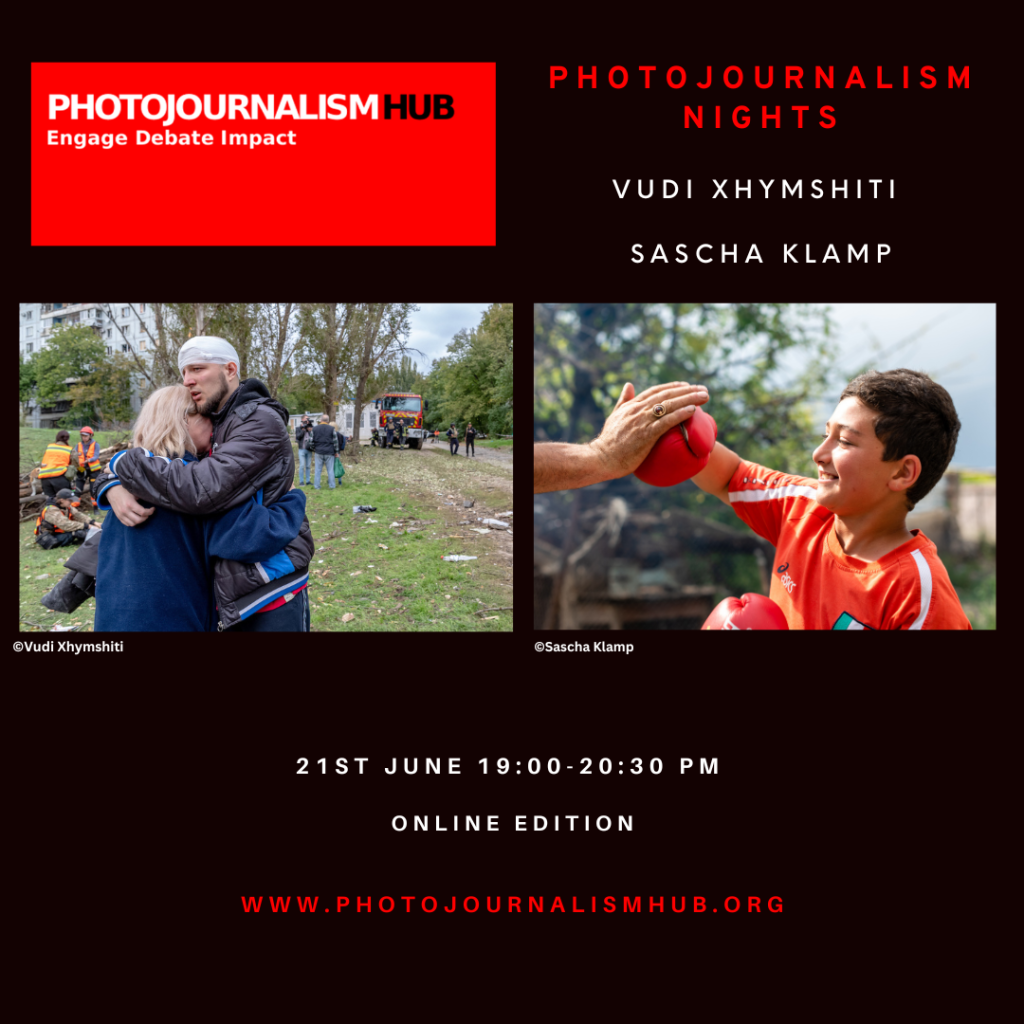
PHOTOJOURNALISM NIGHTS: Vudi Xhymshiti and Sascha Klamp

Join us for an exciting night of PHOTOJOURNALISM! Our online event starts on Wed Jun 21 2023 at 7:00 PM BST. To book: HERE

This event will showcase the works of talented photojournalists Vudi Xhymshiti and Sascha Klamp. Get ready to be inspired by their captivating images and stories. Vudi a renowned photojournalist will share stories from war torn Ukraine where he has been reporting from over 7 months and Sascha who is a multi awarded filmmaker will be speaking about his latest work in Armenia.

During the event, you’ll have the opportunity to interact with the photographers and learn about their experiences in the field. You’ll also get a chance to ask questions and share your own thoughts on the power of photojournalism.

Don’t miss out on this incredible opportunity to connect with two great photojournalists, documentary photographers and filmmakers with and connect with a peer community. Register now and get ready for a night that will inspire.

Vudi Xhymshiti is a photographer and journalist based in London, who has covered major world events since 2007, with his work appearing in prestigious news outlets such as The New York Times, TIME Magazine, The New Yorker, The Guardian, The Times and the Sunday Times of London, CNN, BBC, DW etc. His assignments have taken him to the frontlines of the Arab Spring, the Syrian and Libyan Civil Wars, and the aftermath of the Armenian-Azerbaijani armed conflict in Nagorno Karabakh. Throughout 2022, he reported on the Russian military aggression in Ukraine and travelled to Moldova to observe and report on the impact of Russian territorial expansionist foreign policy on neighbouring countries. He also spent four months familiarising himself with rising tensions in Kosovo, Bosnia and Herzegovina, and Montenegro, following Serbia’s alignment of its Foreign Policy with the Russian Federation. Xhymshiti is not only a talented journalist, but also the founder of VX Pictures and an educator in the visual journalism industry. Don’t miss out on his insights and coverage – visit his website https://vudixhymshiti.uk/ to learn more about him, read his blog https://vudixhymshiti.uk/blog/, and view his latest work on https://vximages.com/.

©Vudi Xhymishiti

Sascha Klamp is a British/German multi-award winning Documentary Filmmaker, Photo-documentary Journalist and Producer based in London, UK. He spent the majority of his career as an investor and entrepreneur which enabled him to travel across frontier and emerging markets. His photography practice centres on highlighting social impact and social justice affairs which is deeply rooted in his curiosity to learn more of the world around him. He tells frontline human and community stories based on empathy for the situation and the people involved. His thinking is informed by his interest in ethnology and anthropology. Sascha exhibited a small selection of his The Art of Seeing, The Art of Remembering project in London in November 2022. His work was highly commended by the TPF Social Documentary Awards (Professional Category, Series) for his The Art of Seeing, The Art of Remembering work. Sascha completed his MA Photojournalism & Documentary Photography studies at the University of the Arts (Distinction), London. He also holds an MBA (Bayes Business School, London) and a Masters in Law, LLM (King’s College, London), and a BSc International Securities, Investment & Banking from Henley Business School (ICMA Centre). He is married with three daughters. Filmography: “The Art of Seeing, The Art of Remembering” (2022), “The Blockade” (2023)

BECOME A PJH MEMBER

Consider becoming a member of the Photojournalism Hub and receive the benefits of free access to events, Photojournalism Hub resources, premier editorial content, portfolio reviews, photography exhibitions, discounts on our courses and training, whilst you will be supporting our work advocating, advancing social justice and human rights. If there were ever a time to join us, it is now. Support the Photojournalism Hub from as little as £1 every month. If you can, please consider supporting us with a regular amount each month. Thank you. JOIN US HERE

CAPTURING CRISIS

I am incredibly pleased to present the first edition of ‘Capturing Crisis’ photography and reporting magazine produced by our youths group living in west London participating in the ‘Stories, Reporting Mag, Photography Course’ project.
In this first edition of ‘Capturing the Crisis’, we present photo stories and articles on the impact of the cost of living crisis on various communities in London. It includes personal and introspective stories of people living the crisis as well as stories reflecting on the way the city of London is rapidly changing as a result of it. Nonetheless, the photography is particularly captivating as each participant is developing their individual style and line of research. I hope you enjoy this first edition and will follow and support the ‘Capturing Crisis’ magazine.
I am very proud for the commitment, talent and drive demonstrated by the young participants.

Capturing Crisis is a youth documentary and photojournalism magazine. All features and photographs are created by participants of ‘Stories, Reporting Mag, Photography Course’.
The magazine provides the opportunity for youths who never had access to, to share their photography and photo stories to a large audience. Photojournalism Hub is committed to providing opportunities and support to youths, enabling equality in accessing opportunities for further education and work in the photo industry.
Capturing Crisis magazine is a testament of the great work and inspiring contribution of our youths.

The project is supported by the NHS west London trust, Hammersmith and Fulham Council and Sobus.

BECOME A PJH MEMBER
Consider becoming a member of the Photojournalism Hub and receive the benefits of free access to events, Photojournalism Hub resources, premier editorial content, portfolio reviews, photography exhibitions, discounts on our courses and training, whilst you will be supporting our work advocating, advancing social justice and human rights. If there were ever a time to join us, it is now. Support the Photojournalism Hub from as little as £1 every month. If you can, please consider supporting us with a regular amount each month. Thank you. Join us: HERE

Injustices & Inequalities: Covid-19 – Edition 12

Covid-19 pandemic has disproportionately affected communities and individuals who are poor, marginalised, discriminated; has brought to light the existing inequalities and injustices and in some cases how the impact has generated wider repercussions.

Through an Open Call, began at the heights of the global pandemic in 2020, Photojournalism Hub has been collecting photo stories, articles and multimedia pieces on the impact of Covid-19 on the most vulnerable, including the poor, BAME communities, refugees, the elderly, women, the stateless, and asylum seekers.

The submitted stories have been published on the Photojournalism Hub website providing an independent visual investigation on governments missed opportunities and on the scale of systemic failings which have caused sufferings and losses.

We would like to present this independent visual investigation in a series of public events, including a photography exhibition to present a body of evidential work that would leverage and provide a platform for a public discourse to enable recommendations and key actions, for improved, cohesive and inclusive protection of the most marginalised, discriminated and disadvantaged and would provide accountable points in order to advance to social justice for all.

NUESTROS +ESENCIALES (OUR +ESSENTIALS)

Photography by Sebastian Ambrossio

This Photographic-Documentary Report came from a personal concern to show, narrate and visually document through photographs the work of health professionals, of the essential workers who work in the hospital in Mercedes, and those connected to the hospital who work to combat the pandemic. The project explores how health workers dealt with this virus, leaving everything to give the best to patients.
Blas L. Dubarry Acute General Zone Hospital, Sanitary Region X – Mercedes, Province of Buenos Aires, Argentina.

©Sebastian Ambrossio

©Sebastian Ambrossio

Photography and text:
Sebastian Ambrossio
@sebastianambrossio

Music:
Rodrigo Almas
@rodrigo_al_mar


ANTI-LOCKDOWNS IN IRELAND

Photography by

Krzysztof Maniocha

Photographer Krzysztof Maniocha has documented anti-lockdown protests in Dublin, Ireland. Ireland had one of the longest lockdowns and some of the most controversial restrictions in Europe.  His photographs are presenting moments of clashes between police and protesters, as well as uncovering the existing issues externalised by the imposed restrictions: religion, identity and people’s resistance.

©Krzysztof Maniocha
©Krzysztof Maniocha
©Krzysztof Maniocha
©Krzysztof Maniocha
©Krzysztof Maniocha

Photography:
Krzysztof Maniocha
@krzysztofmaniocha

Photo editor: Cinzia D’Ambrosi

FROM THE INSIDE

Photojournalism Hub welcomes three photographers whose work addresses disabilities and stigmas – of their own or of the others .

28th February 2022 18:30 – 21:00

The Invention Rooms, Imperial College
68 Wood Lane
London
W12 7TA

To join: HERE

©Patricia Lay-Dorsey

Living with one or more chronic conditions is the daily routine of so many people in the world. Nonetheless, the way visible and invisible illnesses are portrayed by media, films, and schoolbooks can be highly frustrating. “The disabled” tend to be portrayed as dependent persons who constantly need help. When they are not, they tend to suddenly become heroes, simply for facing their daily lives. Both views point out that the invisible barrier of unconscious stereotypes and bias on the others’ daily truth is the biggest hurdle for a disabled person. For this reasons, Photojournalism Hub welcomes three photographers whose work addresses disabilities and stigmas – of their own or of the others – in differently unique ways: Patricia Lay-Dorsey, Jameisha Prescod and Sophie Harris Taylor.

©Sophie Harris-Taylor
©Jameisha Prescod

This event will be hosted by Sabrina Merolla. She is a documentary and press photographer, multimedia storyteller and participatory photography facilitator, who has shown her daily routine of “diverse ability” in more than one personal project. www.sabrinamerolla.co.uk