The Photojournalism Hub Calendar 2026 showcasing the incredible work of photojournalists and documentary photographers who have contributed to our mission.
A compelling article ‘Supporting communities throughout the lockdown’ by Near Neighbours on the work that the charity supported throughout the ongoing Covid-19 emergency and how the various groups and organisations have found ways of being relationally close to communities and individuals even when they were physically distant. The article recounts heart-rending examples here of projects supported by the charity that carried on supporting their communities during lockdown overcoming communication, technical and logistical challenges. I am very humbled that the project ‘Knowing You’ is among the project described in the article. To read about it: https://www.near-neighbours.org.uk/response-covid
During the summer of 2020, I decided to commit to a photo project documenting the Black Lives Matter demonstrations around London. The tragic death of George Floyd in Minnesota on the 25th May triggered the first demonstration in London on the 31st May 2020. I wanted to use this opportunity to hopefully capture a positive change in our country. I believe that mainstream media are effective at dividing the nation, writing articles that are designed to cause anger, at times it is difficult to find honesty in the writing. I wanted to discover firsthand what the BLM movement was about.
Experiencing the protests, it is clear that there’s a lot of anger and frustration towards racism in the country, and it was insightful to be able to listen to so many passionate speakers sharing their experiences. As a white photographer covering these protests, I quite often had the feeling that maybe I didn’t belong, wondering who I really was to be covering the demonstrations. I now believe that attending the protests has opened my eyes to a lot of things, mainly the fact that just being not racist doesn’t help solve much at all.
A more proactive approach is needed to help create change in the country when it comes to racism. Being more inclusive towards other cultures within a work place is one of the many things to think about. I work as camera crew in the film industry, an industry that is notorious for being dominated by white males. I have however seen a lot of positive change towards the diversion of cultures and gender when it comes to crewing up for productions. One organisation that has been set up is The Hue List, a film and TV crewing service for hiring BAME workers in the UK and EU. A wonderful initiative for helping to create a more diverse group of workers in the UK film and tv industries.
In the process of wanting to be as objective as possible with my project, I also photographed an opposing protest on the 13th June. Far Right and English Defense League supporters turned up in Westminster to counter protest the BLM demonstrations. It didn’t take long to realise that these protesters where basically using this opportunity to have a ‘piss up’ in the park, with little to no agenda to their protesting. Witnessing EDL supporters harassing members of the public, along with aggression towards police and the press, were all things that created a feeling of disgust within me. A placard from a BLM demonstration on Speakers Corner sticks in my mind, ”Racism is not Patriotism”.
I think one of the more eventful days was the 6th June. BLM protesters peacefully marched down Whitehall to the gates of Downing Street. In a dramatic turn of weather, a thunder storm opened up and torrential rain poured down on London in an almost disorientating fashion. This created chaos on the street, riling up protesters as a select group of people began throwing projectiles and smoke grenades towards Metropolitan police and Downing Street. In a turn of events this led to mounted police officers attempting to control the crowds of protesters.
A young protester then pushed his bike into one of the horses, causing the horse to spook and for a police officer to sustain serious injuries. These events all got majorly criticized, with opinions stating that the Met police acted too heavily in this scenario. It was a combination of people turning up to purposefully cause trouble and the police making some bad decisions controlling that. Leading to the BLM movement as a whole receiving backlash from the media for the events that happened that day.
White City Place Holds PhotojoWhite City Place | 18 April 2019
In April 2019, Photojournalism Hub brought together photographers, community organisations and practitioners at White City Place for a discussion exploring participatory photography and ways of working with communities.
Curated by Photojournalism Hub founder and director Cinzia D’Ambrosi, the event brought together Tom Elkins, CEO of PhotoVoice; Andy Fearn, Director of Protection Approaches; photographer and FotoSynthesis director Ingrid Guyon; and photographers Becky Warnock and Grace Gelder, whose work includes participatory approaches.
The discussion explored how photography can be used collaboratively with communities and considered different methodologies for engaging people in projects that address sensitive social issues.
A central part of the event was the question of how community outreach can be developed in a respectful and safe way. During the Q&A, local community members asked the speakers about building meaningful relationships, reaching people who may be excluded from traditional photography projects and ensuring that participation does not cause further harm.
The speakers drew on their own experiences of working with communities around sensitive subjects, including projects involving young people and self-harm.
The event reflected an important strand of Photojournalism Hub’s early work: bringing practitioners together to question how photojournalism is made, who gets to tell stories and how photographers can work responsibly with the people whose lives they document.
It also reflects the Hub’s wider commitment to using photography not simply to represent communities, but to engage people in the process of telling stories and addressing issues that matter to them.
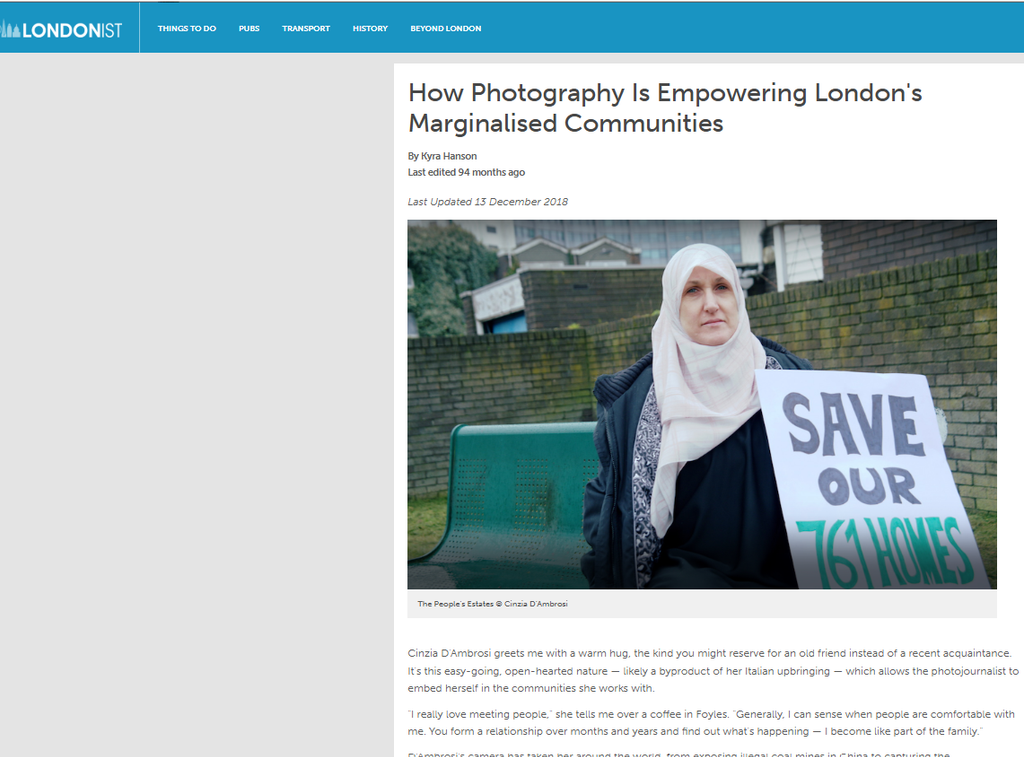
In December 2018, Londonist featured the work of photographer and Photojournalism Hub founder Cinzia D’Ambrosi in an article exploring how photography can give visibility to communities affected by poverty, housing insecurity, discrimination and social exclusion.
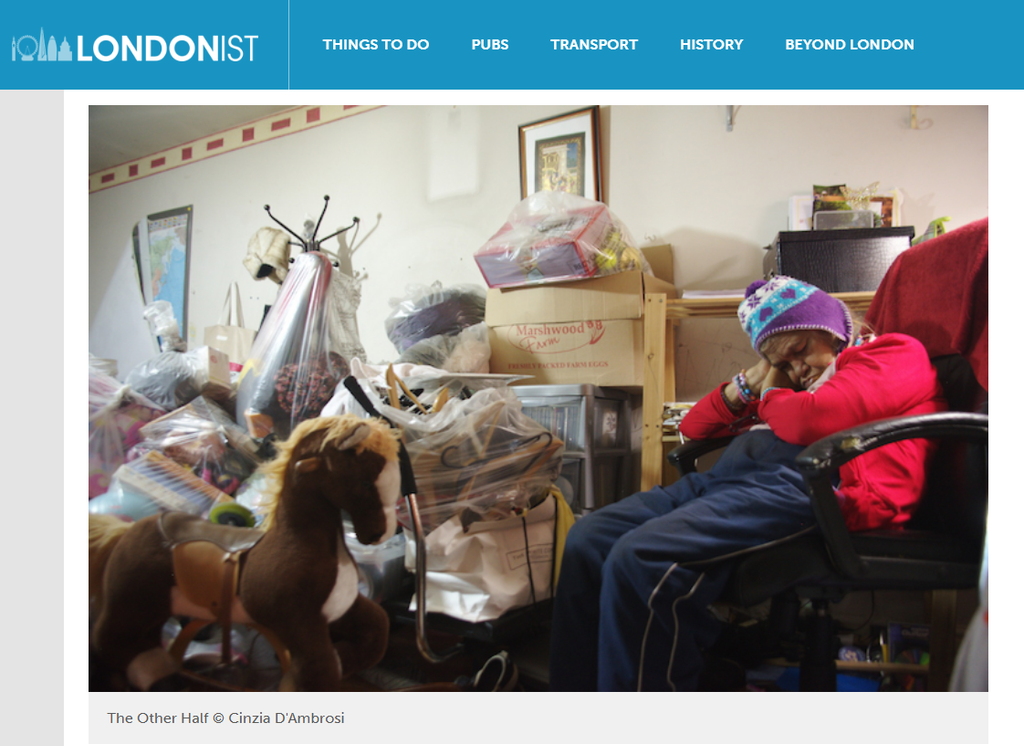
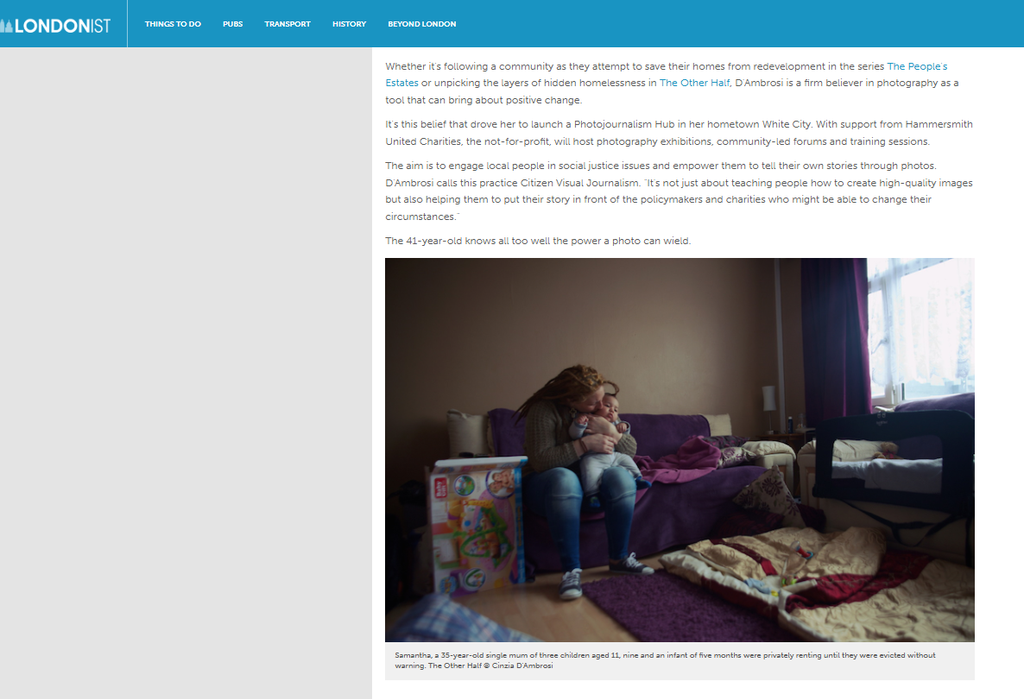
The article focuses on D’Ambrosi’s long-term work with communities in west London, including The People’s Estates, which documented residents facing redevelopment and the threat of losing their homes, and The Other Half, which explored the experiences of people living with hidden homelessness.
It also introduced the Photojournalism Hub, then newly established in White City with support from Hammersmith United Charities. The Hub was founded on the belief that photography can be more than a way of documenting social issues: it can be a way for people to tell their own stories, create dialogue and bring their experiences to those with the power to influence change.
At the time, D’Ambrosi described this approach as Citizen Visual Journalism — using photography to help communities document their experiences and bring their stories to policymakers, charities and wider audiences.
The article also featured Prejudice and Us, a project developed with Protection Approaches in which young people explored their experiences of racism and prejudice through photography and peer interviews. Their work created a platform for young people to share their experiences with police and councillors.
Alongside stories of poverty, displacement and insecurity, the article recognised the resilience, family connections and strength within the communities D’Ambrosi photographed. It reflected an approach that remains central to Photojournalism Hub today: using photography to understand people’s experiences, question injustice and make stories that are too often overlooked visible.
The article was published at an important moment in the development of Photojournalism Hub, documenting the ideas and values that shaped the organisation from its earliest days.
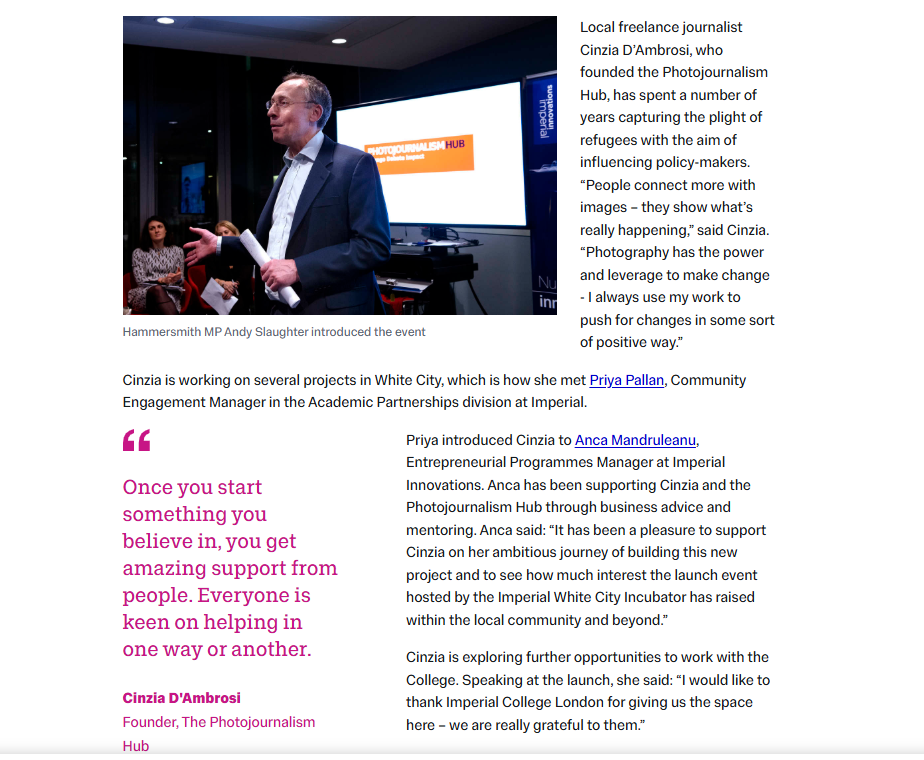
A new community-led Photojournalism Hub launched at Imperial’s White City Incubator this week.
In November 2018, Imperial College London reported on the launch of Photojournalism Hub at its White City Incubator, marking the beginning of a new community-led initiative founded by photographer and journalist Cinzia D’Ambrosi.
Supported by Hammersmith United Charities, the Photojournalism Hub was established with a clear purpose: to use photojournalism to generate positive outcomes for vulnerable communities and individuals, while supporting the development and dissemination of photojournalistic work.
From the outset, the Hub brought together photography, journalism, social justice and community engagement. Its programme was intended to include exhibitions, investigative visual and written content, debates, community-led forums, training and research, creating opportunities for people to engage with important contemporary social justice issues through photography.
The launch was introduced by Andy Slaughter MP, then MP for Hammersmith, alongside local activists, journalists and photographers. Among the speakers was Daniel Renwick, who presented Failed by the State, his film made following the Grenfell Tower fire. Other contributors included Katie Webb of the Writers’ Union of Italy and veteran photojournalist David Hoffman.
The article also introduced Citizen Visual Journalism, a concept developed by D’Ambrosi through Photojournalism Hub. The idea was to enable community groups and individuals to learn how to tell their own stories through high-quality images and to identify and raise social justice issues that matter to them.
Rather than simply documenting communities, the approach aimed to give people the tools to communicate their experiences and reach those with the power to influence policy and create change.
The launch at White City established the foundations for what Photojournalism Hub continues to develop today: using photography and visual journalism to question injustice, amplify overlooked voices and create opportunities for communities to tell their own stories.
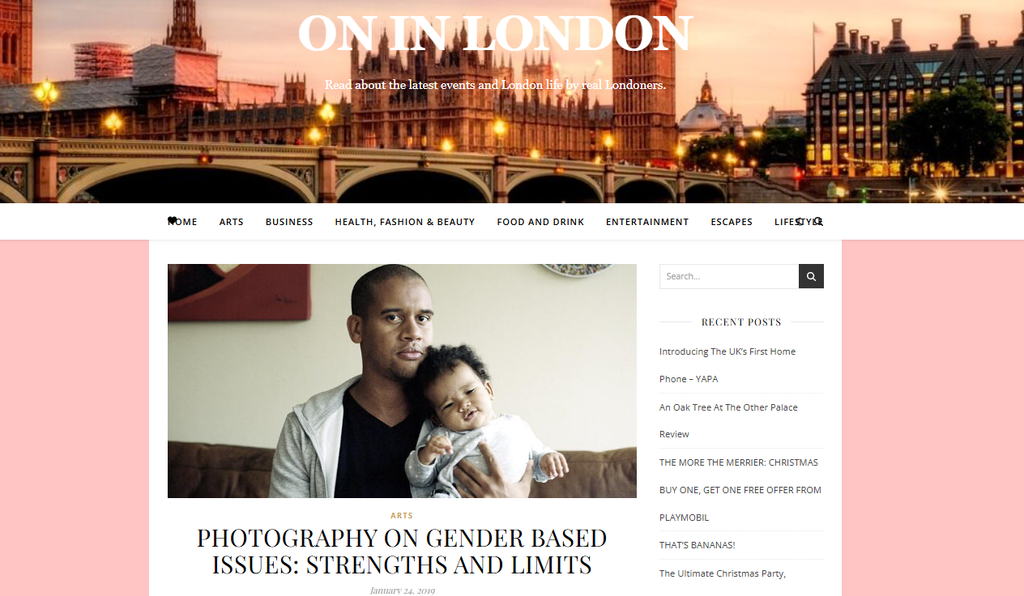
PHOTOGRAPHY ON GENDER BASED ISSUES: STRENGTHS AND LIMITS
ON IN LONDON | 24 January 2019
In January 2019, ON IN LONDON featured Photojournalism Hub ahead of a special event exploring how photography can address gender-based issues and give visibility to experiences that are often difficult to discuss or overlooked.
The event, held at the Imperial White City Incubator on 4 February 2019, brought together photographers working on different aspects of gender, identity and violence.
Photojournalist Giovanna del Sarto and artist Antonia Porter presented their multimedia project Still Figuring Out What It Means to Be a Man, exploring masculinity in the context of South Africa.
Photojournalist Wamaitha Ng’ang’a presented Speak Out, an ongoing project centred on women sharing the stories of survivors of domestic violence.
The presentations were followed by a discussion and Q&A, creating a space to consider not only what photography can reveal about gender-based issues, but also the responsibilities and limitations involved in representing deeply personal experiences.
The article also describes Photojournalism Hub’s early mission: to promote photojournalism focused on social justice and to connect, organise and develop projects and events using photography as a tool for engagement and dialogue.
The event is part of the early history of Photojournalism Hub and reflects an approach that remains central to the organisation today — using photography to question social injustice, create space for difficult conversations and bring underrepresented experiences into public view.
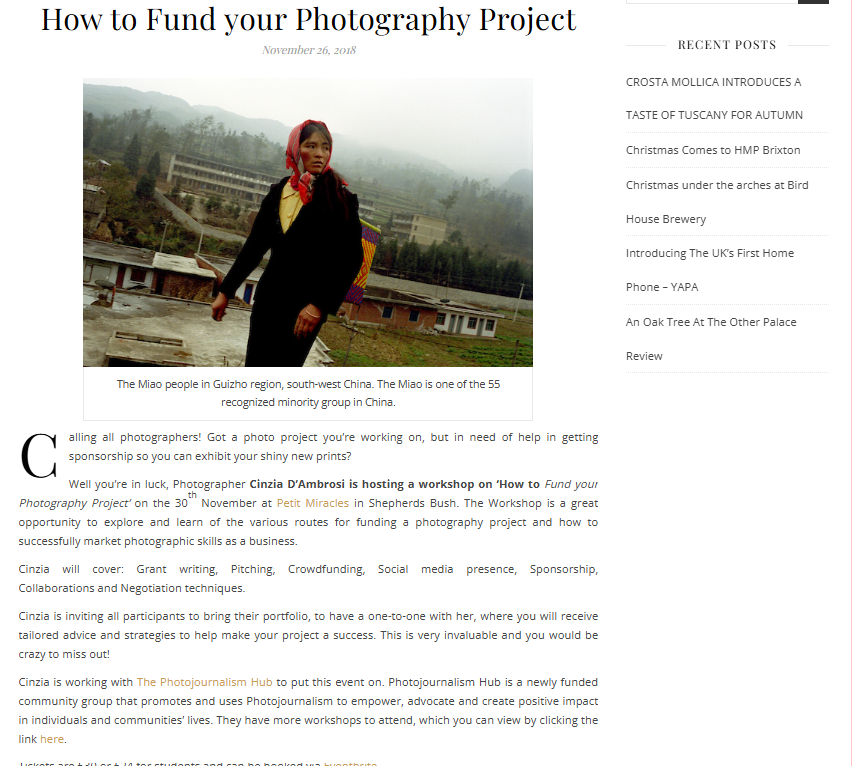
Calling all photographers! Got a photo project you’re working on, but in need of help in getting sponsorship so you can exhibit your shiny new prints?
Well you’re in luck, Photographer Cinzia D’Ambrosi is hosting a workshop on ‘How to Fund your Photography Project’ on the 30th November at Petit Miracles in Shepherds Bush. The Workshop is a great opportunity to explore and learn of the various routes for funding a photography project and how to successfully market photographic skills as a business.
We have invited a number of editors and media organisations to join us in the Photojournalism Nights to offer publishing prizes and media support.
Very pleased to welcome Silvia Pingitore, the founder and Editor-in-Chief of The Shortlisted Magazine , who has offered to select and feature one of the presented projects at the Photojournalism Nights on The Shortlisted Magazine. Silvia Pingitore is a multilingual journalist, novelist and illustrator with three books published nationwide in Italy, her native country. She is the founder and editor-in-chief of The Shortlisted Magazine, the UK’s 1st Independent Career Magazine: nothing but the truth about work and career. The magazine reunites the best international career writers and bloggers, and publishes tips, how-tos, artworks and frank interviews with celebrities such as Giorgio Armani and the winners of the BBC Apprentice, all focused on work and career. The Shortlisted Magazine | Facebook | Twitter LinkedIn
Will Carleton, Founder and Editor of Photo Archive News
We have also asked Will Carleton, founder and editor of Photo Archive News to join as a media partner to the Photojournalism Nights. We are thrilled that he has accepted and has also offered to feature a selected project in their media website.
More on Photo Archive News: www.photoarchivenews.com – Founded and Edited by Will Carleton PhotoArchiveNews.com (PAN) reports editorial photo industry news, jobs and features – daily. The site is read by photo agency and photo library owners and staff, photo editors and creative photo buyers, editorial and stock photographers and photo researchers.
Genesis Imaging has worked for over 20 years with world-class photographers and artists, international galleries, museums, interior designers, architects and individuals across the breadth of the creative industries to deliver a wide range of projects through our diverse range of services.
Designed by the award-winning architecture studio Liddicoat & Goldhill, Elephant West occupies a repurposed petrol station adjacent to the BBC’s former headquarters on Wood Lane. We aim to establish a new model for cultural spaces; neither publicly funded nor a commercial gallery, we support and promote emerging creative practice and build a community of the culturally interested around our programme. The space includes a café-bar, Fuel, and a small shop offering limited-edition prints, books, magazines and associated products. Elephant West programme centres on the Elephant Commissions, projects by emerging visual artists selected and curated by Becca Pelly-Fry, Head Curator. Alongside the central programme, the space plays host to a wide range of events such as film screenings, dance performances, panel discussions, inspirational talks, yoga classes and DJ nights.