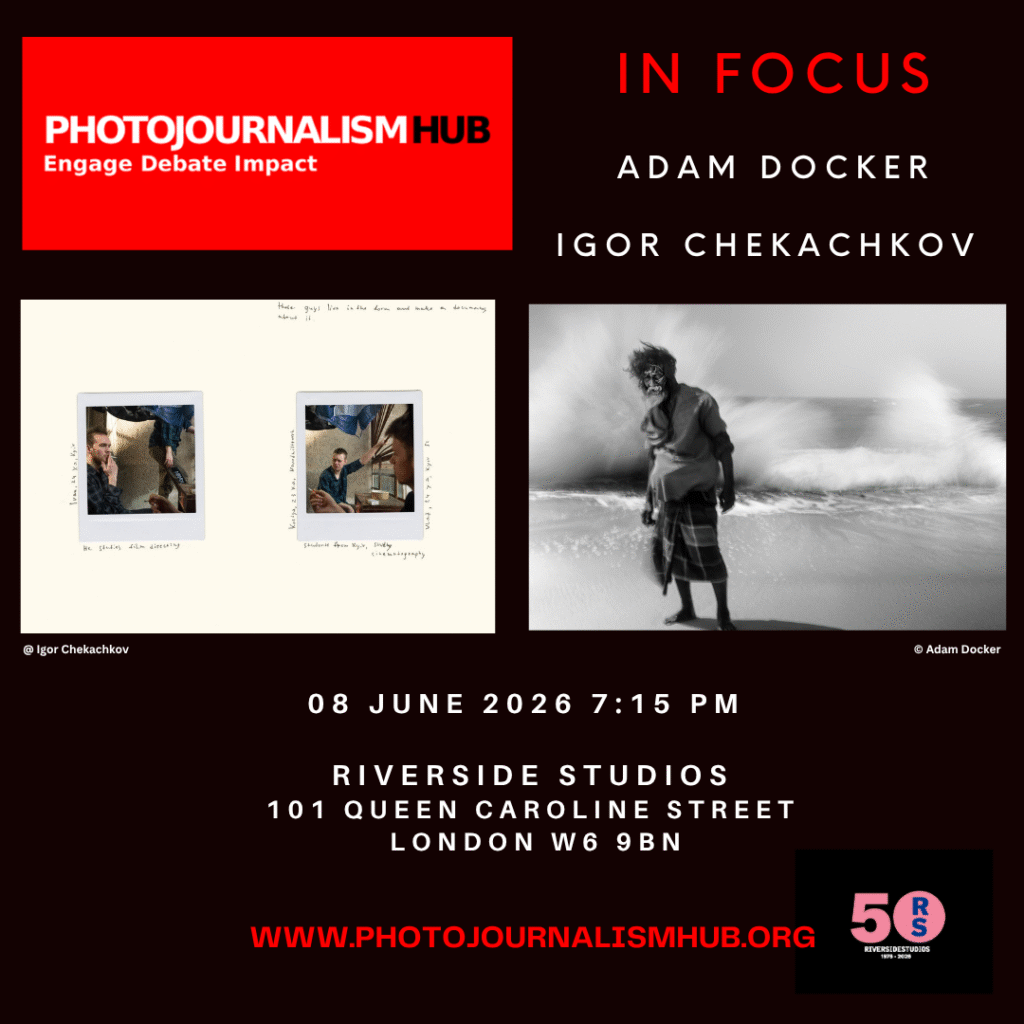
IN FOCUS: Adam Docker and Igor Chekachkov
To book a place: HERE

This June, as part of Refugee Week, IN FOCUS brings together two photographers whose work explores what it means to endure displacement, uncertainty, and survival and the human stories that exist beyond the headlines.
Join us for an evening with Igor Chekachkov and Adam Docker, two photographers documenting lives shaped by conflict, movement, and resilience from deeply personal and unexpected perspectives. Through his powerful project 100 Days of War, Igor documents the emotional reality of war in Ukraine, capturing fragments of daily life, fear, tenderness, and survival during moments of upheaval. His images move beyond reportage, revealing the psychological weight of living through conflict and the fragile humanity that persists within it. Alongside this work, Adam Docker will present photographs made while travelling through refugee camps in Kenya with veterinary teams working on the frontlines of humanitarian aid. His work uncovers a rarely seen aspect of displacement: the vital relationship between people and animals in refugee communities, and how protecting livestock and pets can mean protecting livelihoods, health, dignity, and hope.
Though working in different environments, both photographers ask urgent questions about care, survival, and connection in times of crisis. Together, their work reminds us that stories of displacement are never abstract, they are intimate, layered, and deeply human.
Join us for an evening of photography, conversation, and reflection on the realities of conflict, refuge, and the resilience of people rebuilding life in impossible circumstances.

Adam Docker – is a photographer and cinematographer working across fine art, documentary, and portrait. His work is shaped by a cinematic eye, grounded in instinct, light, and human connection. Based in london but shaped by journeys through more than 90 countries, his photography captures striking human stories, intimate moments, and evocative landscapes from around the world.
For Adam Docker, photography is not merely a visual medium; it is a profound exploration of humanity and culture. his images are a testament to his understanding of composition, storytelling and emotion. Adam grew up between London and Rome, deeply influenced by his italian roots and a large extended family. His father was tragically shot dead when Adam was just ten years old. although they never met, his father’s legacy left a deep imprint and instilled in adam a deep sense of resilience, justice, and identity. these themes form the foundation of his creative work. Fuelled by a childlike curiosity and an insatiable desire for knowledge, Adam has always been fascinated by other cultures, histories, and the ever-changing landscapes that unfold beyond a window. this constant sense of wonder drives him to seek out the unfamiliar, to observe, to listen, and to translate what he discovers into imagery that feels both intimate and universal. “I want to catch something in the act and see how it becomes something else.”
Adam is a two-time winner of the British Journal of Photography’s Portrait of Britain award (2021 and 2025), and recipient of the Portrait of Humanity award (2021 and 2023). His work has also been recognised by LensCulture and The Independent Photographer.

Igor Chekachkov – When Russia invaded Ukraine in February 2022, I was forced to leave my hometown, Kharkiv and go to the West of the country. From the very first day, I began to put together photographs and notes in a small notebook, creating a personal record of war and displacement from the inside. What originally stemmed from an intuitive desire to document my experience of war and uncertainty, developed into something broader: a reflection on the notions of home, identity, and displacement. Whilst the work literally describes the sudden evacuation of my family and the consequences of a brutal Russian attack, it also seeks to question the language of photography itself, and its limitations in documenting, representing and affecting conflict.
This deeply personal visual chronicle became 100 Days of War, a project that explores the tension between memory and documentation, the limits of photographic truth, and the search for meaning in the face of destruction

IN FOCUS is presented by the Photojournalism Hub in collaboration with  Riverside Studios, bringing to the public compelling and thought-provoking contemporary documentary photography and photojournalism.

Photojournalism Hub x Riverside Studios 24th February

24th February 2025, 7 pm
Riverside Studios
101 Queen Caroline Street
London W6 9BN

IN FOCUS brings together two remarkable photographers whose works centre on the themes of community and diaspora, exploring identity, memory, and the cultural landscapes that shape collective experiences.

Myah Asha Jeffers is a Barbadian-British writer, director, photographer and dramaturg. As the previous Literary Associate at the Royal Court Theatre, she was responsible for shaping the works of new and established playwrights. 
Myah’s photographic work has won the Portrait of Britain Prize twice and The Photography Foundation Social Documentary Award. She is the 2024 recipient of the renowned Joan Wakelin Bursary (Royal Photographic Society & The Guardian). 
Her photographs have been featured in publications such as Vogue, The Guardian, The Sunday Times Magazine, ELLE and The Independent amongst others. She has also worked in collaboration with the likes of Tate, Somerset House, ICA, South London Gallery and Whitechapel Gallery.  Myah’s debut short film Bathsheba world premiered at Inside Out (TIFF) and has screened at festivals including New York Shorts, Leeds FF, Norwich FF and Atlanta’s Out on Film, garnering nominations at multiple festivals for Best British Film and Best Director.
Myah’s practice
I am a photographer, writer and director, particularly interested in witnessing and documenting the nuances of daily life within diasporic communities. My practice is conceptually focused on ‘Black Interiority’, where I closely examine themes such as class, cultural identity, queerness, grief, gesture, and truth. Working solely with small & medium format analogue cameras and darkroom-based hand printing processes, the work is particularly concerned with the intersection of “naturalism” and “myth”, through illuminating the magic of rituals, quiet, and connection. With a focus on the (in)tangibility and truth of grief / its relationship with what I call “living abstraction” – where Black folk sculpt or construct versions of themselves as a tool for survival;  I aim to make work that lends itself to abstraction through the experimentation with form, monotone, texture, and structure.
Exclusion Zone.
I’ll be presenting a first preview of my most recent project, Exclusion Zone supported by the Joan Wakelin Bursary and the Visual Studies Workshop Artist Residency. In 1995, a series of seismic Volcanic eruptions rendered two thirds of the island of Montserrat uninhabitable, catalysing a mass exodus. With now only 20% of the island deemed habitable and a current population of just over 4000 people – Montserrat is one of the least populus countries in the world. It also happens to be one of the few remaining British colonies. The uninhabitable 80% of the island is known as the “Exclusion Zone” – a site of buried infrastructure, homes and memories. It is both a graveyard for relics of the past.
This photo series explores the legacy of the natural disaster 30 years on; through the lens of both elders who are nostalgic of what the island was and young people who only know the island for what it is today. 

Paulina Korobkiewicz (b. 1993, Suwałki, Poland) is a London-based photographer and visual artist. Her work explores themes of cultural identity, memory, and the transformation of social spaces. Her projects focus on the visual and cultural landscape of her hometown and region as well as that of her current residence in the UK, documenting everyday scenes and environments with a sense of nostalgia and socio-political commentary, drawing from her own experience of migration. Her practice involves community-based research, conducting workshops, and mentoring. In addition to developing long-form personal projects, Paulina continues to undertake commissions and residencies.
She has participated in several group and solo exhibitions internationally. Her work has been featured in a variety of publications, such as Hapax Magazine, Kajet Journal, Contemporary Lynx, Photomonitor, the BJP, and Creative Review. Paulina is a winner of the Camberwell Book Prize, has been shortlisted and nominated for awards including BarTur Photobook Award, Magnum Graduate Photographers Award and Prix Pictet.

BECOME A PJH MEMBER
Consider becoming a member of the Photojournalism Hub. Your support will enable us to continue our work promoting photographic work that expose, raise awareness of social justice issues. To learn more how to become a member and the benefits of joining, follow the link HERE