The Photojournalism Hub Calendar 2026 showcasing the incredible work of photojournalists and documentary photographers who have contributed to our mission.
Please join the live stream of the Photojournalist Hub fifth edition of the Photojournalism Nights with an amazing line-up of photographers: Marco Longari, Neeta Satam, Julie Huang.
The Photojournalism Nights is an event that promotes committed and courageous photojournalism and engages the public to social justice and human rights.
The Photojournalism Hub presents a Live Stream of the 7th Edition of the Photojournalism Nights.
Please join the live stream of the Photojournalist Hub seventh edition of the Photojournalism Nights with an amazing line-up of photographers: Igor Coko, Kirsty Mackay, Paul Iwala.
Igor Coko, photojournalist and street photographer based in Belgrade and editor in chief of Grain photo magazine that showcases street and documentary photography. Igor will be talking about his latest photo book Life in limbo, the experiences of migrants and life inside prisons in Serbia.
Kirsty Mackay, award-winning social documentary photographer, born and raised in Glasgow. She will be presenting The Fish That Never Swam that considers class and discrimination against working-class people. Combining first-person narratives with photographs, it takes Glasgow as a case study, looking at the root causes for the city’s poor health and low life expectancy. This ongoing work will be published as a book in 2021.
Paul Iwala, is a London based photographer. whose work spans for over 20 years covering news, street photography and fashion, which carries no commercial freight, but presents raw and powerful images with a political tow.
The Photojournalism Nights is an event that promotes committed and courageous photojournalism and engages the public to social justice and human rights.
The fourth issue of Wondering about West London? presents photo stories and street photography on Christmas and Winter Holidays with London in full lockdown as […]
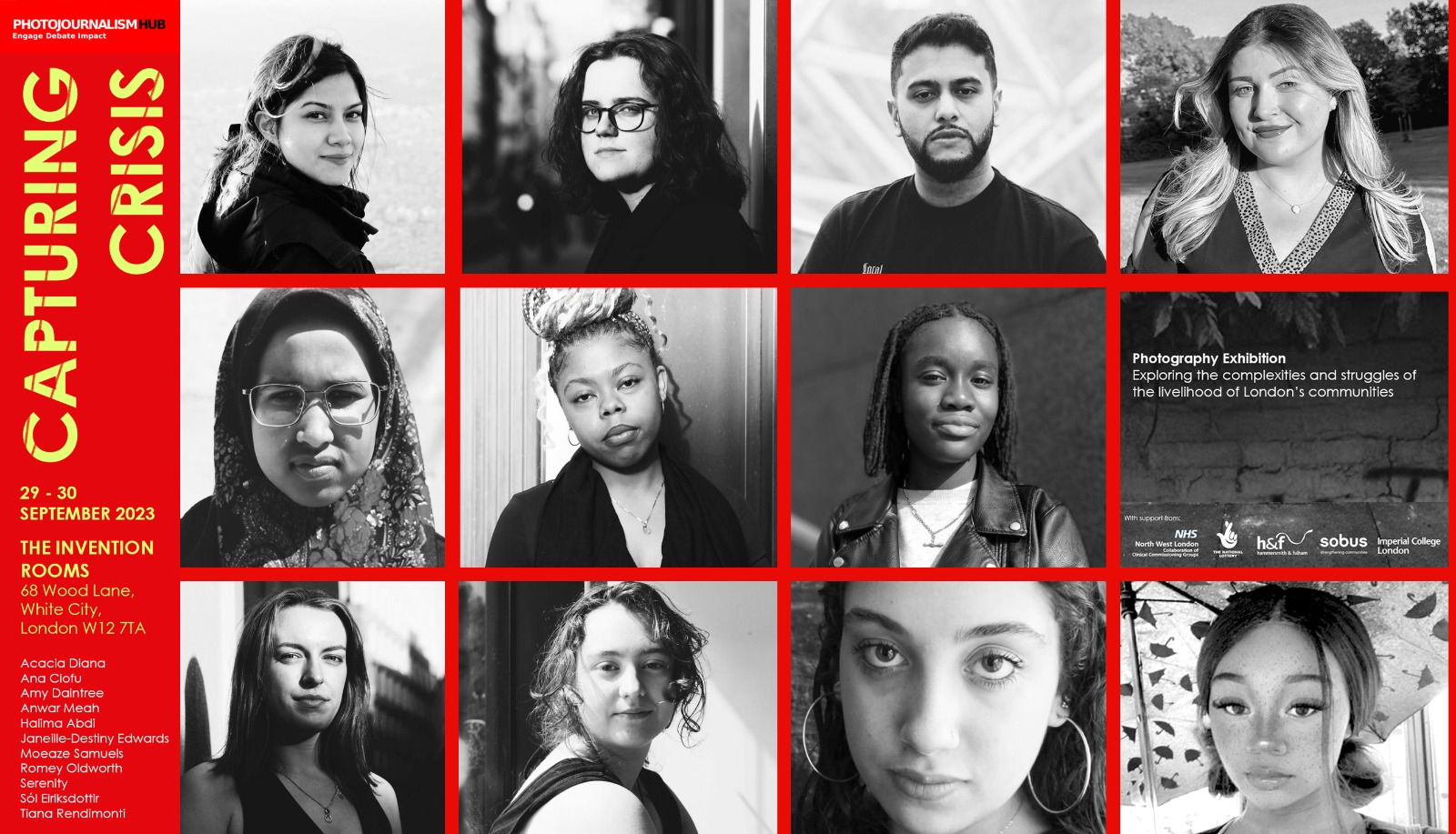
We are incredibly pleased to present the third edition of 'Capturing Crisis' photography and reporting magazine produced by the group of youths of the 'Stories, […]
We are incredibly pleased to present the fourth edition of Capturing Crisis photography and reporting magazine produced by the group of youths of the 'Stories, […]
I am incredibly pleased to present the fifth edition of Capturing Crisis photography and reporting magazine produced by the group of youths of the 'Stories, […]
In this new edition of ‘Capturing Crisis’ youth photography magazine, we present a special edition on a local coffee shop to learn of its championing […]
Photojournalism Hub presents Why shop small business? – the latest edition of documentary photography and writings from our local young and senior participants of our […]
Photojournalism Hub presents What home means to me – the latest edition of documentary photography and writings from our participants of our documentary photography workshops. […]
The Photojournalism Hub is proud to present the latest edition of documentary photography and writings from our workshop participants. This issue focuses on the theme […]
Presenting the latest magazine on Sustainability produced with participants of documentary photography and photojournalism course with the Photojournalism Hub. […]
The third Photojournalism Nights event guests speakers Jillian Edelstein, Roland Ramanan, Valentina Schivardi answer questions posed from the audience on their work and practice. Their answer lead us into their journey of resilience and commitment in voicing stories of prejudice, injustice and poverty.
From Sabrina Merolla : Well, you say you are not a photojournalist, but you are showing a stunning example of long-form traditional documentary photography. And the method you described, plus the interviews, make me think of serious socio-anthropological research perspectives. Out of curiosity: what do you teach and what kind of formation do you have? I would certainly say that I am working within the long form documentary tradition with people like Eugene Richards being a big influence. Richards was a social worker and I am a special needs teacher. I started as a primary school teacher and now I work with a local authority advisory service. I think this gives me a certain training to be able to work with people, empathise and present my ideas.
Really powerful stories and you have shown them all as whole human beings without judgement. You obviously gained their trust, how did you establish consent?
I establish consent by showing them honesty and trying to be clear about what I am doing. That was not always easy and I had set backs. A piece about my work in the local newspaper (which I thought was written sensitively) damaged my relationship with some individuals for a long time. I have more or less given up on trying to get formal written consent, I think it establishes more barriers than it removes. I try to show the work as its developing as much as I can practically can. At the start of the project I didn’t really know what my aims were, now I can be much clearer with people what I’m trying to do and that really helps to build trust. That, and just being there; relentlessly!
Roland, how do you feel about the work now and how do you see the work evolving or is it now finished.
Well, its not finished in terms of becoming a book. I have this on good advice from my mentor and others I trust so I need to keep working and thinking about different angles. Sometimes, nothing happens in the work and I get very down and frustrated but it just takes one good picture to lift my spirits. Just being there and hanging out for hours is something I find gets harder but its what I need to do. You need to find new angles to generate different situations. So at the moment , that means going to the foodbank/church and joining there – once it starts up again. That may lead to other things like photographing a baptism which would be amazing – tantalisingly now just out of reach. But I’m in no particular hurry.
Very interesting work but there are some ethical issues for me when photographing vulnerable people. Do you make people aware of the fact the photos are being made public? Do you get model release forms from people?
I did worry a lot, previously about model release but I don’t need it for a documentary/art project. It is non-commercial use. In the end, you simply have to demonstrate your own integrity and question your own motives over and over again. No model release is a substitute for that.
Roland Ramanan’s compelling image of Nina from his powerful ‘Gillett Square’ series is featured among other great photographers in Paul Sng’s This Separated Isle photobook, which is currently being crowdfunded on- https://www.kickstarter.com/projects/invisiblebritain/this-separated-isle If you can, please support this photobook of stories and portraits exploring concepts of identity in modern Britain.
How did you protect yourself from the trauma of these stories?
I think it was hard for people to see people (mainly men) who had performed unspeakable acts and atrocities, walk free …but the concept of forgiveness espoused by Tutu, Mandela allowed that to happen. It is to be commended and admired. It was a powerful ‘tool’ to call upon, to draw out, to involve many victims of human rights abuse, torture and conflict. The fact that it happened was remarkable. It helped. It may not have healed but it was powerful in the transition process. I don’t think it ever hoped to turn things around overnight. The compromise is that it is human fragility, survival , emotion at stake ; sadly we don’t seem to learn from history.The after effects of Apartheid and it’s ugly legacy will be felt for decades to come.I was lucky enough to be able to ‘come and go’ as I had my work, my family life in the UK, so being able to leave it, feel a certain distance from it and then later revisit the horror of it intermittently was an enormous saving attribute.
Excellent thanks! How long did you document their ceremonies and are you still in touch with the community? The first ceremony was back in 2009. Yes, we are still in touch – I’m still working on this project.
Just wondered why the men in this community were not featured so much in the photos?
I guess because women are more photogenic. I’m just kidding. Actually, there were more men than women featured in the editing I showed.
Is the project ongoing? what’s next?
Yes, it’s an ongoing project. I’d love to make a book next.
When you were working on the project were you thinking about making photographs for them at the same time as making pictures for yourself? Did you take different approach for these?
This is a very interesting question for me. Yes, when I’m working on this project I think about both taking pictures for them as well as for myself, which can be tricky. Luckily, it’s been clear in my head since the beginning: I was able to start this project because I was hired to take photos for them. This allowed me to find a point of entry to their community. When possible, I work with an assistant, to make sure that he/she can cover the event for them, so that I can focus on my own project.
Given that the subjects seemed very keen to pose, did you capture moments where subjects had their guards down?
Oh yes. This is a question I had in my head since the beginning. What makes a photograph a more authentic and honest representation of someone? On one hand, it’s fascinating to see how my subject is very conscious of the camera. There’s something very strong about the way they always seem to know exactly how to pose. On the other hand, I’m also interested in showing how contradictory and much more complex we can be, by trying to capture my subjects off guard.
Oh yes. This is a question I had in my head since the beginning. What makes a photograph a more authentic and honest representation of someone? On one hand, it’s fascinating to see how my subject is very conscious of the camera. There’s something very strong about the way they always seem to know exactly how to pose. On the other hand, I’m also interested in showing how contradictory and much more complex we can be, by trying to capture my subjects off guard.
The fourth issue of Wondering about West London? presents photo stories and street photography on Christmas and Winter Holidays with London in full lockdown as well as article with Rosie Whitney-Fish, Founder and Chief Executive of DanceWest, and wonderful illustrations.
Wondering about West London? Issue four is sadly our last edition for the time being. As the Editor in Chief of the magazine and project manager and facilitator of the project, I would like to share my feelings of awe at the determination, initiative and creativity demonstrated by the participants. The zine has shared meaningful, resourceful, and touching content from a youth perspective. I would like to express my thanks to our editor Laura James who has worked on the layout of the zine and to W12together for supporting this worthwhile project – Cinzia D’Ambrosi, Editor in Chief.
As Coronavirus continues to spread throughout the world, it is increasing social injustices and bringing inequalities to the forefront. In this fifth edition, documentary photographer David Gilbert Wright shares the touching photo story of Paul, a homeless man who he became friends with during the current pandemic. This photo story highlights the impact of years of austerity on the most poor and exposes the further impact of the outbreak on them. The story of Paul speaks of the many which were already at the receiving end of funding cuts and support and they now in a lot worse conditions. These are issues we need to see, reflect upon and action.
Homeless and Locked Down Paul’s Story
by David Gilbert Wright
It was springtime, and the weather was beautiful. The skies had been clear for several weeks and the sun had been warming up the earth. But this was no normal spring. England was in the grips of an unknown pandemic and the Government had ordered a lockdown. Everyone but a few, were staying home. Buses and trains were empty, roads were empty and we were all trying to adapt to a new way of living. Rules about when you can go out and for what were in place. The population were being ‘frightened’ into believing that hundreds and thousands would catch this new virus and many would die. I was out walking the dog in nearby woods when I came across a tent pitched deep in a thicket, out of sight. I was intrigued. It took several more days before I plucked up the courage to investigate. That was when I met Paul. He was homeless and living in these woods. He was locked down too! Over the next 3-4 months I got to know Paul and he is the subject of this story.
Paul is 52 years old. He had a brother who died in his forties and a sister. He told me that his Mum left home when he was 15 years old. That was the start of things. “I left home and came to London. London was a terrible place back then and being homeless was very dangerous. I was sleeping rough when some one picked me up and took me along to a kind of hostel. You had to ‘book’ a night and then get out in the morning. I think they felt sorry for me and gave me a job sweeping and cleaning the rooms. That saved me. I lived in a house in Thurrock at some point and had a sort of job. I had to go sick and so I lost that job and couldn’t pay the rent so they evicted me. I have been on the move ever since. I don’t like towns. They are too scary. I decided to get a tent and live out in the country somewhere so here I am”. He got up and started to make a little fire. “Now it is warming up, the midges are starting to get on my nerves so I light a fire and the smoke keeps them away” he said laughing.
Paul often walked up to the town. He had broken his hip some time in the recent past and suffered from terrible sciatica. “I have to take pain-killers” he told me, “so I come up to the chemist every week or two to get me repeat prescription. Trouble is, people try to mug me and take my drugs”. We sat for a while in the warm sun and then this woman came along. Her name was Lizzie. She told me that she was what some call a ‘sofa-surfer’. “That’s someone who is homeless and manages to get a place to sleep in someone’s house.” She was in her 50s and had been homeless since the breakdown of her marriage. She was very guarded but alluded to being badly abused and beaten by her partner until she couldn’t stand it anymore and managed to escape. She had several grown-up children and managed to see them occasionally but she also was living a hard life. She told me how difficult it was in the winter. ‘We both try to find something a bit more permanent if we can because you can freeze at nights’ Paul told me.
We were talking in his encampment in the woods one day and he started to tell me about his Faith. It surprised me somewhat. He rummaged around in his tent, beer can in one hand and pulled out a book. It was the Pilgrim’s Progress by Chaucer. I see myself as a kind of pilgrim, always on the move. I am like the guy in the book, in search of something. It is something I can identify with. He rummaged a bit more and pulled out another book. “This is my Bible”. He said “I pray everyday. I try to speak to God. I think He loves me despite my faults. He loves me unconditionally. He does not expect me to change. I feel he forgives me for all the stuff I have done. He is my rock. Later that morning, we were walking up to the town together and he started reciting the Lord’s Prayer.
I asked Paul what he did for food. He told me that he visited a food bank in Brentwood. He told me where it was and I realised that it must take him nearly an hour to walk to it because he was very slow, due to his arthritis and needing a crutch to help. “They are very good and deliver stuff to me sometimes”. The food bank only opens twice a week between 10 and 12 midday. Paul was not usually an early riser. I often got to his tent mid-morning to find him sound asleep. “Jem looks after me. He will always open up if he is around”. So one afternoon we set off on the walk to the Food Bank. We talked about all kinds of things as we walked. Steve was the priest. He found a whole lot of food and Paul was so pleased with the large tin of assorted biscuits, like you get at Christmas. It was then that I realised first-hand how important these food banks are to people like Paul.
“I used to have another guitar but when I stayed a night with this woman she stole it and sold it for 5. Probably spent the money on drugs. Someone gave me another one then a bloke grabbed it off of me. I chased and tracked him down to this shed and got it back. Thing is, the E string was broken, that’s why I haven’t managed to replace it yet. I do a bit of busking to earn a few bob. I like Reggae and Punk and usually do a bit of both or improvise”. He started strumming something with a reggae beat and then sun along. He was making the words up and they were about him and his God or ‘Jah’ as he liked to call Him. On another occasion, we were walking past a charity shop and he saw a violin in the window. He went in and persuaded the assistant to let him try it out. Clearly, Paul was musical. When he came out, I asked what he thought of the violin. “The strings on the bow were all frayed so it was not a good bargain”.
“Some guys came to my camp one night and tried to rob me. It is very dark here in the night and they didn’t have lights. I am pretty good in the dark because I know where everything is. I managed to roll away into the undergrowth and just hide. They couldn’t find me and got very angry. I heard them say something and then heard a ripping sound. Once they had gone I discovered they had ripped me tent. This isn’t the first time” he said pulling out a roll of Gaffer Tape and starting to repair the ripped canvas. Camping out in the woods his not such a halcyon existence!
As the days wore on, I noticed Paul’s demeanor change. He didn’t seem so happy-go-lucky. At one point in June he disappeared for a couple of weeks. He had a phone but often as not, he had no credit or it the battery was flat. Out of the blue, I got a call from him. He told me he had been in hospital. I asked what was up and he said “I have been feeling very low and things got to much and I tried to top me self”. He told me he was being transferred to another hospital and hoped to be out soon. I went by his camp each day to check on things and one day I found him asleep in his tent. He was out of food so I went with him to the food bank. Jem was just leaving but when Paul told him about his illness, he agreed to open up and give him some supplies. Jem went off inside and we sat out in the sun. Paul was sitting very quietly waiting. I couldn’t help seeing the picture in front of me. Here was someone who really needed to talk.
While Paul was in hospital his tent got vandalized again. “Someone slashed it again” he said. I told him I had seen a bunch of teenage kids riding around his camp. “All me stuff got soaked cos the rain came through the whole” he lamented. Paul looked like a shadow of the man I had first met. As we sat quietly, he hung his head and said “I’m not happy, I don’t like living like this. People think I’m happy but I’m not.” I could see he had tears in his eyes. He looked up to the sky and shouted “This is not Heaven!” It was then that I realised that he yearned for the safety and security of a home and a family that many of us take for granted.
I saw Paul several more times then he disappeared and I never saw him again. I don’t know what came of him. All I do know is that when I went back to his camp one evening, I found that his tent had been pulled down, poles broken, bedding scattered around and his clothes flung into the surrounding bushes. Then I spotted his guitar or what was left of it. It was completely smashed up and the pieces were strewn around near what used to be his campfire. But that wasn’t the thing that really got me! As I looked around I noticed something white under a bush amidst the leaf mold of the forest. I went closer and realised I was looking at the discarded copy of his Bible. It was open at the penultimate chapter of the New Testament. It is about Jude, who was also a traveler. He went from city to city spreading the gospel. His name was Judas but has become shortened. He was a living example of faithfulness to Jesus Christ, in contrast to Judas Iscariot who betrayed Him. The picture of the Bible, its pages dirty, crumpled and tattered is a poignant ending to this story about someone who was also ‘discarded’ and homeless during the Lockdown.
If you have work which highlights the social injustices that are being intensified or laid bare by Covid-19 please submit your work to the Photojournalism Hub. Next deadline is the 4th January 2021. Please submit your work to Cinzia D’Ambrosi, cinzia@photojournalismhub.org Further details on how to submit on our Submission page https://photojournalismhub.org/contribute-submissions/
It is with great pleasure to present the 6th issue of JustZine magazine and with great sadness to announce that this is the final issue under the Photojournalism Hub ‘s Mayor of London Culture Seeds support. In JustZine Issue 6 we focus on protests. It is an open interpretation on this topic, because protests which have become more and more embedded in our societies, can take many forms, from personal change, activism, to protest for our ideals or personal goals. Acknowledging protests summarises the diversity of the challenges that we face in today’s world. Contributors have shared articles and photo stories responding to the theme and shared coverage of protests, activism, the people behind them and shared their personal protests. In this issue, we also present the wonderful contributors to the project and let you discover a little of their lives through their profiles. The young reporters, photographers, poets and artists behind the courageous, committed and honest journalism have a showcased profile produced by young photojournalist Fatima Sanchez who put forward initially the idea, and passion in producing these. As the chief editor of the JustZine, I am very proud for the commitment, talent and drive demonstrated by the participants of the ‘Youth Zine West’ project run by the Photojournalism Hub, who produced this issue. I would like to renew my thanks to our founder the Mayor of London and the Culture Seeds team. This has been an amazing and enriching experience for all of us, and we sincerely hope to find means to continue sharing local stories. – Cinzia D’Ambrosi, Editor in Chief
As Coronavirus continues to spread throughout the world, it is increasing social injustices and bringing inequalities to the forefront.
In this fourth edition we show you two strong photography contributions. Firstly, Erhan Us shares a powerful insight into women’s lives and the harm that is inflicted upon them by patriarchal family structures in Iran which is being exacerbated during the pandemic. Secondly, Jo Fountain shares interviews and photographs that focus on the pandemic’s impact upon communities in Manchester.
These are issues we need to see, reflect upon and action.
Mummy
By Erhan Us
‘The Mummy Project is created to criticise the ‘ornamentation’ and disidentification of women in Iranian society that have their freedoms and preferences exploited. Since lockdown, I wanted to raise awareness on the harm patriarchal family structures incur onto women’s identity and equal rights.‘
About Erhan
Us is a conceptual artist and author. After studying at Bilkent University in TH Management; he was granted to 25+ local and international / honorary awards. He has participated in 70+ exhibitions in 20+ countries. He continues his studies in Sociology & Philosophy at Istanbul and Anadolu Universities. Us is a member of Photographic & Visual Arts Federations, whose book ‘Digital Prestige’ was published in 2018.
“It is true that this world where we have difficulty breathing Now inspires in us only evident disgust A desire to flee without further ado And we no longer read the headlines” A Disappearance by Houellebecq
‘This photo project aims to break down social barriers to reflect how people have stood together as a community during this time despite extreme isolation. It allows us to see the common threads of human experience and within this highlight inequalities and injustices amongst us. There is a power of support and acknowledgement that this is a shared responsibility. We stand together to create our own narratives. The portraits have been collected from around Manchester in the UK and with an open brief people were asked to write messages and signs to summarise their experiences or give words of support out to the world. The response has been varied, highlighting familiar phrases, funny, invites protest, politically charged, esoteric, others personal. Accompanying the portraits are interviews collecting oral histories of personal experiences and issues that have been highlighted such as effects of isolation on mental health, issues with state support responses, social care, lack of funding, and prejudices that have been brought to the foreground to be questioned.
Overwhelmingly people have struggled with the constant and crushing weight of relentless news stories covering daily atrocities and global crisis. There is a network of support around you if you look for it and take part. The window acts as both a lens and a reflection on the messages that have been created. It highlights the power of the word, graffiti, and protest banners. Even in simplified language, and sometimes especially, there is a re-narration of our view of the world.‘
Meave’s Interview
Meave Cohen
It’s been awful. Just fucking awful. I’ve had many conversations with people and they’re like “I don’t think the pandemic’s been that bad. I’ve been able to think about me and do my yoga and do my music and do my cooking and I’m like fuck you. Tens of thousands of people have died. Fuck you. I’ve absolutely hated it. I genuinely thought I would never see my mum again and that was awful. I’ve not been able to see my niece, like, see’s only a week and a half old but … my brother wasn’t even in the same fucking hospital when his baby went blue. It’s been fucking awful.
It’s been really tough with my mum but even that’s loads better now. Since we’ve been able to see her she’s been loads better. We can’t ‘see’ her, see her, we can just see her through the glass but now that she knows we’re alive I think she’s … I rang her yesterday. So when you ring her you sing songs and sometimes she would join in and sometimes she doesn’t. But yesterday she was singing all the songs and then she made up a little song. She made up this little melody, so I finished singing a song and she just kept singing this little melody she had made up. Adorable. We’re four of us, she’s got four children and we’re all really engaged with her care and really engaged with all of it…. old people with Alzheimer’s I can’t imagine, like millions of people would have died of loneliness.
My friend has got a chronic lung condition and he’s gonna get a letter through the door soon saying it’s OK, you don’t have to shield anymore. He isn’t going to go out the house. If he gets it he will die. So he’s going to loose his job now because the government said he can work now, but he can’t work. They are just not able to test or trace where anything is so you are having these local flare ups like Leister is in lockdown again. Apparently Bradford is really bad and fucking nobody knows what’s going on because they never managed to get rid of the virus anyway and they can’t test for it, or trace for it in the way that would be useful because they’re fucking useless. So people like him will just never be able to leave the house. Or, when am I ever able to give my mum a hug? Children died, children died on their own, it’s awful. Then you’ve got fucking Dominic Cummings driving up to Durham. It’s just awful. People died alone, people couldn’t hold their dying children. I’m working on this local economic… it’s called Local Economic Development but it’s basically how local authorities shape their economies. It’s called Community Wealth
Building, and the whole idea is retaining and creating wealth within the communities. So right now we have a model, for example, if a hospital got it’s laundry done by a local supplier instead of say, Serco. That wealth goes back into the local area, so that local people get employed to do that work and they then spend their money in the local shops and cafes.
In my opinion they should have had lockdown much earlier than they did. Not like you can go out one exercise a day or… like all of that shit that was completely un-policeable so everyone is just doing the fuck they wanted. Obviously we don’t have a fucking police force because they cut that to shit so they had no-one to police it anyway but .. got rid of the virus then we could have had a gradual easing of the Lockdown.. But because we didn’t really lockdown hard enough and we definitely didn’t lockdown early enough we’re in this kind of semi-lockdown, until when?
This is a crisis of globalisation. This crisis basically means the end of Globalisation because it was able to travel so fast and because when trade ceased and when the borders closed, Britain in particular was in a real problem because we don’t have places that produce PPE or places that produce hand sanitiser and we had to mobilise our industries to try and create these things and we had mass shortages. This is why the supermarkets ran out of food. Instead of having spare stuff to sell it’s as and when you need it, and we’re gonna have to move away from that model. Basically we have to make our supply chains much smaller to be able to cope with things like this. People are making tonnes of money out of this it’s perverse. So people that already have money can make more money but people that have no money are just fucked.
The entire world is in transition and transitions are very unnerving and we have no idea what the other side is gonna look like and it’s incredibly anxiety inducing then on top of that hundreds of thousands of people had died. And you read things like today the US has bought up all of this specific drug. It’s not a vaccine but it’s basically like right well so… Africa can just die. India can just die. Europe can just die. So the way that patents work is that you make money out of curing diseases, which also applies to pandemics. It’s just fucked. So you have to disengage a bit, I think.
Pete’s Interview
Pete Keeley
“I was freaking out because I couldn’t get any food, and it was like what the fuck, how am I going to do this!?
I stick my foot out of the window with a bucket on a string and wait for attractive ladies to come and give me food. But I’m still waiting for them man! I’m starving!
I joke. Dad dropped some stuff off and my mate Mark came with 4 big bags of stuff and I ate chicken boob for about 25 days. The government food package took about 3/4 weeks. I could have dropped dead in that time if people hadn’t have been there. It was pretty nuts. For a lot of understandable reasons people have been very critical of the governments response, but once this food thing was started it was incredible the way that they were getting through to people like us. I got a letter from the the doctors saying that I needed to shield. The way it effects Cerebral Palsy is that even when I get a cold, if I start coughing, my whole body shakes and I have to hold on to something to stop myself falling forward. My body kind of goes all over the place. I think they said that I was okay to calm me down because I was freaking out.
The next thing was, you need to stop yourself going mad, and work, like I say I’ve not worked since 1997. I would have gone super loopy without writing for theatre. That, and I have been making Grandmaster Pea videos. A character I had developed before, who claims he is the Tsar of the disabled, although he is self-appointed.
I kind of felt that there was something coming and I needed to be more safe than other people. I got this feeling and I just shut the door and that was it. That was 3 and something
months ago. I would say that lockdown has been difficult. Just trying to keep yourself going. Once you’ve found a way of doing that, it’s okay. It was worse for me because I lost my Mum as well. She got ill last September and died just before Christmas and dealing with that has been tough. It wouldn’t really go away. I was really close to her and you know, she doesn’t leave me, but that doesn’t stop you missing somebody. It’s a weird acceptance but also hell.
My twin brother is in a residential home which has had people with Covid in so that’s been a concern, but I’ve been phoning and face timing him and he’s fine with being shut in because he is on a bed a lot of the time. It’s kind of normal for him. He has the staff and he has some connection. It is terrible, I’m not saying it’s great, but what I am saying is that in terms of my brother, he doesn’t come out of his room much, he watches TV so it’s been a different experience for him because we cannot visit.
They had the problem like a lot of people, where they couldn’t get PPE, and so thats the other thing about Grandmaster Pea as well, I gave some of the videos to a comedy night to help raise money for actors who needed food. That was good, I felt like I was doing things for other people, at a time when I felt like I couldn’t do anything or help. As a
disabled person, you don’t actually get the opportunity to give back to people. This was a time when I could do that.
I also gave money to the NHS in Mums memory, because she was a midwife, and quite complicatedly she was a midwife, and we were born on the ward she ran. She had brought many babies into the world and saved them from the fate that me and Christopher were not saved from. She always blamed herself I think. We had conversations about it, I think she wanted to be working and giving birth at the same time. I think she felt guilty, which she shouldn’t have done, but I think that she did, bless her. Unfortunately the NHS let her down a number of times. So, that was difficult because everyone was clapping and I was angry and annoyed, but I still gave money to them.
When she died she wasn’t treated well, they made what was a very difficult situation worse. They said under no circumstances can you move this woman as she won’t be able to walk, and that’s what they did. It’s really difficult to process that kind of brutality. I mean this is a woman who gave years of her life caring for people. She learnt Arabic in the early 70s and felt that people should be understood. That was the incredible thing about her. What killed me, was she was that compassionate and helped people and that’s how the
NHS sort of thanked her for it. So I have a really weird relationship with them. I mean when the thing with PPE happened I gave money to that immediately. A big chunk of money, not that I’m a millionaire but I felt it was important. The idea that people were risking their lives to save other people, it’s an amazing thing that people wanted to do that, and that they were brave enough to do it. The idea that they were not being given the support was just disgusting”
Pete
Jag
Claire Mooney
To keep up with the story, or take part please visit lockedinlight.com or re-post your own using the signedtimes hashtag. Extend perceptions, deepen resonances, reinforce connections. Jo’s has a background in Visual Anthropology, oral history and photojournalism.
If you have work which highlights the social injustices that are being intensified or laid bare by Covid-19 please submit your work to the Photojournalism Hub. We will be adding a dossier page on a monthly basis. Submit by October 30th to be included in the next dossier.
The fifth issue of JustZine magazine presents photo stories and articles that cover pressing and important social justice issues from Environmental and Climate justice, to stigma surrounding women periods. Contributors have shared articles on cyber bullying, chronic fatigue, environmental justice movement and an informative piece on racism and a lot more. Once again, the content engages with often challenging and difficult, albeit very relevant thematic. I am very proud for the commitment, talent and drive demonstrated by the participants of the ‘Youth Zine West’ project run by the Photojournalism Hub, who produced this issue. I would like to renew my thanks to our founder the Mayor of London and the Culture Seeds team.
This issue of JUST ZINE magazine, we focus on domestic abuse, an issue that is affecting many lives. Covid-19 global outbreak and the subsequent lockdown measures have left many women and men in vulnerable conditions. To understand the scale of this problem may take months to assess for any government and charities. Furthermore, you can find articles and photo stories on honour-based killing, male and women survivors of abuse. We also have powerful interviews with Marco Groves, CEO of the National Centre for Domestic Abuse, and the poet Sir Troy Cabida. Photography on Trans Rights protests in London to the moving photo story ‘Missed Opportunities’, a chance encounter with a victim of abuse. We also have children’s experiences of the lockdown presented by two young additions of the team! I would like to express my gratitude to the funders of the Youth Zine West Photojournalism Hub project, Culture Seeds, Mayor of London and to the incredibly talented participants of the JustZine magazine.