JUSTZINE MAGAZINE

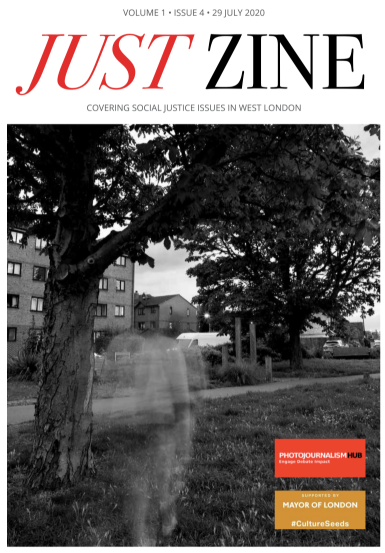
JUST ZINE ISSUE 1

In this very first issue of JUSTZINE magazine we are presenting a Special Report on food banks in Hammersmith & Fulham with insightful interviews, photostory and a letter from a user, poems on lockdown and articles. JUSTZINE is part of a Photojournalism Hub project called ‘Youth Zine West’ which sees a production of a digital magazine focusing on local news stories by young adults in and around White City. JUSTZINE is kindly supported by Mayor of London Culture Seeds.

JUST ZINE ISSUE 3

JUST ZINE magazine issue 3 focuses on homelessness in a Covid-19 world as we understand that the pandemic has worsened an already widespread issue. It touches on the different forms homelessness can take from life on the streets, to insecure housing and now, to temporary residence in hotels thanks to the Government’s public health initiative to get people off the streets to reduce the spread of the virus. Contributors have also shared an extract from a children story on homelessness and a touching and powerful personal story on homelessness. Furthermore they shared a photo story on the reopening of non-essential shops and the merging of DfID and the UK Foreign Office and the potential implications on foreign aid as a result of this merger. Once again I would like to thank the hard-working and very talented group of participants in the Youth Zine West project, run by the Photojournalism Hub, who produced this issue and as always, I thank our founder the Mayor of London, Culture Seeds.

MINI TALKS

The Photojournalism Hub Live Mini Talks: a series of conversations with photojournalists and practitioners on their work and on their experiences to share useful advices and insightful know-how on photography and current topics.

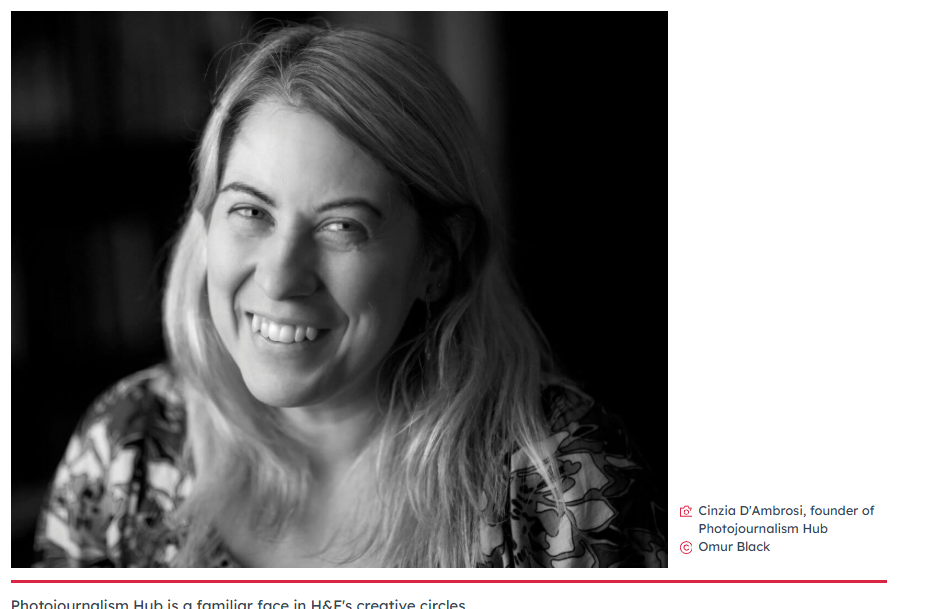
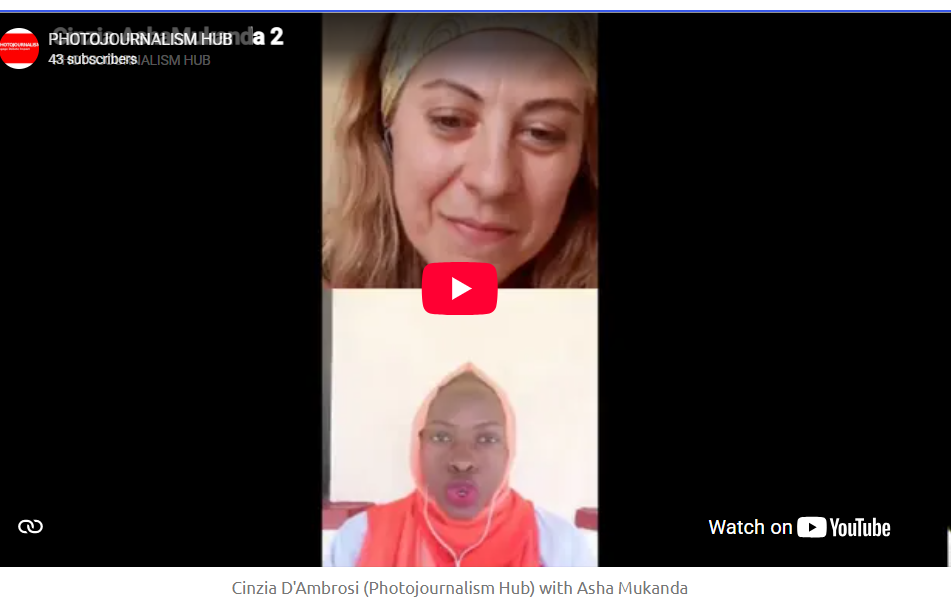
Cinzia D’Ambrosi, founder/director of the Photojournalism Hub is in conversation with Asha Mukanda, activist, writer and executive assistant of the Open Institute in Kenya. The conversation surrounds the impact that the current pandemic is having on the existing issue of health disparities and police brutality in Kenya.

Photographer and Photojournalism Hub collaborator Carli Adby in conversation with Cinzia D’Ambrosi, founder and director of the Photojournalism Hub discussing ongoing and future engagement programme of the PJH including an ongoing call for photographers and journalists on injustices and inequalities laid bare by Covid-19 and the Photojournalism Nights, an event dedicated solely to photojournalism.

Carli Adby from the Photojournalism Hub is in conversation with Suzanne Plunkett from Women Photograph discussing under representation in the photography industry and how we can lift the voices of ourselves and those around us, particularly those who otherwise are overlooked.

In Conversation with Suzanne Plunkett, Women Photograph – 12/06/20

 ‘Covering conflict in Iraq’ – in conversation with Claire Thomas –  29/05/20 

‘Being a photojournalist on the frontlines‘ – in conversation with Felipe Paiva –  16/05/20 

Cinzia D’Ambrosi, founder and director of the Photojournalism Hub introduces an ongoing series of mini Talks, live conversations on Insta with various practitioners to share useful and insightful topics.

Injustices & Inequalities: Covid-19 – Edition 1

We are witnessing disregard for basic human rights in every continent: restricted access to health care, lack of government transparency, deepened poverty, inadequate financial protection, racial discrimination and increased risk of domestic abuse.

In the UK, years of austerity measures, subsequent cuts to important social services and years of public spending over Brexit had already severely damaged public services, imperilled human rights and restricted collective and individual freedom. Covid-19 has exacerbated this pre-existing damage. What we are witnessing day after day is the culmination, or rather the unravel, of years of political, social and economic failure.

Photographers, photojournalists and journalists have submitted material to this dossier giving us a powerful insight into human frailty at the hands of injustice and the inequalities being intensified in new and tragic ways during the pandemic. They have highlighted the imbalances of power, poverty and desolation at this time of Covid-19. 

These are issues we need to see, reflect upon and action.

PHOTOGRAPHY 

Erica Dezonne

‘I have chosen the pictures here because they show very roughly the real scenario of how people are neglected by society in general but mainly now during this pandemic’.

Erica is a Brazilian photojournalist / photographer based in London since 2014. She comes from a background of staff photojournalism and has worked for some of the most important newspapers in Brazil such as Correio Popular, Diário do Povo, Notícias Já, Metropole and Panorama Magazines, O Diário de S. Paulo and O Estado de S. Paulo.

Ericadezonne.com

Giorgio Ghiotto

Stills from a documentary Georgio shot about the current situation with food delivery riders during the COVID emergency in Rome, Italy.

‘Riders continue to cross cities delivering takeout, and groceries too, in full lockdown. Their work never ends, but the emergency of the Coronavirus makes new precautions necessary, brings out fears and uncertainties, and reveals moments of unexpected humanity. One day, from sunrise to sunset, together with four riders on the streets of Rome: different ages, stories, and nationalities. “Now I always have hand sanitiser with me” says Nicolò, “and for every delivery, I wash my hands”. “Now during the day we don’t have a place to stop to eat or simply go to the bathroom” says Renzo. “But I feel proud,”  confesses Pino, “when I bring food to disabled or blind people”. “A boy with a disability looked me straight in the eyes” Simona recalls, “and said, I would not have known how to do it without you.”

Instagram: Giorgioghiotto

Angela Christofilou

‘I shot the images during lockdown with the streets being empty, and the messages have been sprayed on a wall on Euston road. It’s so important to point out that behind closed doors domestic violence is on the rise’.

Angela is a half English, half Greek actor, voice over artist, photographer and singer/songwriter living in London.

Angelachristofilouphoto.com
Instagram: Protests_photos / Angela_photographs

Talia Woodin Assisted by Connor Newson

‘Now, as the coronavirus pandemic has forced us all into lockdown and global emissions have dropped by 6% it seems that people are finally beginning to think about the air that they are breathing. But why has it taken so long and why were all those thousands of previous deaths not enough to merit this scale of action? This is something that I am hugely keen to explore and portray in a thoughtful and thought provoking way through a continuing of this project. I want to convey the pain and harsh understanding that I gained through my own fathers death and the upbringing that I had and combine that with my photography and experience in the climate justice movement in order to motivate and inspire people.

I grew up in a city that has one of the highest concentrations of air pollution in the UK. When I was four years old my dad died from a rare form of lung cancer, having never smoked and being only 38 years old. Because of this it led my family to believe that the air quality in our city had been a key part in causing his death. Fifteen years later I now live in South East London, an area with such awful levels of air pollution that children growing up here are found to have stunted lungs. So often when we talk about the climate crisis we think of Ice caps melting and forests burning and whilst these are catastrophic consequences they often distract from the very real and current impact that our behaviours and consumption has in our immediate lives. An average of 64,000 in the UK die every year due to air pollution and yet no one seems to be talking about it.

Having experienced such a loss as a result of this at a young age its has shaped my life and perception of the world hugely and has long been something I’ve been almost craving to communicate and explore. For a few months now I have been working on a project entitled ‘The Air That We Breath’, focusing on these issues through various mediums such as photography, film and writing’.

Instagram: Taltakingpics

Thabo Jaiyesimi

‘The pandemic has amplified the disparities of those at the lower end of income percentile whilst also shining a light to those that support conspiracy theories with the latter getting arrested as they voiced their anger at speakers corner on 16 may. Coronavirus has exposed the inequalities on a class and race basis. Those of a different hue in England are 54% more likely to be fined under coronavirus rules than white people, with some accusing the police of racial profiling. As people marvel at images of deserted London streets many small and medium-sized businesses are already feeling the effects of the Lockdown. I find it hypocritical that some people applaud hospital staff while attacks on NHS is on the increase according to the Parliamentary committee’.

Thabo is a freelance photojournalist based in London. His work has been widely exhibited and published in periodicals and newspapers such as The Guardian, The Times, The Observer and Time. His body of work ranges from documentary to editorial style and undertakes long-term projects examining socio-political activism and cultural trends.

Thabojaiyesimi.com
Instagram: Thabo_jaiyesimi_
Facebook: Thabo.jaiyesimi

Ömür Özkoyuncu Black

‘The queue in my images was for food. It was organised by a charity organisation Nishkam Swat. I believe the people were homeless. The moment was iconic as no one was in streets, except those people who were queuing for food right front of The National gallery’.

Ömür is a healthcare specialist as well as a professional photographer and multimedia producer living in the United Kingdom and working worldwide. She provides editorial and editorial style photography to media industries including features, portraits, case studies and documentary style work for newspapers, magazines, corporates, PR and NGO clients.

Instagram : Omur_ozkoyuncu
Twitter: Omurphotographs

Zula Rabikowska

‘The images visually bear the feeling of isolation, loneliness, craving for human contact as well as nature. Feelings, which have become more or less universal in the recent weeks. I hope that they can also contribute to a larger discussion on wellbeing and mental health, which are severely being affected by the current situation’.

Zula was born in Poland, grew up in the UK and worked in France, China, South Africa, India, Palestine and the Caribbean. She has obtained an MA in Photojournalism and Documentary Photography from London College of Communication. Zula also works as a freelance photographer and as a photojournalist for SOPA Images in Hong Kong.

Zulara.co.uk
Instagram: Zula.ra

Piero Oronzo

‘These photos are part of the reportage “Covid-18ème”: an artistic reportage that would like to show how the daily life has changed in the 18th district of Paris with confinement measures. I have shot these photos in the only hour of the day in which we were free to go out, but no farther than a kilometer from home. It is a reflection about the wound inflicted by the confinement to the daily life of the district.

Image 1) Marx Dormoy street is one of the major arteries of Paris, it connects Saint-Denis district and Charles De Gaulle Airport to the city centre. A Sunday morning, looking out of my window, I have watched this man for long time, looking for the right point of view to shoot a photo that best represents the emptiness of the street. I find in this photo a good metaphor of the uncertainty that we are living in this period and the difficulty to find a direction for our path.

Image 3) The 18th district of Paris is a place where different social realities live together despite their cultural conflict. The health emergency due to the Coronavirus is affecting especially the poorest sections of population, also here in France where there is a solid welfare system. Many voluntary associations have intensified their activity, offering food, clothes and medications to homeless people. During the confinement measures, the associations recorded several case of abuse of authority in the streets by police officers’.

Instagram: Overview_videomaking
Facebook: Overview videomaking
Twitter: In the Mood for Napoli

ARTICLES

Correct the Balance

By Maura Framrose

Image Credit: Serann

Take it on the chin… ‘business as usual’…  protect finance…  herd immunity… what’s he saying? He [Boris Johnson] wants to ‘cull elderly dependants’ / reduce pension payouts / and continue trading while other countries are in lockdown. The UK government was clearly prioritising finance over health.

We do need the economy, it’s a fundamental reality of life. None of us are alone –  a whole chain of people make life possible for each other and many of them have been seriously undervalued. We’re dependent on each other, inter-relatedly bound up in spending. So much collective energy worldwide is directed into activities supporting finance, the financial system itself ought to be secondary to that. Would this be an opportunity to restructure the way we live? An opportunity for a rethink… how much we’re giving – what we’re giving back… how much is being taken from us. 

The paternalistic and measured approach of UK government as for two weeks it intravenously flushed public money (in future taxes) to private finance (at 5% interest) to ensure the health of property assets and capital – before any serious care was demonstrated for public wellbeing – reflect the attention of the electorate who voted them into power. The majority chose ‘economic security’ over healthcare, demonstrating where concern has been trained to focus... and how risk has been normalised. The suggestion herd immunity would protect the market and if the market was protected, so would we, suggests as long as money is all right, even when that money is not being invested into healthcare – we are immune to risks taken on our behalf. We’ve lost sight of what really matters. Our health is in our own bodies – our lives have been systematically devalued and made secondary to economic activity – we have allowed public money to be spent on weapons which undermine the wellbeing of others, and to be speculated into tax havens instead of actively pressing for social equality and healthcare. 

Many people for the first time, experienced the precarity and panic, the vulnerability of insecurity which for many, is a reality of daily life.

The politics of the capitalist right, non-intervention by the state (especially in financial markets) exploitation, extraction, and lack of concern for those at economic disadvantage – are the deeply flawed thinking patterns of a privileged elite. Who intervene only begrudgingly if you’re able to demonstrate reliance and co-dependency on their system for survival – and offer support if you’ve demonstrated adequate compliance with and complacency towards the structures of their control. Many people with vast personal wealth who do not require assistance, are receiving it while millions are falling through the net. To compensate for the market’s inadequacy and deal with inequalities for which it has no answer –  we’re busy making nets to catch each other now which is a beautiful thing.. but….  

..this preoccupation with finance – massively contributed in determining peoples’ behaviours. With no clear message on public health because..politically there has been no real concern for public health – vague messaging, added as an afterthought open to interpretation, led many to ignore suggestions for social distancing, and others to fly into panic. ‘It’s coming, we need to protect (drastically underfunded) health facilities & the elderly’ – would have been a more honest place to start but they don’t think like that.. for them it’s all about the money.

Countries discredited in our consciousness as ‘authoritarian’, Taiwan, Singapore and South Korea, suppressed the health crisis more effectively because elements of collective responsibility are built into their structures. Countries who model themselves on our socio-economic patterns, Chile and India, now lack access to our financial markets and are unable to guarantee anything near similar assurance to their people – many of whom are already going without food. 

The preoccupation with self and ‘I’ required to maintain capitalism is inadequate as a collective response. ‘We’ are everyone, not an individual decision, not a consumer choice – we are a community and society, we are families and friends. We are only as safe as the most vulnerable among us and we’re all on the planet together.  This crisis is a reminder of that.

In the UK, the emergent capitalist bail-out – maintains the reality of a financial ‘status quo’ where nurses hadn’t had pay rises for 8 years, hospital cleaners’ work was outsourced to agencies on minimum wage without sick pay and hospitals are no longer public assets but since PFI initiatives of the late 1990s, are rented from the private sector.

The bail-out doesn’t change any of that. It’s like receiving a ridiculously large birthday present from someone who’s abused you for years, while other people are still locked in a basement. Money can’t do everything, its interest in social welfare has been only to the degree in which those sectors could be financialised. 

Financial valuation has a set of priorities which are fundamentally distorted. The idea the market will take care of everything is an abstraction. The market cares for its own security and ability to influence outcomes and represents only those with the privilege to participate in it. It also exploits crises so while our lives are on hold – money is working for profit.  And that lies at the heart of the problem. 

 A society where most people can’t afford to live on 94£ a week is failing! 

When government wilfully refuse to see or act on this .. when they have us working for their money.. instead of making our money work for us! We have to realise!! We’re being exploited. Debt is slavery – wages have been slavery .. home ownership is debt  and cycles of exploitation and wealth inequality continue. PEOPLE need the market to work for them…not the other way round.

Pay-outs in the UK being capped at £2,500 a month, suggest a maximum calculation for a  ‘living wage’ – so why aren’t nurses, paramedics, ambulance drivers, bin men, cleaners, carers, postmen and teachers, essential workers – seeing anything like this kind of income while CEOs and asset managers, hedge fund traders take what they want?

Perhaps less money would be available if they weren’t trading it?

Personal fortunes are made by people who simply manipulate money and contribute nothing to society. If speculation in derivatives and stock buy-backs is truly essential? And it can be argued, it’s not – it’s time we learned how they harness the surplus and demand regulation of the finance sector – to redirect privatised ‘profits’ back towards people we have discovered are of much greater value to society than they’ve ever been given credit for – and who create that value for us all in the first place. Not as a tranquillising shot in the arm from a benevolent venture philanthropist – but on socially agreed terms – negotiated by us.  

When essential workers are given the dignity and respect we know they deserve and are validated for their contribution with decent pay-checks , we could recruit from the unemployed and make work pay.

It’s time, past time, we lived in a world where necessities were provided for and excess was shared. Truth is looking us straight in the face. So here’s a pay-rise. We’re going to use the money system to value things we need and stop being harmed and manipulated by agendas we don’t.

References

Campaign against the Arms Trade. End financing of weapons

London Renters Union

Global Justice Now. Corona tax

Arundhati Roy. The Pandemic is a portal.

Mutual Aid in your Neighbourhood

PFI draining the NHS 

MANY THANKS TO ALL CONTRIBUTORS

If you have work which highlights the social injustices that are being intensified by Covid-19 please submit your work to the Photojournalism Hub. We will be adding a dossier page on a monthly basis. Submit by July 30th to be included in August’s selection.


Editor: Laura James, LauraJames@PhotojournalismHub.org

PODCASTS

ERICA DEZONNE

Mother tied up her daughter – Esso Award Finalist Picture ©Erica Dezonne

In this podcast, freelance photojournalist Erica Dezonne is in conversation with Jamie Clark, our podcaster and photographer. Originally from Brazil and based in London, Erica is sharing her fascinating journey into capturing world events, news and stories through the camera lens. Erica’s career sees her working through the fast and challenging world of news for the RAC Group in Campinas, which is one of the biggest media company in the state of São Paulo in Brazil, all the way to reporting on the street of London. Her photography work has gained recognition in various awards finals, including the prestigious Esso final Award in 2011. Erica’s innate curiosity and passion that transpires in her reporting is splendidly summarized in her own words “with my Finnish heritage I had the bravery and courage to leave my comfort zone in Brazil and face what the world is saving for me.”

www.ericadezonne.com IG & Twitter: @ericadezonne #ericadezonne

Prostitutes after police enforcement ©Erica Dezonne

Podcast by photographer, videographer Jamie Clark, jamiephclark@yahoo.co.uk

HANNAH MORNEMENT

In this podcast, photojournalist and documentary photographer Hannah Mornement is interviewed by Jamie Clark about her photographic work The Road to Mote and her journey as a photographer.
Through discussing her long form powerful project The Road to Mote and her personal journey into photojournalism and documentary photography , Hannah shares her working methods and she lets us into the intricacies of working as a photojournalist today. Her passion for humanitarian issues and her years’ long experience of working in challenging environments from Antarctica to Africa has led her to work alongside many international charities and NGO’s documenting complex humanitarian issues. In this podcast, Hannah talks about her photo stories of people relying on food banks in the UK, of children living in orphanages in Eastern Europe, of famine and food security in Africa, as well as discussing her role and the role of photojournalism in documenting social issues today.

www.hannahmornement.com IG & Twitter: #hmornement @teapot_one

Podcast by photographer, videographer Jamie Clark, jamiephclark@yahoo.co.uk

MINI TALKS

The Photojournalism Hub Live Mini Talks: a series of conversations with photojournalists and practitioners on their work and on their experiences to share useful advices and insightful know-how on photography and current topics.

Cinzia D’Ambrosi, founder/director of the Photojournalism Hub is in conversation with Asha Mukanda, activist, writer and executive assistant of the Open Institute in Kenya. The conversation surrounds the impact that the current pandemic is having on the existing issue of health disparities and police brutality in Kenya.

Cinzia D’Ambrosi (Photojournalism Hub) with Asha Mukanda

Photographer and Photojournalism Hub collaborator Carli Adby in conversation with Cinzia D’Ambrosi, founder and director of the Photojournalism Hub discussing ongoing and future engagement programme of the PJH including an ongoing call for photographers and journalists on injustices and inequalities laid bare by Covid-19 and the Photojournalism Nights, an event dedicated solely to photojournalism.

Cinzia D’Ambrosi (Photojournalism Hub) with Carli Adby

Carli Adby from the Photojournalism Hub is in conversation with Suzanne Plunkett from Women Photograph discussing under representation in the photography industry and how we can lift the voices of ourselves and those around us, particularly those who otherwise are overlooked.

In Conversation with Suzanne Plunkett, Women Photograph – 12/06/20

Carli Adby and Suzanne Plunkett

 ‘Covering conflict in Iraq’ – in conversation with Claire Thomas –  29/05/20 

Cinzia D’Ambrosi (Photojournalism Hub) and Claire Thomas

‘Being a photojournalist on the frontlines’ – in conversation with Felipe Paiva –  16/05/20 

Cinzia D’Ambrosi (Photojournalism Hub) with Felipe Paiva

Cinzia D’Ambrosi, founder and director of the Photojournalism Hub introduces an ongoing series of mini Talks, live conversations on Insta with various practitioners to share useful and insightful topics.

Cinzia D’Ambrosi, Photojournalism Hub

VIDEO INTERVIEWS / PODCASTS

FIREHAWKS

The Photojournalism Hub presents a feature on 'Firehawks', a photography exhibition at the Open Eye […]

Continue Reading

MINI TALKS

The Photojournalism Hub Live Mini Talks: a series of conversations with photojournalists and practitioners on […]

Continue Reading

PODCASTS

ERICA DEZONNE Mother tied up her daughter – Esso Award Finalist Picture ©Erica Dezonne In […]

Continue Reading

COMMUNITY FORUMS

Using Photojournalism to make positive changes

Community Talks is an ambitious project which promotes independent journalism and expose issues and topics from communities and individuals around the world whose voice is often neglected, uncovered,  unreported.  Often, photo stories and news that reach mainstream media do not reflect a thorough research, many voices are left behind that would provide a better and fairer understanding  of an issue. The Photojournalism Hub plan is to provide an outlet for those voices and to share news and in-depth photo and journalistic essay that will counteract mainstream media from local and global communities. 

Conversations with the Somali Communities

The Photojournalism Hub and Lido Foundation invited local Somali communities living in/around White City, Shepherds Bush to an open conversation. Many joined us in very constructive conversations that focused on the areas in need of support for an improved well-being of the community. men and women and young people talking openly about their lives and the challenges that they encounter.


Conversations with women in White City

On the 10th January, we hosted our first Open Forums in White City in collaboration with the charity Women Make Change, a local charity that supports women, survivors of domestic abuse.
We sat in circle and we each contributed with our experiences of living in the area as women, mothers, sisters and what are expectations were around support from local governance and policing.  The conversation led towards areas that have not been researched, investigated and analysed in depth as such  exclusions within schools and what it seems to be a highly disproportionate number to come from black and poor background. This was one of the areas that women have asked for support . 

Women in conversation at the Open Forum in White City

Gueules Gazées

By Roberto di Mola 

Gueules Gazées is an ongoing documentary series showing the effects of tear gas among
protestors. Grins, runny noses and burning eyes are just the visible effects. According to a study published by the French association of toxicology-chemistry the aftermaths of exposure could be serious and permanent damages might be caused to the nervous system, to the breathing apparatus
and to the sight. Moreover it certifies the presence of small amounts of cyanide potentially
toxic in case of long exposures.

Gueules Gazées tries not only to underline direct consequences of potentially lethal
weapons used against civilians, but it also aims to show people’s strategies to relieve pain
and provide first aid to those affected by the gas. Heavily armed police, LBD, tear gas: are there any other more peaceful means to provide security and safeness in public order policing?

Instagram: #mirai.mir

Paris, June 2020. Milk is often used to alleviate burns that reach the eyes. Here, after
the passage of the demonstrators, milk flows on the street.
Paris, June 2020. A protester makes a grimace of pain.
Paris, June 2020. A protester sprays his face with milk.
Paris, June 2020. A demonstrator receives assistance.
Paris, July 2020. A typical riot police squad: one of them is holding a LBD gun. The
majority of serious injuries are caused by the reckless use of this weapon.
Paris, June 2020. A Parisian café after being attacked with tear gas.
Paris, June 2020. A man trying to get out from the café after the attack.
Paris, June 2020. More and more protesters, aware of the effects, equip themselves with the necessary to provide first aid.

Paris, June 2020.In this case an umbrella is used to better protect themselves from
“toxic winds”.

Paris, July 2020. Another technique is used to curl up against the wind.

Photographs by Roberto di Mola
Instagram: #mirai.mir