The Photojournalism Hub Calendar 2026 showcasing the incredible work of photojournalists and documentary photographers who have contributed to our mission.
Sharing below some photographs from the talk event on youth and crime we held on the 17th September 2019 at the Invention Rooms in White City.
We presented a very diverse group of panellist who shared their experiences and insights on this very important issue: Raheel Butt, who is an ex gang member, Dr.Roger Grimshaw, Research Director of the Centre for Crime and Justice, Rebecca Omonira-Oyekanmi, investigative journalist and photographer Robin Friend.
The conversations showed different perspectives that included the raw experiences of Raheel Butt, the research of Dr. Grimshaw that points to emotional deprivation and poverty in early years’ link to aggregation to gangs, and Robin’s visual research looking at austerity measures, Brexit and lack of youth provisions as precursors of youth crime.
Once the presentations ended, we asked the public why they came to the event and that was the start of a very powerful sharing of the public’s own experiences, including their own children’ being caught in the fabric of crime, gang membership and radicalisation.
This was a very powerful talk event, matched by a strong feel of wanting to change things in the White City community, a strong fear for the future of children, and a need to connect with each other to look for solutions. The public asked to have their email shared with each other.
A compelling article ‘Supporting communities throughout the lockdown’ by Near Neighbours on the work that the charity supported throughout the ongoing Covid-19 emergency and how the various groups and organisations have found ways of being relationally close to communities and individuals even when they were physically distant. The article recounts heart-rending examples here of projects supported by the charity that carried on supporting their communities during lockdown overcoming communication, technical and logistical challenges. I am very humbled that the project ‘Knowing You’ is among the project described in the article. To read about it: https://www.near-neighbours.org.uk/response-covid
During the summer of 2020, I decided to commit to a photo project documenting the Black Lives Matter demonstrations around London. The tragic death of George Floyd in Minnesota on the 25th May triggered the first demonstration in London on the 31st May 2020. I wanted to use this opportunity to hopefully capture a positive change in our country. I believe that mainstream media are effective at dividing the nation, writing articles that are designed to cause anger, at times it is difficult to find honesty in the writing. I wanted to discover firsthand what the BLM movement was about.
Experiencing the protests, it is clear that there’s a lot of anger and frustration towards racism in the country, and it was insightful to be able to listen to so many passionate speakers sharing their experiences. As a white photographer covering these protests, I quite often had the feeling that maybe I didn’t belong, wondering who I really was to be covering the demonstrations. I now believe that attending the protests has opened my eyes to a lot of things, mainly the fact that just being not racist doesn’t help solve much at all.
A more proactive approach is needed to help create change in the country when it comes to racism. Being more inclusive towards other cultures within a work place is one of the many things to think about. I work as camera crew in the film industry, an industry that is notorious for being dominated by white males. I have however seen a lot of positive change towards the diversion of cultures and gender when it comes to crewing up for productions. One organisation that has been set up is The Hue List, a film and TV crewing service for hiring BAME workers in the UK and EU. A wonderful initiative for helping to create a more diverse group of workers in the UK film and tv industries.
In the process of wanting to be as objective as possible with my project, I also photographed an opposing protest on the 13th June. Far Right and English Defense League supporters turned up in Westminster to counter protest the BLM demonstrations. It didn’t take long to realise that these protesters where basically using this opportunity to have a ‘piss up’ in the park, with little to no agenda to their protesting. Witnessing EDL supporters harassing members of the public, along with aggression towards police and the press, were all things that created a feeling of disgust within me. A placard from a BLM demonstration on Speakers Corner sticks in my mind, ”Racism is not Patriotism”.
I think one of the more eventful days was the 6th June. BLM protesters peacefully marched down Whitehall to the gates of Downing Street. In a dramatic turn of weather, a thunder storm opened up and torrential rain poured down on London in an almost disorientating fashion. This created chaos on the street, riling up protesters as a select group of people began throwing projectiles and smoke grenades towards Metropolitan police and Downing Street. In a turn of events this led to mounted police officers attempting to control the crowds of protesters.
A young protester then pushed his bike into one of the horses, causing the horse to spook and for a police officer to sustain serious injuries. These events all got majorly criticized, with opinions stating that the Met police acted too heavily in this scenario. It was a combination of people turning up to purposefully cause trouble and the police making some bad decisions controlling that. Leading to the BLM movement as a whole receiving backlash from the media for the events that happened that day.
Photojournalist Hub eleventh edition of the Photojournalism Nights presents an amazing line-up of photographers: Barbara Traver, Brian Ongoro, Hannah Kozak.
Barbara Traver, is a photographer based in Spain. She studied at the Espai d’art fotogràfic school (Valencia, Spain) and completed a master’s degree in production and photographic projects at the same centre together with the University of Valencia. That same year, Barbara won a scholarship to study in Madrid (Spain) at the EFTI school, where she took a course in contemporary photography and another in photojournalism and documentary photography. She has self-published two photo-books, exhibited in various national and international venues, and given several lectures where she delves into visual education and bringing photography to all audiences. Barbara is also the founder of @iphotograp.her , a collective of women photographers around the world.
Brian Ongoro, is a photojournalist based in Kisumu, Kenya majoring on documentary, editorial and commercial photography. He has carried out assignments for media houses, news agencies and non-governmental organisations. Brian’s work is known for covering East Africa and has been published nationally and internationally, including BBC, Al Jazeera, Guardian, CNN, Bloomberg, Le Monde. Brian is a contributor of AFP photo.
Hannah Kozak, is a photographer based in Los Angeles, California, who was born to a Polish father and a Guatemalan mother. At the age of ten, she was given a Kodak Brownie camera by her father, Sol, a survivor of eight Nazi forced labour camps and began instinctively capturing images that felt honest and real. While working in a camera store at the age of twenty, Hannah’s life changed when she met a successful stunt woman who became her mentor and helped her start a career in stunts. For over twenty-five years, Hannah followed a career in the film industry capturing images of far away lands, however after decades of standing in for someone else, Hannah has turned the camera on herself documenting subjects that touches her emotionally, including her painful and deeply touching relationship with her mother, powerfully captured in ‘He Threw the Last Punch Too Hard’ photo book and photo story.
The Photojournalism Nights is an event that promotes committed and courageous photojournalism and engages the public to social justice and human rights.
The current Covid-19 pandemic has disproportionately affected communities and people who were already marginalised, discriminated, and at the throng of continuous injustices and inequalities. We are bringing together stories, investigations from around the world to highlight and advocate and create the important exposure to leverage and bring about positive changes. In the 8th edition of the Journal on “Injustice & Inequalities: Covid-19”, we present the work of four great photographers Nic Madge, Victoria Herranz, Zula Rabikowska and Valeria Luongo, who present and share realities being effected by the ever changing society during the pandemic from the tremendous challenges of the refugees and impoverished populations in Sicily, the documentation of the social impact of the pandemic on the people of St Albans in the UK , the vulnerabilities of the elders in Italy, and the enormous human rights strike on the right of abortion for women in Poland. The pandemic has widened social inequalities and injustices and this journal is sharing realities, issues and disparities that we need to see, reflect upon and action.
Living through the Covid pandemic is the biggest challenge faced by the people of St Albans for over seventy years. It is also history in the making. December, when St Albans was only in Tier 2, feels like history. The impact of the virus has changed so rapidly that December 2020 is indeed history. Future generations will study the pandemic and analyse how it changed the social, economic and political fabric of this country.
As a photographer living in St Albans, I am working with St Albans Museums, The Herts Advertiser, St Albans BID, local community groups and businesses to record the way in which we are surviving the pandemic. I am doing that by making portraits of people, mainly in the Market Place, but also elsewhere in town, as they go about their daily lives; shopping; working; exercising etc. I am taking photographs of people both wearing and not wearing their Covid-safety masks. I am asking everyone photographed to write a few words about the pandemic and how it has affected them. I am producing the portraits as digital diptychs – portraits of each person with and without a mask, side by side, with a short caption beneath. The portraits reflect the vitality and diversity of St Albans.
In return for participation in the project, I am emailing a free portrait to everyone photographed.
As well as photographing in the Market Place, when able to do so, I have collaborated with local community groups and charities to photograph their members, including Open Door (housing for homeless people), Passport to Leisure, The Daylight Club (both giving support to young adults with disabilities) and the Sopwell Community Trust (which inter alia delivers food boxes to vulnerable people).
The captions enable the people of St Albans to express themselves; to reveal their experiences, both bad and good; and to mention their hopes and fears. The project has shown that, although St Albans is a relatively affluent city, there are huge disparities in the way in which the pandemic has affected people. The lives of some have been devastated. Others have hardly been touched. The comments included in the captions are very varied and provide a real insight into the effect of the pandemic. They show great public strength and resilience, but private pain and angst.
I hope the project will run for a year, with images and comments divided into monthly chapters so that we can see how experiences and attitudes change over time. Clothing will reflect the changing seasons and perhaps even evolving moods. The portraits with captions will enter the archives of St Albans Museums so that future generations of Albanians will be able to see what we look like and read our short comments about the pandemic. They will also be exhibited in the Museum + Gallery when it re-opens, hopefully on May 17th (after lockdown) until September 30th. They will also be preserved in the British Library digital archives and be exhibited on the Photojournalism Hub website. And, after completion of the project, the diptychs will be available to be exhibited elsewhere either (i) as one multi-media presentation; (ii) a series of monthly multi-media presentations; or (iii) as traditional photographic prints.
But I don’t want this just to be a dry historical record. I want this to be an immediate, ongoing, inter-active project involving all the communities of St Albans. I am uploading a monthly collection of diptychs with a soundtrack onto YouTube. Here are hyperlinks to the monthly editions for October, November, December 2020, January and February 2021. I am also making the images immediately available via Instagram and Facebook (including the All Things St Albans; St Albans Past and Present; St Albans People and Isolation Arts Café Facebook groups), web-sites, digital screens in local businesses and the local press. For example, Ashtons, estate agents in London Road, are displaying some of the images on their street facing digital wall and including them in their newsletter. Some have been reproduced in the Herts Advertiser, My Local News and on the BBC website.
Weather permitting, I will be standing outside the old Town Hall which houses the St Albans Museum + Gallery a couple of days a week. If you wish to be photographed, please email me at nicmadge@ntlworld.com to agree a mutually convenient time and date.
I am very conscious of Covid-safety issues and ensure that social distancing is maintained at all times. I provide hand-sanitiser. All photographs are taken in the open air.
Nic Madge I am a photographer who lives in St Albans. I have recently completed an M.A. in Documentary Photography and Photo-journalism at the University of the Arts, London. Previously, I have published photo-books and had solo exhibitions of my portraits/street photography at the British Museum and the Swiss Cottage Gallery, as well as several joint exhibitions.
Protesters take to the streets to show their rejection of the government’s ban of abortion in October 2020.A protester in Cracow, Poland October 2020 responding to government’s decision to ban abortion.Protesters in Cracow, Poland October 2020 responding to government’s decision to ban abortion.Heavily armed police getting ready to respond to the abortion ban protesters in Cracow, Poland October 2020.
Palermo, the capital of Sicily, and the collateral consequences of the pandemic. In a broken land, punished economic and socially, without jobs, with a high rate of exodus and migration, the situation has been aggravated because COVID-19 lockdown. Now, Palermo is face to face with a known enemy: the hunger, the fear, the death. Different organizations and social movement have joined forces to improve quality of life for all citizens. It doesn’t matter where you were born, the color of your skin, your faith. You are sicilian now. And we’re in the same boat… Frontiers begin to open three mouths after lockdown. But the pain of hit, in this wounded land, will last a long time. Beyond the crisis, the Mafia and the pandemic Palermo resists.
Victoria Herranz http://www.victoriaherranz.com/ Instagram: victoria_herranz
LATER LIFE
Valeria Luongo
Rome, December 2020 – January 2021
What does it mean to give up a year of your life when you are elderly and considered among the most vulnerable group in society?
Since the beginning of the Covid 19 epidemic in Italy, the country in Europe with the oldest population, people over 65 at a higher risk of infection have been asked to take a very different sacrifice to the young in society; to potentially spend the final years of their life in quarantine. Old people have been constantly fearful of becoming new victims. Even those who would still otherwise be mentally, socially and physically active found themselves completely isolated from their youngest relatives or friends.
I photographed and asked old people, all over 65 and under 100, to talk about their first covid year, to imagine their future and that of society and to reflect about later life in times of pandemic. They shared an insight about the passing of time, the challenges and hope for the future. As the members of society with the most life experience it was interesting to hear what they had to say about the current crisis that sees them at the center of it.
Agostino e Bernardo, 68 and 72, retired butchers.
“I still prefer the poverty of my childhood to what we have now. It was a more honest, healthy environment. Today we can count on big industries but inequalities are stronger than ever”.
Isa, 81, retired tailorMarisa, 88, retired housekeeperFlavio, 93, retired engineer
“The world is changing in a radical way. I was part of it: I was born within the change, I saw its development and I can still see it going further. The world will become more homogenous and I am really positive about this process”.
Antonietta, 77, retired administrative assistant
“If there weren’t books, cinema, radio I would have got ill. How could we live without the arts? Knowledge is so necessary to survive hard times. In these past months this has been my window to the world”.
“The crisis started as soon as we abandoned the land. We are not walking on the right path: we need to take a step back and start again from there. The land is the base of life”.
Paola, 84, retired editorial managerRosalba, 77, retired tour guide
White City Place Holds PhotojoWhite City Place | 18 April 2019
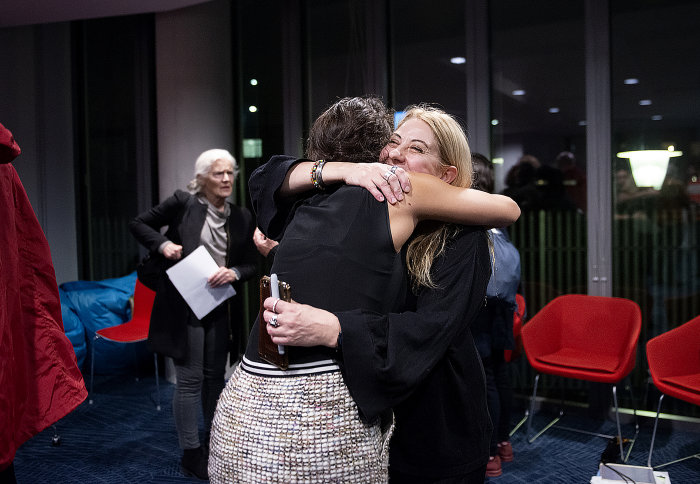
In April 2019, Photojournalism Hub brought together photographers, community organisations and practitioners at White City Place for a discussion exploring participatory photography and ways of working with communities.
Curated by Photojournalism Hub founder and director Cinzia D’Ambrosi, the event brought together Tom Elkins, CEO of PhotoVoice; Andy Fearn, Director of Protection Approaches; photographer and FotoSynthesis director Ingrid Guyon; and photographers Becky Warnock and Grace Gelder, whose work includes participatory approaches.
The discussion explored how photography can be used collaboratively with communities and considered different methodologies for engaging people in projects that address sensitive social issues.
A central part of the event was the question of how community outreach can be developed in a respectful and safe way. During the Q&A, local community members asked the speakers about building meaningful relationships, reaching people who may be excluded from traditional photography projects and ensuring that participation does not cause further harm.
The speakers drew on their own experiences of working with communities around sensitive subjects, including projects involving young people and self-harm.
The event reflected an important strand of Photojournalism Hub’s early work: bringing practitioners together to question how photojournalism is made, who gets to tell stories and how photographers can work responsibly with the people whose lives they document.
It also reflects the Hub’s wider commitment to using photography not simply to represent communities, but to engage people in the process of telling stories and addressing issues that matter to them.
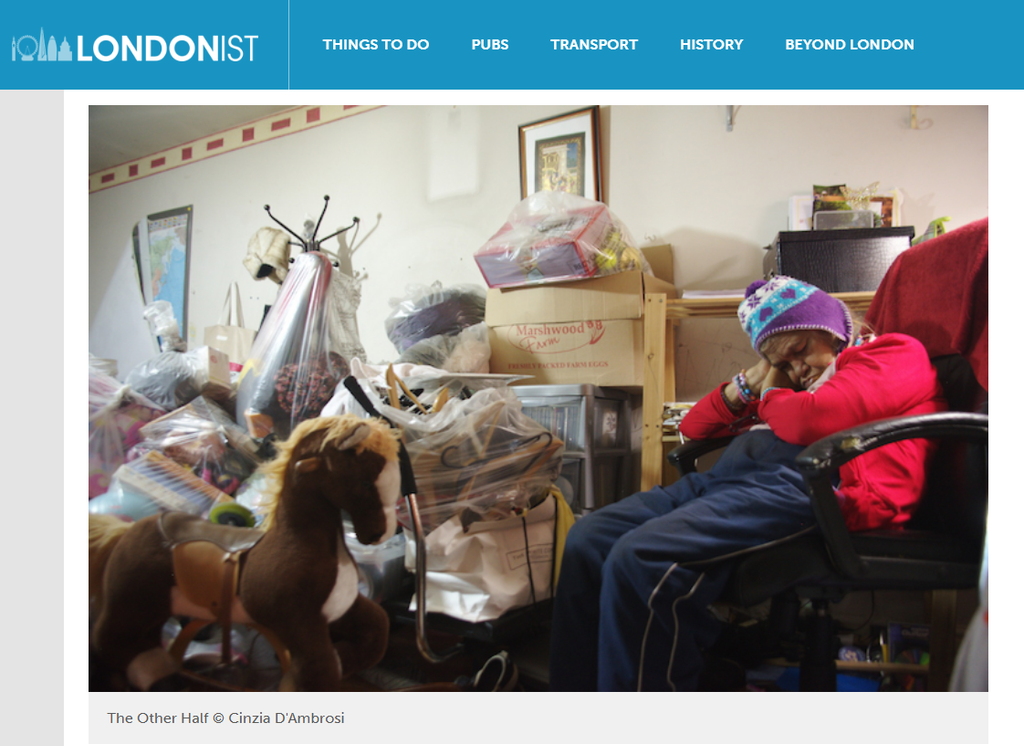
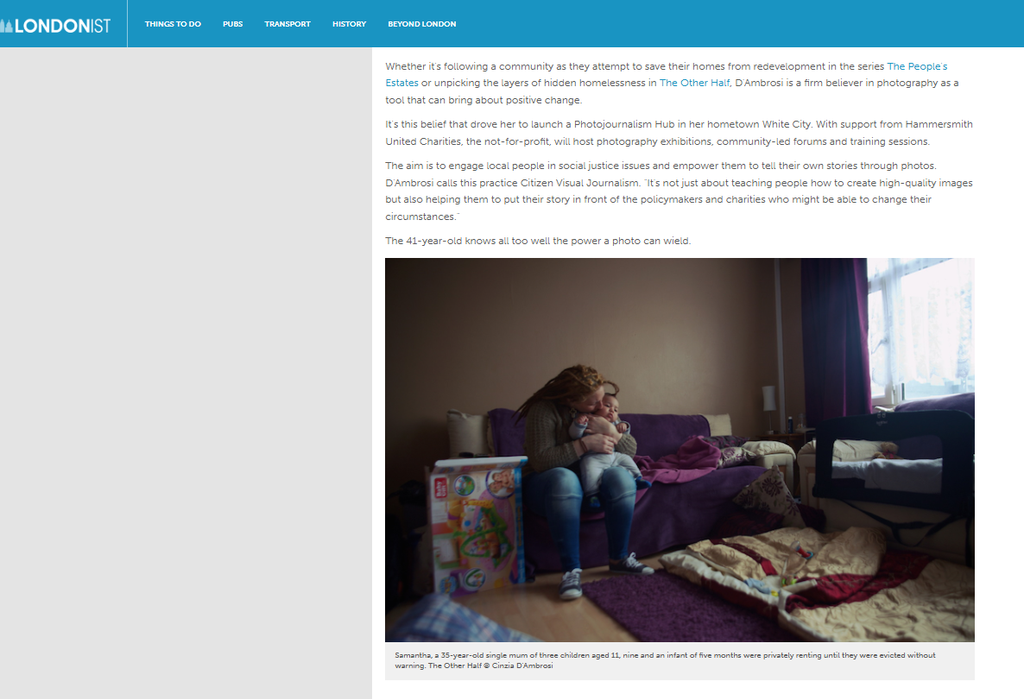
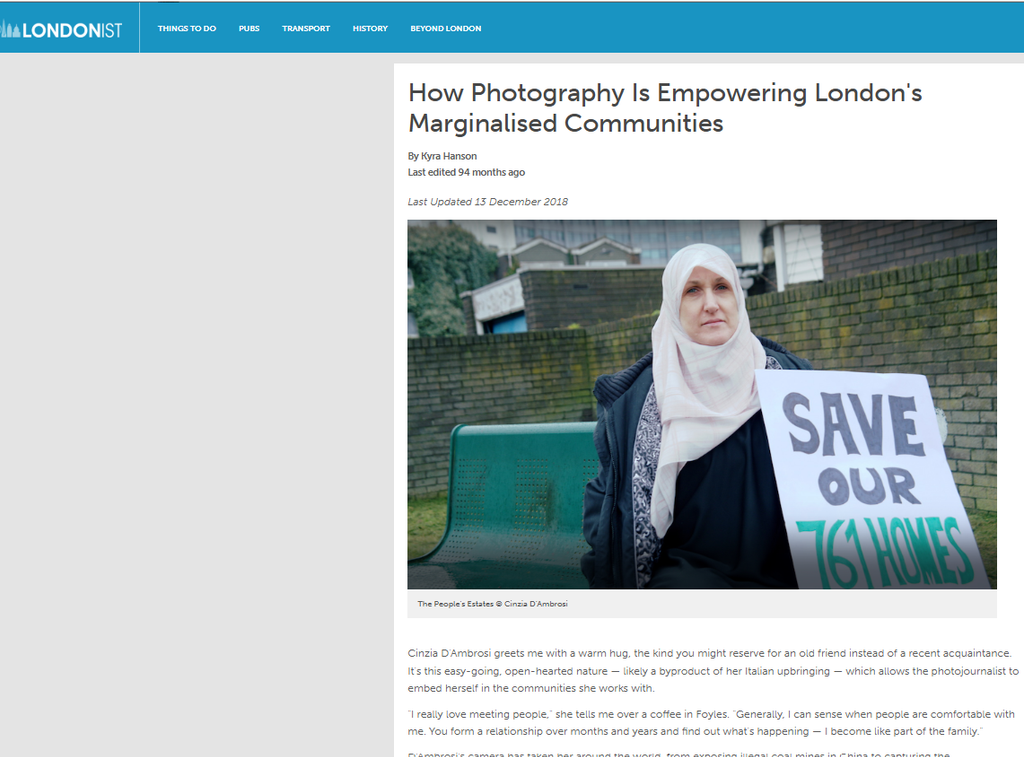
In December 2018, Londonist featured the work of photographer and Photojournalism Hub founder Cinzia D’Ambrosi in an article exploring how photography can give visibility to communities affected by poverty, housing insecurity, discrimination and social exclusion.
The article focuses on D’Ambrosi’s long-term work with communities in west London, including The People’s Estates, which documented residents facing redevelopment and the threat of losing their homes, and The Other Half, which explored the experiences of people living with hidden homelessness.
It also introduced the Photojournalism Hub, then newly established in White City with support from Hammersmith United Charities. The Hub was founded on the belief that photography can be more than a way of documenting social issues: it can be a way for people to tell their own stories, create dialogue and bring their experiences to those with the power to influence change.
At the time, D’Ambrosi described this approach as Citizen Visual Journalism — using photography to help communities document their experiences and bring their stories to policymakers, charities and wider audiences.
The article also featured Prejudice and Us, a project developed with Protection Approaches in which young people explored their experiences of racism and prejudice through photography and peer interviews. Their work created a platform for young people to share their experiences with police and councillors.
Alongside stories of poverty, displacement and insecurity, the article recognised the resilience, family connections and strength within the communities D’Ambrosi photographed. It reflected an approach that remains central to Photojournalism Hub today: using photography to understand people’s experiences, question injustice and make stories that are too often overlooked visible.
The article was published at an important moment in the development of Photojournalism Hub, documenting the ideas and values that shaped the organisation from its earliest days.
A new community-led Photojournalism Hub launched at Imperial’s White City Incubator this week.
In November 2018, Imperial College London reported on the launch of Photojournalism Hub at its White City Incubator, marking the beginning of a new community-led initiative founded by photographer and journalist Cinzia D’Ambrosi.
Supported by Hammersmith United Charities, the Photojournalism Hub was established with a clear purpose: to use photojournalism to generate positive outcomes for vulnerable communities and individuals, while supporting the development and dissemination of photojournalistic work.
From the outset, the Hub brought together photography, journalism, social justice and community engagement. Its programme was intended to include exhibitions, investigative visual and written content, debates, community-led forums, training and research, creating opportunities for people to engage with important contemporary social justice issues through photography.
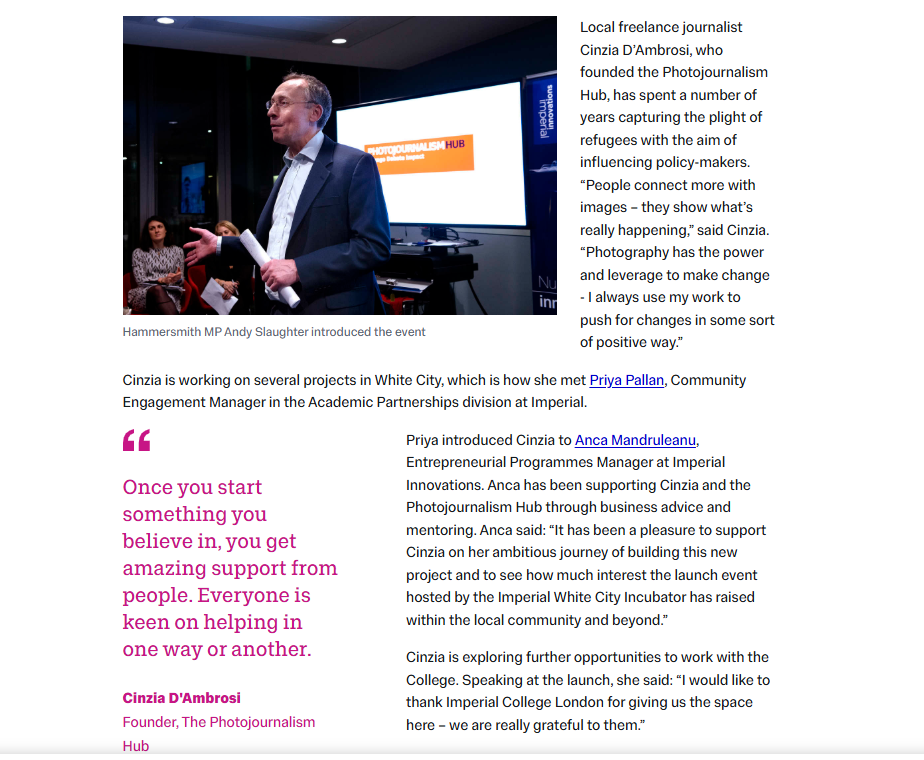
The launch was introduced by Andy Slaughter MP, then MP for Hammersmith, alongside local activists, journalists and photographers. Among the speakers was Daniel Renwick, who presented Failed by the State, his film made following the Grenfell Tower fire. Other contributors included Katie Webb of the Writers’ Union of Italy and veteran photojournalist David Hoffman.
The article also introduced Citizen Visual Journalism, a concept developed by D’Ambrosi through Photojournalism Hub. The idea was to enable community groups and individuals to learn how to tell their own stories through high-quality images and to identify and raise social justice issues that matter to them.
Rather than simply documenting communities, the approach aimed to give people the tools to communicate their experiences and reach those with the power to influence policy and create change.
The launch at White City established the foundations for what Photojournalism Hub continues to develop today: using photography and visual journalism to question injustice, amplify overlooked voices and create opportunities for communities to tell their own stories.