The Photojournalism Hub Calendar 2026 showcasing the incredible work of photojournalists and documentary photographers who have contributed to our mission.
Hundreds protest outside Home Office against Rwanda deportation plan and they shout ‘Refugees are welcome here’. This is the message voiced by demonstrators opposing the government policies which sees deportation of some refugees to Rwanda.
The government claims the policy, belonging to the Nationality and Borders Act, of removing migrants who arrive in the UK illegally will deter people from making dangerous channel crossings, however many including bishops of England have condemned the move as being uncompassionate and intricately divisive and racist.
Among the huge numbers of protesters, many MPs voiced their anger at the policy, including former Labour leader Jeremy Corbyn who spoke out: “It is an utter disgrace that the British government and other European governments are proposing to outsource refugee processing as Australia. We have to say, ‘Absolutely no!”
Campaign groups such as Care4Calais , activists from various campaign groups gave speeches and chanted: “say it loud, say it clear, refugees are welcome here”.
The effort of these groups, PCS Union and Stand Up to Racism organisations, and all those that have opposed the policy, have mounted a forceful legal challenge to stop the first scheduled flight to Rwanda as part of the offshore detention plan. Solidarity is uniting people as more protests are organised to challenge the government plans.
BECOME A PJH MEMBER Consider becoming a member of the Photojournalism Hub and receive the benefits of free access to events, PJHub resources, editorial content, annual portfolio reviews and photography exhibitions, and lots more! whilst supporting our work advocating, advancing social justice and human rights through engaging the public to independent photojournalism and documentary photography. How to join HERE
We can learn someone’s name, age, job and where they live. We can ask about their interests, hobbies and how they spend their time. We can acquire many facts and details about them, but can we say we truly know that person?
I believe to really know another we need to go deeper than the surface level, delve beneath the trivia and touch upon one’s core. We must unearth the defining moments in a person’s life and understand what has shaped them. Ask about their deepest fears, their hardships and come to understand their dreams, passions and longings. When we discover the complex, messy and beautiful nuances of a person, we are beginning to know them.
And this is what the Knowing You project is all about. It is about going beyond the small talk and making those connections. It’s asking us to break down barriers and cross unknown territory. It is bringing women from diverse backgrounds together and learning who they really are underneath the exterior glaze. Through the project I hope to truly get to know the other women participating and allow myself to be known to others. I am excited for the journey to unfold and to see how this manifests in the photographs taken.
The current Covid-19 pandemic has disproportionately affected communities and people who were already marginalised, discriminated, and at the throng of continuous injustices and inequalities. We are bringing together stories, investigations from around the world to highlight and advocate and create the important exposure to leverage and bring about positive changes. In the 9th edition of the Journal on “Injustice & Inequalities: Covid-19”, we present the work of two great photographers Richard Juilliart and Tomás Cajueiro.
Richard Juilliart shares his in-depth and poignant documentary on the conditions of the Rohingya displaced population in Bangladesh. For over twenty years, the Rohingya people have suffered the atrocities of racism, violence and displacement. Their plight has only intensified with the current Covid-19 pandemic rendering them extremely vulnerable to infections due to poor, inadequate, and terrifying living conditions in the refugee camps of Cox Bazar in Bangladesh.
Tomas Cajueiro’s work maps the emptiness of our known world filled by the incessant work of volunteers. Interposing the empty streets with the portrays of those filling them, Tomas is presenting a touching documentation of collective and personal experiences of the Covid-19 pandemic.
The pandemic has widened social inequalities and injustices and this journal is sharing realities, issues and disparities that we need to see, reflect upon and action.
The Rohingya people are a stateless Muslim minority in the western Myanmar state of Rakhine. They have been forced out of Myanmar (also known as Burma) by violence and racism for more than 20 years. Myanmar’s government refuses to recognize the Rohingya people as one of the 135 official minority groups in the country, denying them citizenship as long as they identify as Rohingya. The most recent crisis began in August 2017 when hundreds of thousands of Rohingya people — more than half of whom were children —fled violence against them by seeking refuge in neighboring Bangladesh.
Currently estimated to include a million people, most of these refugees have settled in the Cox’s Bazar region of Bangladesh, living in sprawling refugee camps. The largest camp houses as many people as the City of Baltimore but in a space occupying only five square miles (13 square kilometers). These temporary settlements were put up very quickly, leading to concerns about WASH (Water, Sanitation and Hygiene), shelter and safety for women and girls.
The arrival of COVID-19 in the Cox’s Bazar area has raised concerns about the health of the Rohingya refugees occupying the settlements. The tight spaces, accompanied by the lack of access to basic services, especially healthcare, leave those residing in Cox’s Bazar especially vulnerable to the virus. As a result of these concerns, Bangladesh imposed a complete lockdown on Cox’s Bazar with only critical aid and healthcare staff being allowed to enter and exit the area. Aid agencies working in Cox’s Bazar have mobilized Rohingya volunteers to support hygiene and prevention messaging in order to avoid the spread of COVID-19. As they work to limit the spread within the camps, relief and response workers have started transitioning away from collective points of distribution into delivering supplies directly to the households of people at high-risk of COVID-19.
Despite the best efforts of healthcare organizations, aid agencies and Rohingya volunteers, the first case of COVID-19 in Cox’s Bazar was confirmed on May 15, 2020, with the first death confirmed on May 30, 2020. As of Dec. 31, 2020, more than 360 cases of COVID-19 have been confirmed among the Rohingya refugee community in Cox’s Bazar with another 5,200 in the surrounding region. Of those cases, 10 members of the refugee community have died from COVID-19 along with another 72 from the surrounding region. In addition to the toll COVID-19 is taking on the physical health of Rohingya refugees, the increased restrictions on aid and aid workers have also reduced the amount of mental health support available to these displaced people.
Newly arrived Rohingya refugees waiting for food aid at Kutupalong camp on April 16, 2018 in Cox’s Bazar, Bangladesh.
Over 650,000 Rohingya have crossed the border to Bangladesh since August last year, fleeing the violence.
Rohingya people walk around as shelters are seen behind them at Kutupalong refugee camp in Maynar Guna, near Cox’s Bazar, Bangladesh on April 16, 2018. Rohingya people, who fled from oppression in Myanmar, try to live in hard conditions at makeshift settlements made from bamboo, adobe or nylon at Kutupalong refugee camp. Over 650,000 Rohingya have crossed the border to Bangladesh since August last year, fleeing the violence
Newly arrived Rohingya refugees waiting for food aid at Kutupalong camp on April 16, 2018 in Cox’s Bazar, Bangladesh.
Over 650,000 Rohingya have crossed the border to Bangladesh since August last year, fleeing the violence.
Newly arrived Rohingya refugees waiting for food aid at Kutupalong camp on April 16, 2018 in Cox’s Bazar, Bangladesh. Over 650,000 Rohingya have crossed the border to Bangladesh since August last year, fleeing the violence.
Rohingya refugee at the Kutupalong transit center . Over 650,000 Rohingya have crossed the border to Bangladesh since August last year, fleeing the violence.
A Rohingya refugee woman holds her young child .
Over 650,000 Rohingya have crossed the border to Bangladesh since August last year, fleeing the violence.
Rohingya refugee is seen at hospital at Kutupalong camp on January 17, 2018 in Cox’s Bazar, Bangladesh.
In November 2017 there were 7 named camps in Kutupalong, now there are 20 and there are now approximately 600,000 Rohingya refugees in the Kutupalong refugee camp of Southern Bangladesh. While preparations are now being made for the Monsoon season which is fast approaching.
A 90-year-old Rohingya refugee talks with his granddaughter. They walked more than 7 days before crossing the border at the Kutupalong transit center. Over 650,000 Rohingya have crossed the border to Bangladesh since August last year, fleeing the violence.
Rohingya refugee at the Kutupalong transit center . Over 650,000 Rohingya have crossed the border to Bangladesh since August last year, fleeing the violence.
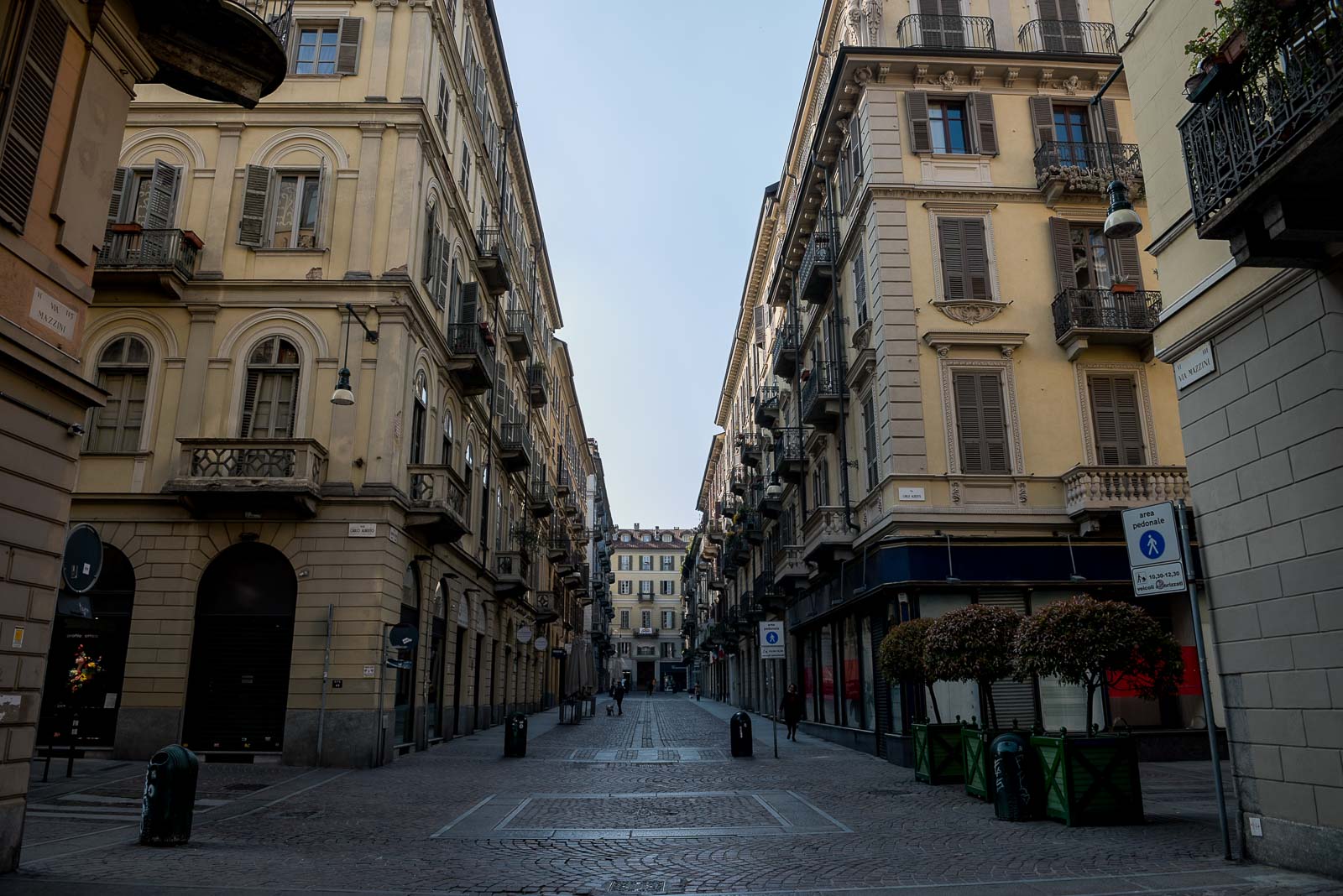
It was March 2020 when suddenly everything stopped. Gone in an instant cars horns and noises, the shouting in the bars, the curious glances in the museums, the screams of the kids in the park. Maybe we’ve never really given the proper attention to the importance of all those small details as they have always been there available. Why worry about losing something that we’ve never lost? Then COVID came, and suddenly everything was not there anymore. In just a few weeks, all changed, and we were deprived of these simple but essential things. Nothing has been the same as before. Suddenly the world became empty. However, that void was immediately filled by the volunteers who, wearing a mask, placed themselves at the service of all those who held out a hand in search of help. Volunteers were the human face emerging out of the emergency.
It was in such a situation that ‘Dal vuoto, al volto’ was born. ‘Dal vuoto, al volto’ (‘From the void to the face’) is a photo reportage produced by Tomás Cajueiro that register Turin in the pandemic period through the eyes of a photographer who was recently arrived in the city. A photographic journey under the banner of the strength of a community that, while facing an epochal challenge, sees an important part of its citizens unite to fight the immediate social effects of the inevitable economic crisis.
A project that combines the emptiness of the streets with the faces of the volunteers. Taken partly in the streets of different neighbourhoods and partly within non-profit associations that continue to work, the reportage ‘From the void to the face’ creates a historical testimony of a particular moment characterized by isolation and social distancing but which brings many citizens closer to the values left out in everyday affairs.
Under the silence of the main streets and the solitude of the parks, Turin society has moved and has shown enormous strength and resilience, which is highlighted in the second part of the series: portraits with and without masks, in the foreground, of the volunteers who fight the pandemic in its various aspects. Pictures that show the faces behind the masks, which give a human look to the emergency.
The images were taken in various Turin associations, in partnership with Torino Solidade, Volontariato Torino, Circo li Arci and Case del Quartiere. Remember who the volunteers are facing the health risk, have been at the forefront in the fight against the social impacts caused by Coronavirus emergency.
Tomás Cajueiro is a photographer with a long experience in producing reportages capable of proposing with feeling a reflection on people’s lives and how differences, starting with cultural ones, can ennoble and enrich the world around us.
The Turin Volunteer Service Center promotes and supports Volunteers’ presence and role in Third Sector Entities, with particular reference to Volunteer Organizations, providing free technical, logistical, training, and information support services.
The Turin Volunteer Service Center enthusiastically shared Tomás Cajueiro’s project. It offered a privileged position to tell the world of Turin volunteering and how it mobilized to provide immediate responses to the new needs arising from the health emergency.
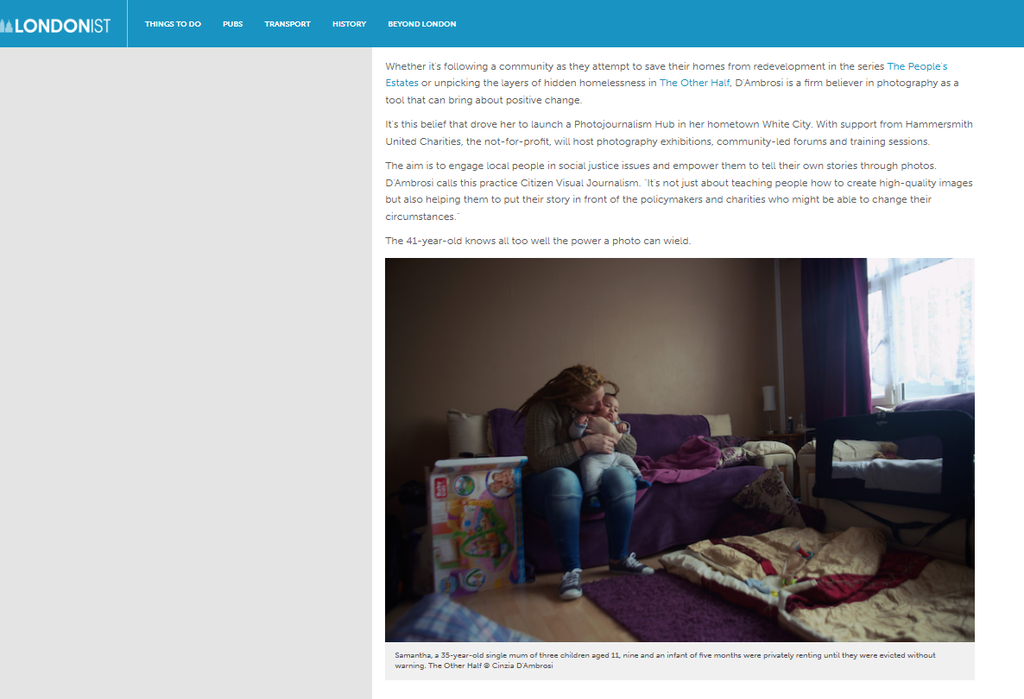
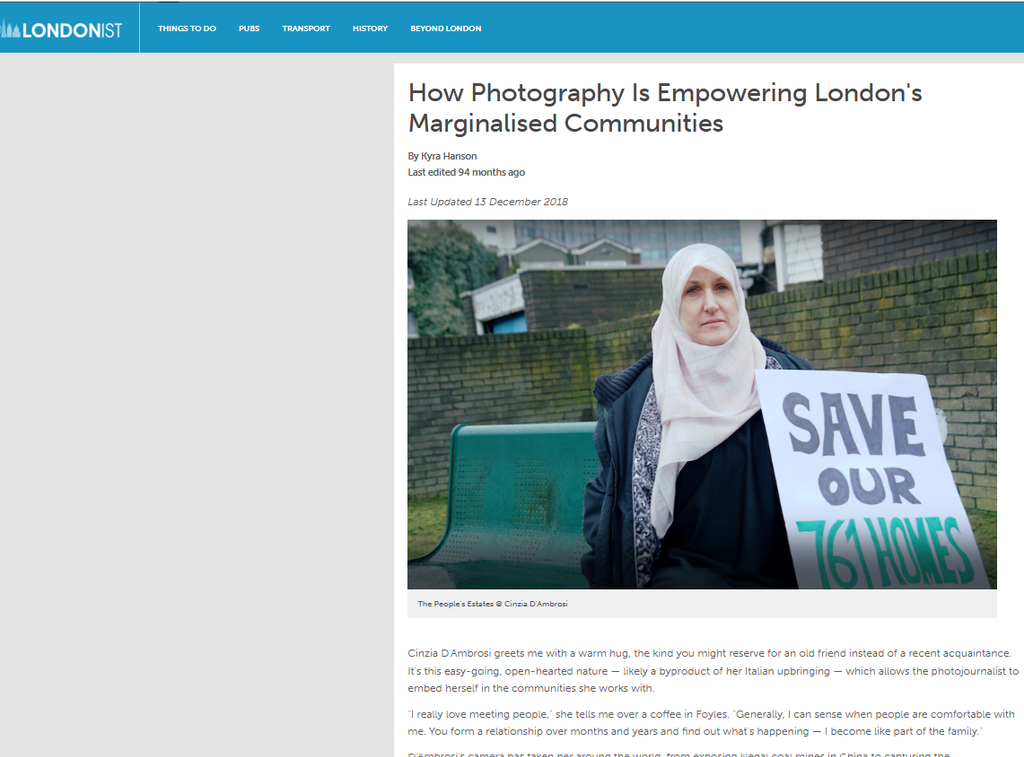
In December 2018, Londonist featured the work of photographer and Photojournalism Hub founder Cinzia D’Ambrosi in an article exploring how photography can give visibility to communities affected by poverty, housing insecurity, discrimination and social exclusion.
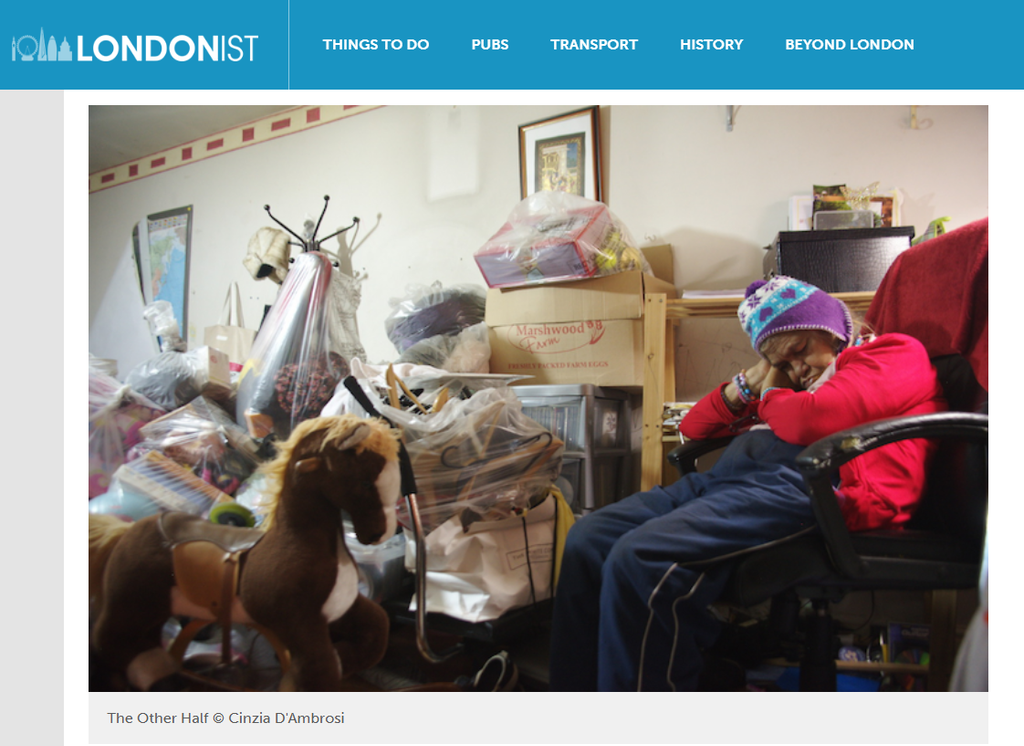
The article focuses on D’Ambrosi’s long-term work with communities in west London, including The People’s Estates, which documented residents facing redevelopment and the threat of losing their homes, and The Other Half, which explored the experiences of people living with hidden homelessness.
It also introduced the Photojournalism Hub, then newly established in White City with support from Hammersmith United Charities. The Hub was founded on the belief that photography can be more than a way of documenting social issues: it can be a way for people to tell their own stories, create dialogue and bring their experiences to those with the power to influence change.
At the time, D’Ambrosi described this approach as Citizen Visual Journalism — using photography to help communities document their experiences and bring their stories to policymakers, charities and wider audiences.
The article also featured Prejudice and Us, a project developed with Protection Approaches in which young people explored their experiences of racism and prejudice through photography and peer interviews. Their work created a platform for young people to share their experiences with police and councillors.
Alongside stories of poverty, displacement and insecurity, the article recognised the resilience, family connections and strength within the communities D’Ambrosi photographed. It reflected an approach that remains central to Photojournalism Hub today: using photography to understand people’s experiences, question injustice and make stories that are too often overlooked visible.
The article was published at an important moment in the development of Photojournalism Hub, documenting the ideas and values that shaped the organisation from its earliest days.
A new community-led Photojournalism Hub launched at Imperial’s White City Incubator this week.
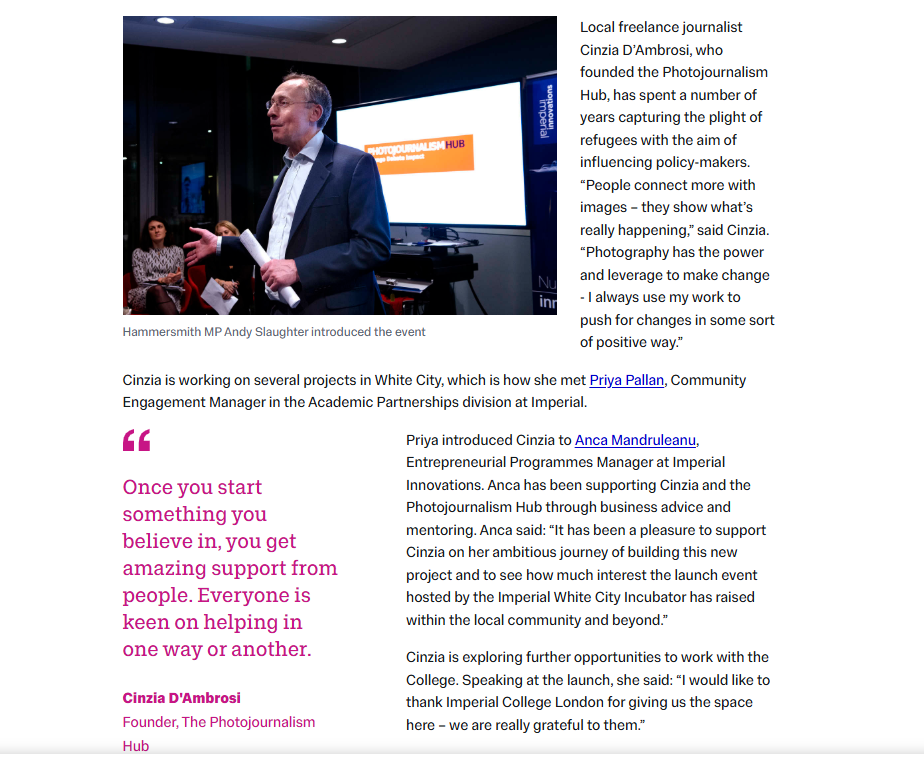
In November 2018, Imperial College London reported on the launch of Photojournalism Hub at its White City Incubator, marking the beginning of a new community-led initiative founded by photographer and journalist Cinzia D’Ambrosi.
Supported by Hammersmith United Charities, the Photojournalism Hub was established with a clear purpose: to use photojournalism to generate positive outcomes for vulnerable communities and individuals, while supporting the development and dissemination of photojournalistic work.
From the outset, the Hub brought together photography, journalism, social justice and community engagement. Its programme was intended to include exhibitions, investigative visual and written content, debates, community-led forums, training and research, creating opportunities for people to engage with important contemporary social justice issues through photography.
The launch was introduced by Andy Slaughter MP, then MP for Hammersmith, alongside local activists, journalists and photographers. Among the speakers was Daniel Renwick, who presented Failed by the State, his film made following the Grenfell Tower fire. Other contributors included Katie Webb of the Writers’ Union of Italy and veteran photojournalist David Hoffman.
The article also introduced Citizen Visual Journalism, a concept developed by D’Ambrosi through Photojournalism Hub. The idea was to enable community groups and individuals to learn how to tell their own stories through high-quality images and to identify and raise social justice issues that matter to them.
Rather than simply documenting communities, the approach aimed to give people the tools to communicate their experiences and reach those with the power to influence policy and create change.
The launch at White City established the foundations for what Photojournalism Hub continues to develop today: using photography and visual journalism to question injustice, amplify overlooked voices and create opportunities for communities to tell their own stories.
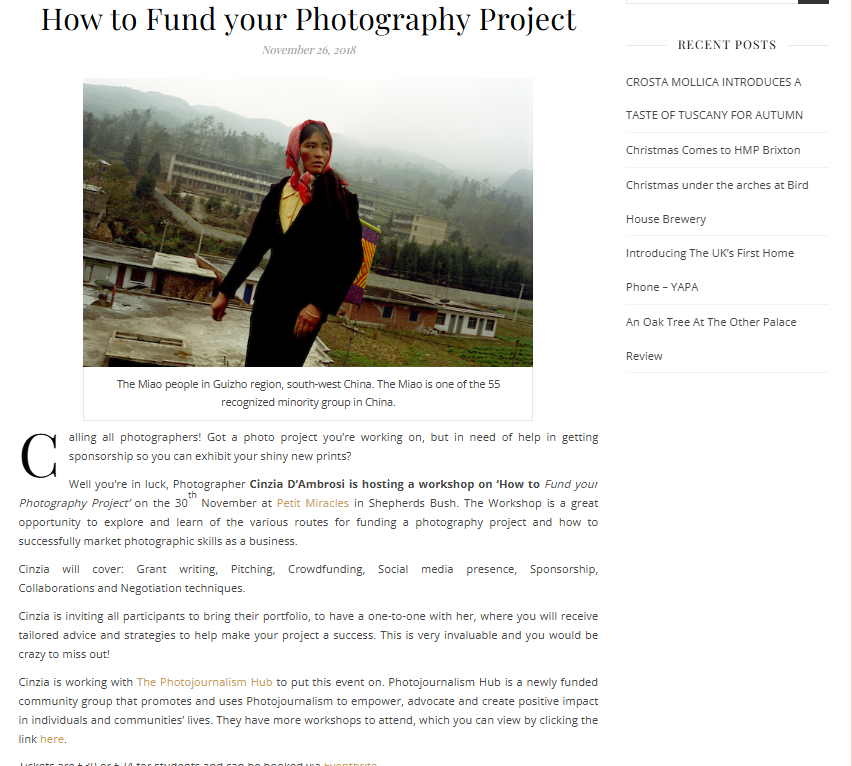
Calling all photographers! Got a photo project you’re working on, but in need of help in getting sponsorship so you can exhibit your shiny new prints?
Well you’re in luck, Photographer Cinzia D’Ambrosi is hosting a workshop on ‘How to Fund your Photography Project’ on the 30th November at Petit Miracles in Shepherds Bush. The Workshop is a great opportunity to explore and learn of the various routes for funding a photography project and how to successfully market photographic skills as a business.
Photojournalism Hub holds the first Photojournalism Nights Event on the 21st May at Elephant West Gallery, London White City!
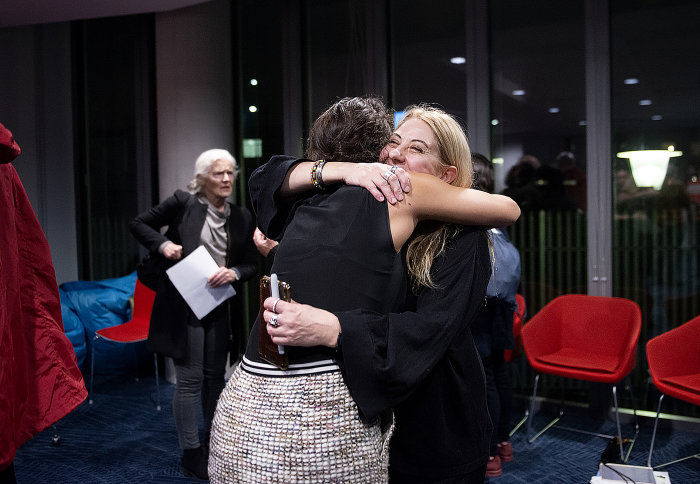
The first event dedicated purely to photojournalism is the culmination of an ambition of Photojournalism Hub founder and director, Cinzia D’Ambrosi to re-ignite the passion for this form of journalism. The event was a real success with the large gallery full of people, who engaged to high quality photojournalism and Q&A. The public also had the opportunity to win an original print of the guest photojournalists through a raffle ticket, printed with the support of Genesis Imaging. The renowned and respected Photo Archive News supported the event by selecting and publishing the work of one of the guests photographers.
Cinzia, founder/director of the Photojournalism Nights introduces the first guest photographerPhotographer Rob Pinney presents his work Wamaitha wins an original print from guest photographer Tavis BohlingerTavis Bohlinger presents his workThe public engages in a Q&A