The Photojournalism Hub Calendar 2026 showcasing the incredible work of photojournalists and documentary photographers who have contributed to our mission.
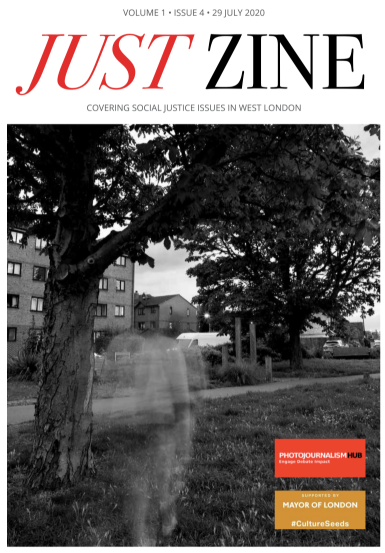
In this issue of ‘Just Zine’, we focus on domestic abuse, a deeply important and urgent issue affecting countless lives. The Covid-19 global outbreak and subsequent lockdown measures have left many women and men in vulnerable situations, some in dire need of support yet unable to reach out or be reached. Understanding the scale of this crisis continues to challenge governments, charities, and communities alike. Choosing to focus on domestic abuse was not an easy editorial decision.
The issue is complex, with many forms and dimensions of violence and control. As an editorial team, we do not claim to have all the answers, nor the ability to cover every aspect. However, through this issue, we offer a space for reflection, awareness, and empathy. Recognising and understanding the scale of this problem is itself a vital step forward. This issue of Just Zine stands as a remarkable testament to the commitment, sensitivity, and talent of our young team. Among its diverse and powerful content, you will find articles and photo stories exploring honour-based abuse, and experiences of both male and female survivors of violence. We also feature interviews with Marco Groves, CEO of the National Centre for Domestic Abuse, and poet Sir Troy Cabida.
The visual work in this issue spans from compelling photography of the Trans Rights protests in London to the deeply moving photo story “Missed Opportunities,” capturing a chance encounter with a victim of abuse. Additionally, we include children’s experiences of lockdown, creatively presented by two of our youngest contributors. Through their words and images, the contributors of Just Zine continue to raise awareness, spark dialogue, and inspire change.
Proceeds from the sale of the Photojournalism Hub 2026 Just Zine will fund bursaries for portfolio reviews for young disadvantaged photographers and a grant supporting the development of an emerging photographer’s photojournalism project.
The Photojournalism Hub in partnership with the Sulgrave Youth Club is offering a unique free documentary photography and photojournalism course for young people as part of the celebrations marking Sulgrave Youth Club’s 100th anniversary. The project is free for young people to join and it is part of the celebrations leading up to the 100th anniversary of the Sulgrave Youth Club.
We are looking for passionate local young people aged 16–30 who dream of building a career in media or the creative industries and want to gain hands-on experience in documentary photography, video, and sound recording.
The programme unfolds in three dynamic phases, offering
– Practical training in documentary photography and visual storytelling – One-to-one mentorship – Specialist sessions in exhibition curation and public presentation
Participants will be offered the opportunity to see their work published and showcased online, in print, and at the Sulgrave’s Centenary Exhibition!
By the end of the course, participants will have developed a strong portfolio, professional experience, and an enhanced CV opening doors to exciting pathways in photography, journalism, and the wider creative sector.
November – January: Photography and Video Workshops
January – June: One to one mentorship with project review and presentation Curatorial workshop (Date to be confirmed)
June – August Exhibition and post exhibition involvement in the various aspects learning how to present and manage an exhibition. There will also be opportunities to be hired as photographers during the three days Sulgrave Centenary event in June 2026.
Facilitators Workshops will be delivered by Cinzia D’Ambrosi, founder and director of Photojournalism Hub and an experienced photojournalist, with support from guest photographers and video professionals.
Why join? This is your chance to gain professional level experience, build your creative skills, and be part of a large public event.
The project is kindly supported by the King Charles III Coronation Youth Fund:
Shadow Photography Project Coordinator‘Lens on a Century’
Project: Lens on a Century – Documentary Photography Workshops & Exhibition Organisation: Photojournalism Hub Location: Sulgrave Youth Club, 287 Goldhawk Rd, London W12 8EULondon Rate: £13 per hour Eligibility: Young people aged 18–25 Contract: Freelance, project-based (flexible hours)
About the Role We are seeking a motivated young person to join the Photojournalism Hub as a Shadow Project Coordinator. This is a learning-focused role designed to support the delivery of ‘Lens on a Century’ photojournalism and documentary photography project, which includes documentary photography workshops and a public exhibition celebrating the Sulgrave Youth Club’s 100-year history and community impact. The successful candidate will shadow the Project Lead (Cinzia D’Ambrosi) and gain hands-on experience in coordinating and supporting a community-based photography project. This role is particularly suitable for someone interested in photography, community engagement, or cultural production, and who would benefit from close mentoring and practical experience.
Key Responsibilities Under guidance and supervision, the Shadow Project Coordinator will support: The planning and delivery of documentary photography workshops Assisting in coordinating activities with the participants of Lens on a Century project. Basic project administration (emails, notes, timelines, documentation) Assisting with evaluation and reflective learning from the project Supporting exhibition preparation
What You will Gain Direct mentoring from an experienced documentary photographer and project director Practical experience in delivering a community-focused cultural project Insight into exhibition production and public engagement Skills in coordination, communication, and arts project delivery A supportive environment that values lived experience, creativity, and learning
Who We are Looking For Aged 18–25 Based in Hammersmith & Fulham Interest in photography, arts or community projects Good communication skills and a willingness to learn Reliable, organised
Desirable An interest in documentary photography or visual storytellingLived experience of barriers to access in arts, culture, or educationWe particularly encourage applications from young people who are underrepresented in the cultural sector.
Support & Accessibility We are committed to making this role accessible. Adjustments and support can be discussed to ensure the role is inclusive and responsive to individual needs.
How to Apply To apply, please email us at admin@photojournalismhub.org with: Your name, age, and your London postcode. A few lines telling us why you would like to apply for this role and a CV.
We are much more interested in your interest, and motivation than in formal experience. There is no requirement to have worked on similar projects before.
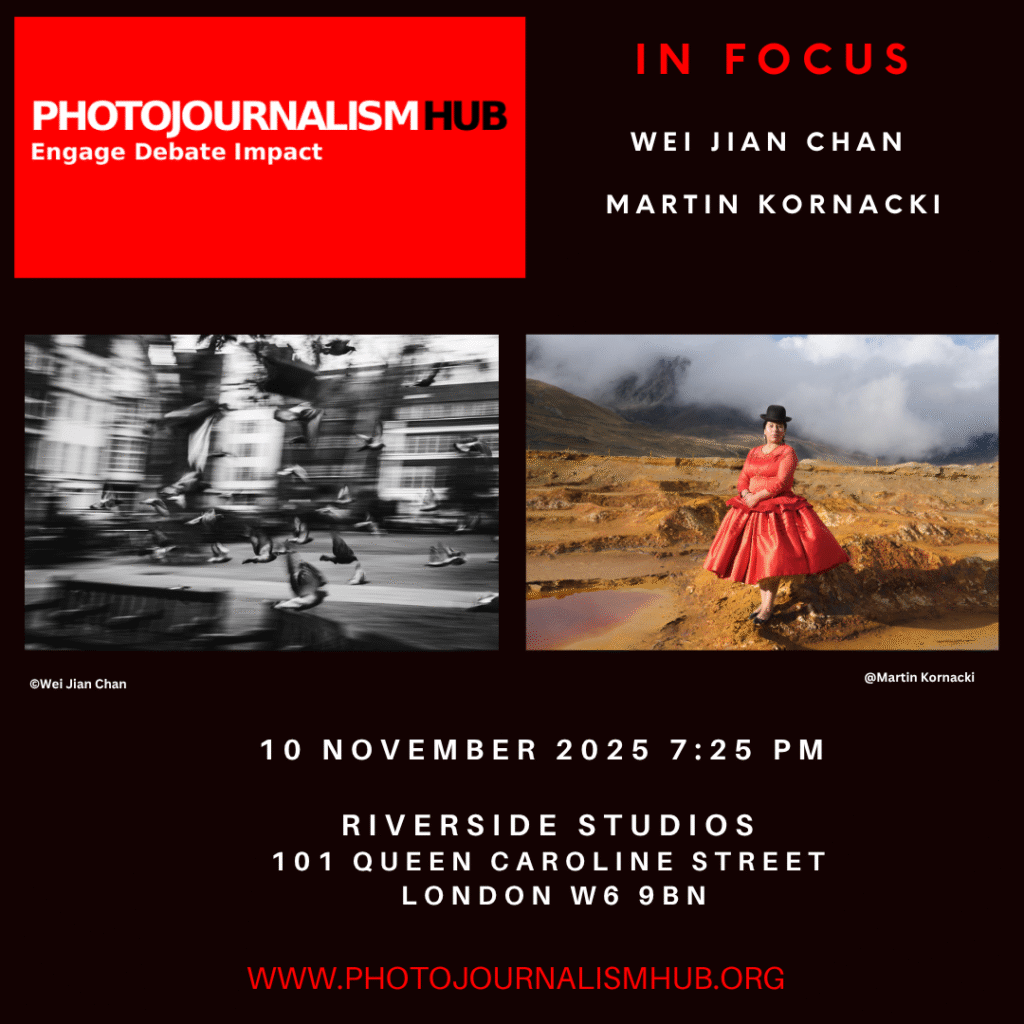
This edition of IN FOCUS brings together two photographers whose practices, while distinct in subject and style, both explore how history, memory, and identity shape lived experience. Marcin Kornacki’s long-term documentary projects in Haiti and Bolivia investigate the legacies of political violence and the endurance of communities in unstable landscapes. In contrast, Wei Jian Chan’s Journey to the West reflects on the personal journey of migration, using the formal language of street photography to evoke dislocation and belonging. Together, their presentations offer powerful insights into working independently in challenging environments, and into photography’s ability to bridge the political and the personal.
Marcin Kornacki is a London-based documentary photographer and UAL Photojournalism and Documentary Photography MA graduate whose work explores memory, landscape, and the marks of collective history. His practice draws stories to the surface through close attention to place and the unpredictability of encounter. His current projects focus on sites where political violence and colonial legacies remain alive in land and memory. His ongoing work in Haiti documents its capital Port-au-Prince as it descended into gang control, tracing the layered aftermath of revolution, foreign intervention, and daily survival, documenting both the gangs terrorising the city as well as the people enduring the conflict. In Bolivia, he photographs the mining communities around La Paz, focusing on Milluni, site of a government-led miners’ massacre in 1965, examining how resistance and political narratives endure and develop across generations. Grounded in sustained fieldwork and research, Martin’s photography connects personal testimony with broader historical forces. His images invite reflection on how memory is shaped, how trauma is carried, and how communities protect identity in the face of erasure. His talk aims to focus on the practical aspects of working independently with little training and no official support in conflict zones and politically unstable regions, reflecting in particular on the mistakes he has made, and the lessons he has learnt during his most recent work in Haiti and Bolivia.
Wei Jian Chan (b.1991) is a Singaporean-born photographer based in London, whose work seeks to find beauty in the chaos of modern life. Wei Jian first picked up a camera at the age of 14 while growing up in Singapore. Over the years, as he moved to Oxford to attend university and to London for work, the camera has been his constant companion. In his time behind the camera, photography has grown from a pastime into a source of inspiration and a passport to new experiences. Working primarily in black-and-white, Wei Jian utilises both traditional wet darkroom processes and modern digital techniques in his work. His work frequently incorporates elements of geometry, architecture, and motion. Wei Jian’s photography has been exhibited in various locations in the UK and Europe, and has been acquired to form part of the permanent collection of the Kiyosato Museum of Photographic Art. His work has also been featured by numerous outlets, including The Guardian, Deutsche Welle and National Geographic. Wei Jian will be showcasing images from his debut photobook ‘Journey to the West’, published by Setanta Books. This book features his black and white street photography, and seeks to evoke the sense of dislocation and uncertainty that Wei Jian experienced in the early years of moving from Singapore to the UK, during which he set about to integrate into a foreign culture and find his place in the world. The title ‘Journey to the West’ comes from a Ming dynasty Chinese myth about the journey of the Buddhist monk Xuanzang who travelled to the ‘Western Regions’ to obtain Buddhist sacred texts (sutras).
The event IN FOCUS is presented by the Photojournalism Hub in collaboration with Riverside Studios, bringing to the public compelling and thought-provoking contemporary documentary photography and photojournalism.
Between Gaza and Naples. A Childhood Story by Mahmoud Abu Al-Qaraya and Tylerdurdan is born from the encounter of two free voices coming from distant worlds, yet united by the same urgency to bear witness. On one side, Mahmoud Abu Al-Qaraya, a 29-year-old photographer from Gaza, who after years of hard work and recognition saw his career and his life shattered by war: his family displaced four times, the loss of his camera — his only working tool — and a daily struggle against hunger, disease, and constant bombardment. On the other side, Raffaele Annunziata, a Neapolitan photographer and artist known as tylerdurdan*, who for over a decade has combined music, images, and words as a form of cultural resistance, with the aim of denouncing injustice and restoring centrality to what makes us human. Together, they have chosen to tell — through parallel photographs — the everyday life of two little girls, one in Naples and the other in Gaza.
Soso – Gaza, 2025
Between Naples and Gaza. A Childhood Story Two distant cities, one childhood to defend.
Dede – Naples, 2025
Scenes that appear simple elsewhere (playing, going to school, having breakfast) become almost impossible under siege. Between Naples and Gaza. A Childhood Story is not only a photographic project, but a narrative and ethical bridge: to give voice to those at risk of being silenced, reminding the world that childhood is a universal right. The project also supports the campaign “Mahmoud Loves Photography, Family & Life ”, a concrete appeal to help Mahmoud and his family rebuild their life and his work as a photographer.
Wake up in NaplesWake up in Gaza
On the way to school in NaplesOn the way to school in Gaza
Between Gaza and Naples. A Childhood Story is a project bringing together two perspectives: Raffaele Annunziata (tylerdurdan), an artist from Naples, and Mahmoud Abu Al-Qaraya, a photographer from Gaza. Through parallel images, we tell childhood in two distant worlds, to remind the world that childhood is a universal right.
Soso and her friend, barefoot, play by gently touching each other and laughing. For a moment, there is nothing but joy. Dede runs and laughs with her friends, her world filled only with games and joy.
Mahmoud Abu Al-Qaraya Together, they have chosen to tell — through parallel photographs — the everyday life of two little girls, one in Naples and the other in Gaza. Scenes that appear simple elsewhere (playing, going to school, sleeping) become almost impossible under siege. Between Naples and Gaza. A Childhood Story is not only a photographic project, but a narrative and ethical bridge: to give voice to those at risk of being silenced, reminding the world that childhood is a universal right.
Mahmoud Abu Al-Qaraya is a 29-year-old photographer and online trader from Gaza, whose life has been marked by passion, tragedy, and resilience. Before the aggression of October 7, 2023, Mahmoud was building a promising career: photography and Amazon trading were not only his livelihood but also his way of capturing the beauty of his city and telling the story of his people. Since the beginning of the war, his family has been displaced four times; he lost his home, his camera — the starting point of his entire work — and all of his savings were consumed. Many of his friends and relatives have been killed or remain missing. Mahmoud himself was ill, and airstrikes — but he holds on to his dignity, his art, and his voice. He was abducted and tortured for two weeks, an experience that left deep scars. Despite all this, he keeps on fighting: every day he faces hunger, thirst. His mission is clear: to use photography not just to witness pain, but to carry hope — so the world can see, remember, and act. Through Between Naples and Gaza. A Childhood Story, Mahmoud aims to share both his story and that of those who, like him, live under the weight of conflict but continue to resist with humanity.
Raffaele Annunziata is a Digital Media Strategist, author, and speaker, and the founder of Seed Media Agency, established in 2012. He holds degrees in Cultural Heritage Management and Cinema, Television and Multimedia Production, combining his artistic background with over 20 years of experience in digital communication. At Seed Media Agency, he has designed storytelling strategies that merge creativity, ethics, and digital innovation for clients across multiple industries. A passionate urban photographer, he documents reality through the lens of a Fujifilm X‑T5, crafting an authentic visual narrative. With the project ‘ Raffele Annunziata (tylerdurdan), he brings together his technological and visual expertise with music and poetry, becoming the unmistakable voice of a human author in the age of AI. With his media account tylerdurdan, he weaves photography, writing, and generative AI music into a single narrative, convinced that every artistic act is a political one — a gesture of resistance in defence of minorities and, above al, of the Palestinian cause.
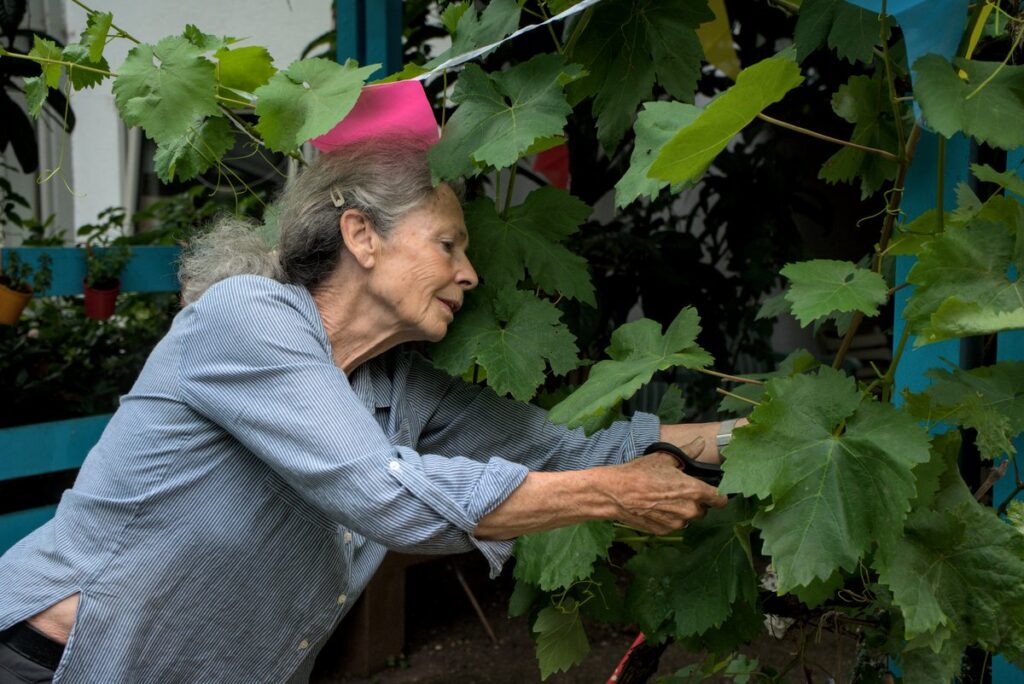
In 2012 I retrained in horticulture at the Capel Manor site in Regent’s Park. After two years of study I set up my own garden maintenance business and continue to work.
I’ve been concerned about climate change for 20+ years and have been protesting about that and Making Poverty History since I was a teenager with Global Justice Now! It’s clear it’s the poorer countries who are suffering most from disasters such as floods, hurricanes and earthquakes.
My ‘greening’ project relates to the trees planted in public spaces, which do several things to make life better. Trees are essential to human life, providing oxygen and purifying the air by absorbing carbon dioxide and filtering pollutants.
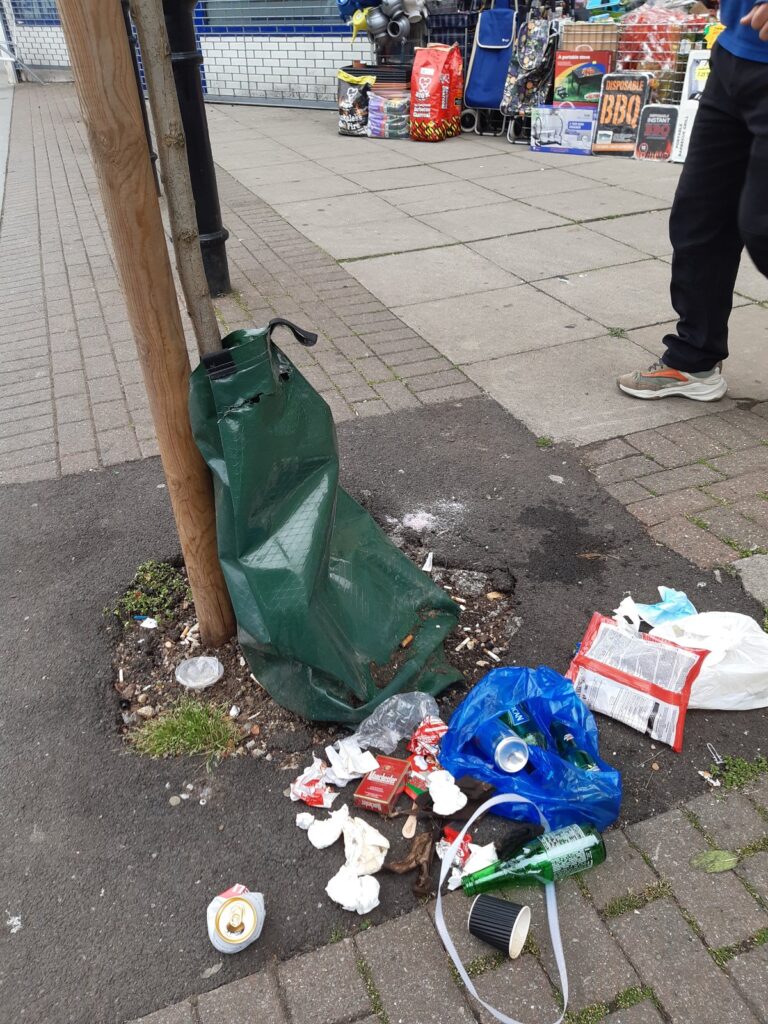
Straight away I noticed there were two young trees opposite Church Street library, with tree jackets that are meant to enable easier watering. However, I was horrified to find them regularly stuffed full of litter and detritus.
I tried to engage with one or two street cleaners and spoke to Muhammad Aziz, pictured. It’s quite easy to lift the tree jackets to expose the litter. In August I was able to speak to two Council staff with responsibility for Church Street market and I expressed my concerns.
I’d like to see Westminster Council being more proactive in caring better for the younger trees in particular. This summer we’ve experienced four heat waves and it should be obvious that these trees need regular watering. This is crucial during their early years in order for them to establish a good root system to ensure they survive and grow to maturity.
I’ve lived and worked in Westminster for over 40 years. A few weeks ago I spoke by phone to Curtis Fletcher, a Council representative and asked why the trees couldn’t be watered by those responsible for watering the hanging baskets. However, it appears that’s been outsourced to a private contractor.
I’d like to encourage residents who live on the ground floor where there are young street trees to lend a hand in watering them as well. We all know from the summer we’ve just experienced that the trees are still going to need our help in the years ahead.
Anne Hogben
Listen to the audio
Seeing the Green
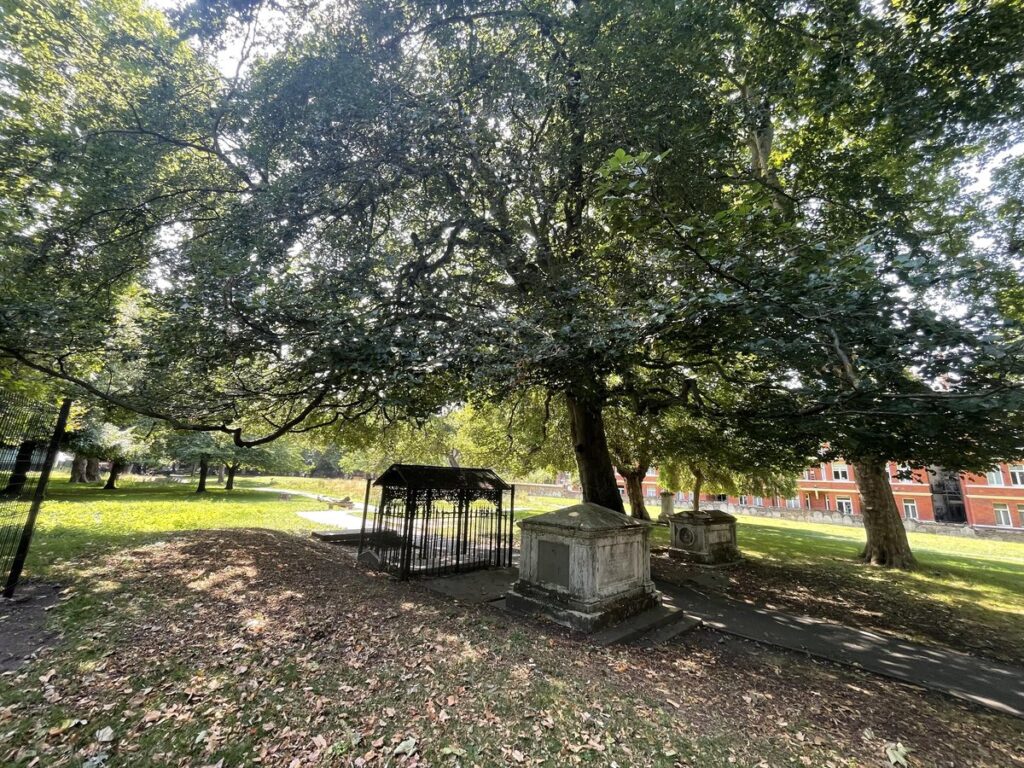
This series of six photographs explores some of the different ways that light falls and how those reflections and the shadows cast can transform or distort our perception of everyday objects in curious and unexpected ways.
The viewer is invited to slow down and pause and look again and notice how our ordinary everyday world can become something a bit strange and mysterious.
The images were captured on sunny mornings in the green spaces near the Church Street area of Westminster.
Although I’ve lived in London for more than 40 years I’m still a country girl at heart and happiest in places where I can commune with nature.
Grave yards, parks, canals and riversides have become a haven for wildlife, plants and trees who have set down their roots and adapted to urban living giving us all the opportunity to reconnect to the natural world in our everyday lives.
We walk through London’s green spaces every day. Parks, gardens, and tree-lined squares that feel like a breath of fresh air in the middle of the city. We stop to admire the flowers, we sit on the grass, we watch the leaves turn with the seasons.
But rarely do we ask ourselves: who made this possible?
Behind every well-kept lawn, every blossoming rose, every path free of weeds, there is a person. Someone who woke up early, who worked in the rain, who shaped the soil with patience and care.
These are the quiet heroes of our shared spaces. Their hands, often unnoticed, give us beauty, shade, and peace. They turn patches of land into living canvases, where we find rest, joy, and a sense of belonging.
This project is about them. About making their work visible. About showing the faces and the stories behind the gardens and parks we sometimes take for granted.
When you next walk through a park and feel the calm it brings, remember: it didn’t happen by chance. It happened because someone cared enough to tend it.
And today, it’s time we see them, not just the spaces they shape, but the people who give those spaces life.
Victoria Sanders
Listen to the audio
Green is a very calming, natural, hopeful colour. However, rather than photographing vegetation in the local area, I chose to focus on other objects that display vivid flashes of green – items that define the locality or promote community or have a beneficial environmental impact.
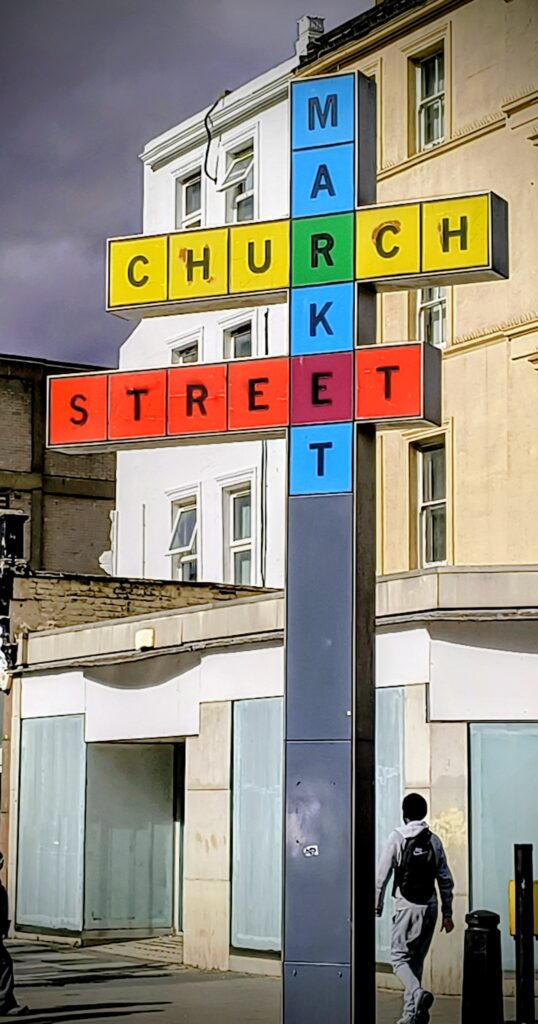
The landmark Church Street Market sign welcomes visitors to this busy, vibrant, multicultural market. The giant childlike alphabet blocks centred on the letter ‘R’ are arranged like the answer to a crossword puzzle.
The library is ‘home’ to our project and an important community space. The textured approach wall features circles reminiscent of bubble wrap just waiting to be ‘squished’.
On nearby Gateforth Street, the Cockpit Theatre makes a bold turquoise statement, its columns march into the distance protecting the theatre-in-the-round within.
A psychedelic number 98 bus stands at the Church Street Market stop. The hybrid and zero-emission buses sport a distinctive livery promoting a greener city.
The Westminster Wheels community bike shop, painted in a cool shade, encompasses environmentally friendly transport, refurbishment, recycling and retraining.
A single photo of capsicum peppers represents the vast array of market produce, the solo green fruit in strong contrast to its red counterparts.
Maria Speller
Listen to the audio
The Silent Decline of London’s Canals
The Paddington Arm and Regent’s Canal were once key trade routes, transporting coal and goods from across the country into London. With the arrival of the railway, the canals fell into decline until recent redevelopment transformed them into vital public spaces.
Today, these waterways provide accessible green areas for walking, cycling, and boating while supporting a wide range of wildlife. These restored canals now play a crucial role in urban wellbeing and biodiversity. However, pollution threatens to reverse this progress.
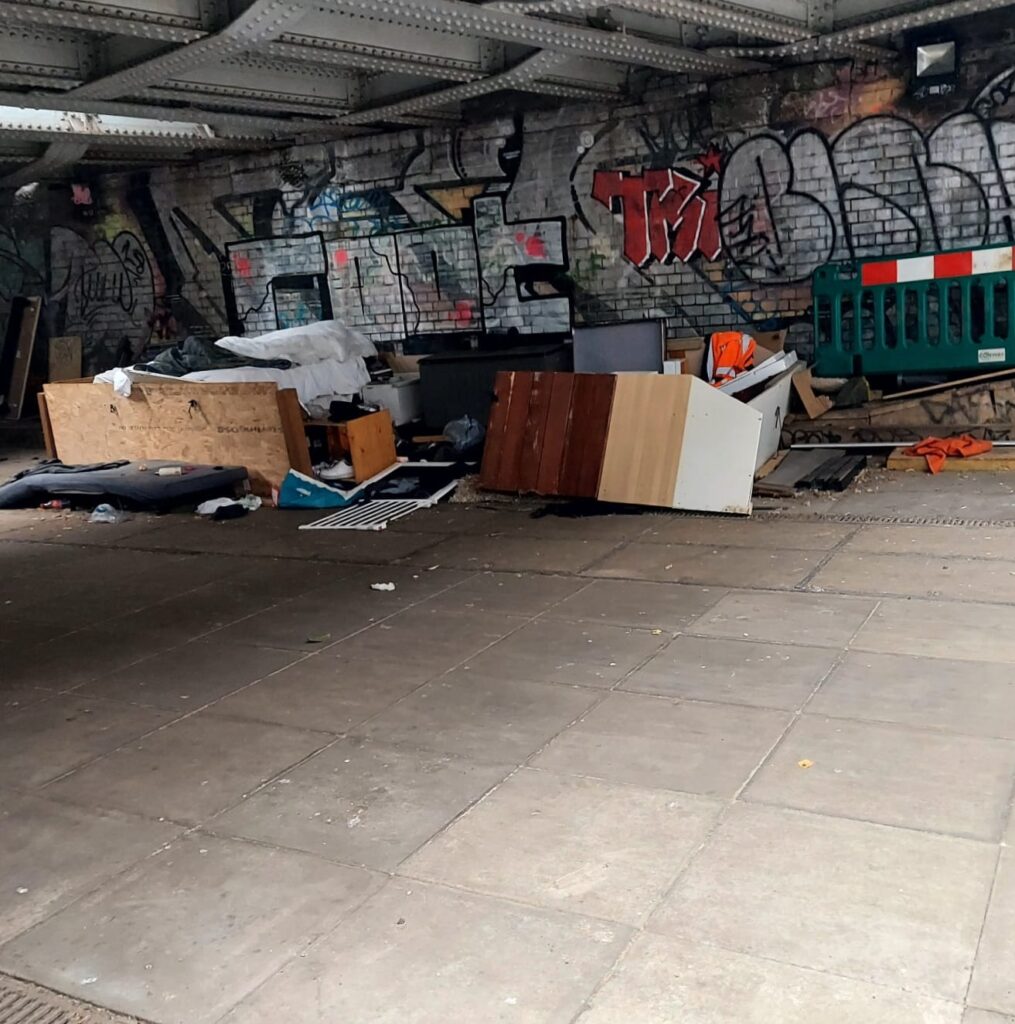
Bottles, wrappers, and discarded debris are frequently seen along the water’s edge. It not only degrades the canal’s appearance but also damages habitats and harms wildlife.
Although the Canal & River Trust and local volunteers work hard to maintain the area, the problem persists, largely due to public neglect. Clear signage is often ignored. If this continues, parts of the canal may become unpleasant and unsafe, losing the very qualities the redevelopment aimed to provide. Protecting these spaces is crucial, not just for the environment but for the communities who depend on them.
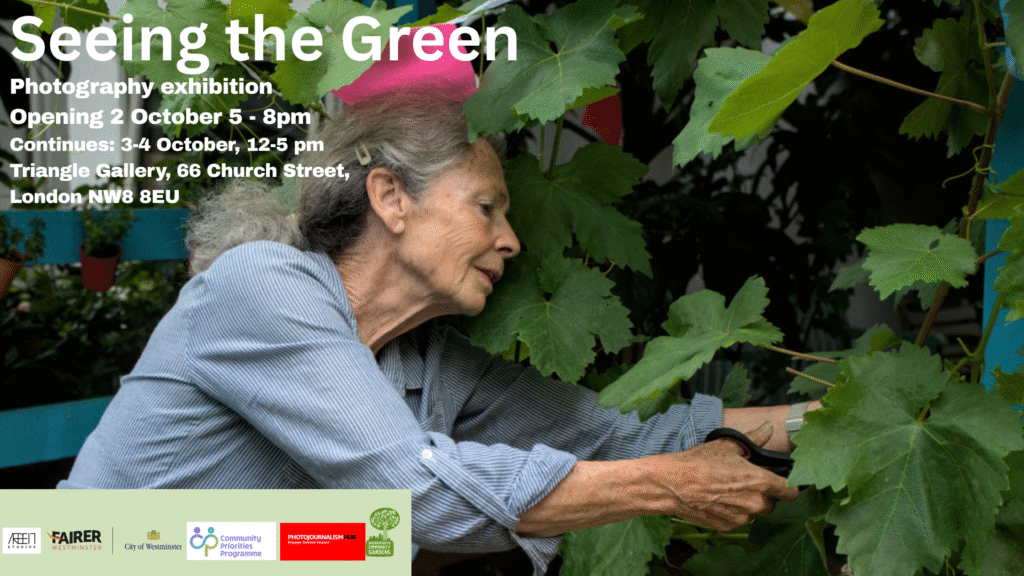
Seeing the Green Exhibition Opening: Thursday 2 October, 5pm to 8pm, Arbeit Gallery, 66 Church Street, London NW8 8EU. Exhibition dates: Thursday 2 – Saturday 4 October 2025, 12 to 5pm
Opening in Triangle Gallery on 2 October 2025, the ‘Seeing the Green’ exhibition showcases the work of participants of Seeing the Green photography project uncovering stories in and around Church Street green spaces. You are invited to visit the exhibition to the Opening between 17:00 and 8 pm on Thursday 2 October.RSVP HERE.
The Photojournalism Hub is delighted to present Seeing the Green photography exhibition. Over the past months, participants of the Seeing the Green photography project have explored stories and visuals around Westminster’s green spaces, with a special focus on the Church Street ward. Through photography workshops, walks, and field trips, participants connected with nature, communities, and local spaces to develop photographic stories now presented in this exhibition. As a viewer, you are invited on a journey into what is often unseen or forgotten to explore humanity through the simplicity of green spaces. The group’s observations reveal acts of generosity, community, and quiet contemplation, offering a new perspective on Church Street. This exhibition stands as both a personal and collective archive of the area and its people.
“The images created here remind us that even the smallest green spaces hold stories worth telling. They remind us of the importance of connection, community, and nature.” – Cinzia D’Ambrosi, Founder & Director, Photojournalism Hub.
The photographers of ‘Seeing the Green’ are: Anne Hogben, Carol Cooper, Laura Martin Laderas, Maria Speller, Mattei Muntiu, Ottavia Verziera, Roberta Mitchell, Victoria Sanders.
Seeing the Green is kindly supported by Community Priorities Programme, City of Westminster.
NOTES TO EDITOR About Photojournalism Hub Photojournalism Hub is a West London community interest company dedicated to empowering individuals and communities through documentary photography. We provide training, portfolio development, and opportunities for print publication and exhibitions. Our projects foster personal growth, social connections, and community cohesion while amplifying voices and creating pathways to employment and further education. www.photojournalismhub.org
About Arbeit Studios We take empty spaces – ranging from small 750sq ft buildings to vast 15,000sq ft warehouses – and transform them into studio spaces for artists, designers, makers, start-ups and small businesses – to inspire creativity, connect communities and power ideas. www.arbeit.org.uk
Documentary photos & text by Masoud Amin Naji copyright Masoud Amin Naji, 2025
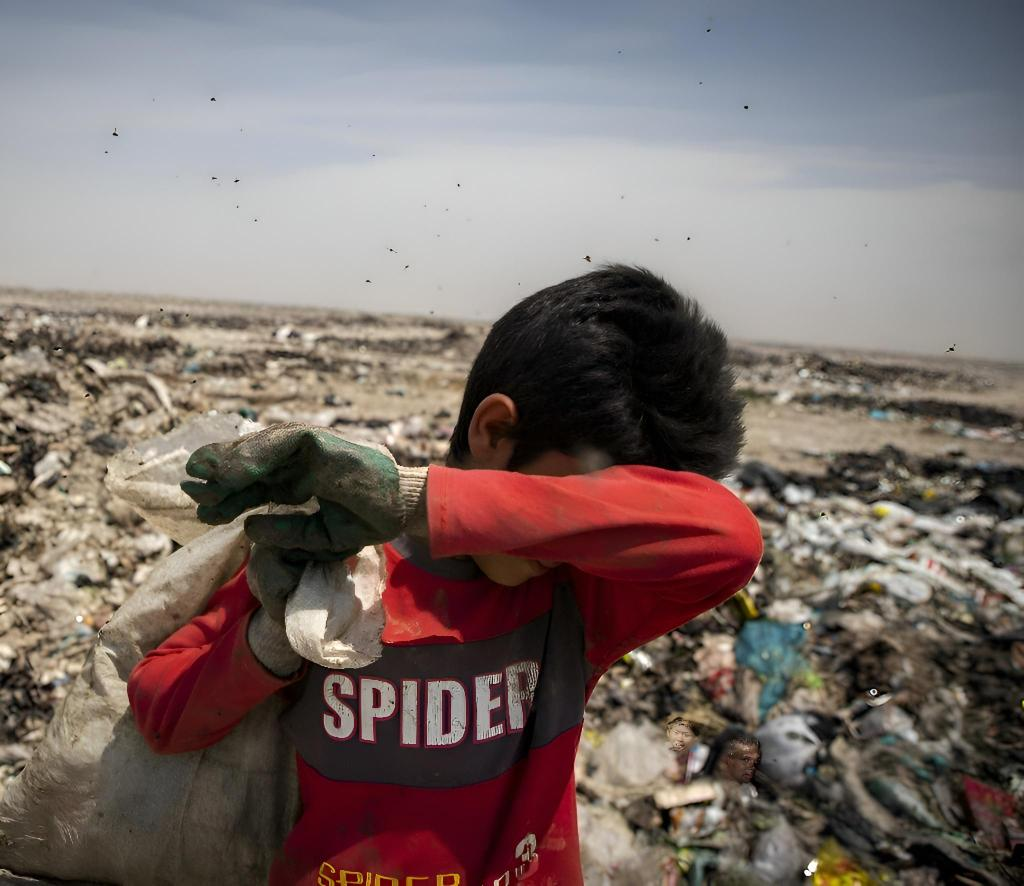
We are delighted to present Masoud Amin Naji as our featured photographer. His work documents the plight of street children in Iran, who are forced into labour due to economic hardship. Through his lens, Masoud offers a rare and powerful glimpse into a reality that is often hidden from view, as access to such stories from Iran remains extremely difficult.
“This is the Middle East. It consists of Afghanistan, Pakistan and Iran. The people here are kind and knowledgeable, but for various reasons such as tribal wars, poor economy, cultural and religious differences, they are forced to either abandon their children or use them for a living. They force children who are deprived of education, love, happiness, fun and play to do hard and tiring work. Even if they do not want to work, they are forced to work and, without wanting to, they lose a good life full of happiness, health and respect.
Maybe they can be helped to return to the normal cycle of life. There is no doubt that they are brilliant talents. You may have heard these sentences in newspaper headlines or in films such as Bicycle Thief (Ladri di Bicicletta), but here with these documentary photos we want to talk about children whose entire childhood or perhaps their entire life is spent longing for a normal life.
After all, for what crime and mistake should the entire life and happiness of a child be ruined, this is the Middle East and such things happens a lot, let’s be together for once and work for women and children so that they can have a normal life” – Masoud Amin Naji
Photojournalism Hub Jamie Clark is in conversation with social documentary photographer David Hadland.
David Hadland is a British social documentary photographer originally from Luton and currently based in London. His work focuses on the lives and experiences of diverse communities, using portraiture to convey nuanced, human-centred stories. From British subcultures to the fishing community in Brixham, his photography explores themes of identity, culture, politics, and belonging.
David’s projects have included documenting the cultural significance of the keffiyeh during pro-Palestine protests in London, as well as an ongoing body of work about the war in Ukraine. A key aspect of his practice is the commitment to building trust with his subjects, which allows him to create images that are intimate, honest, and sensitive to the complexities of lived experiences. Through this approach, David aims to provide deeper insights into the social forces that shape contemporary life.
BECOME A PJH MEMBER Consider becoming a member of the Photojournalism Hub. Your support will enable us to continue our work promoting photographic work that expose, raise awareness of social justice issues. To learn more how to become a member and the benefits of joining, follow the link HERE
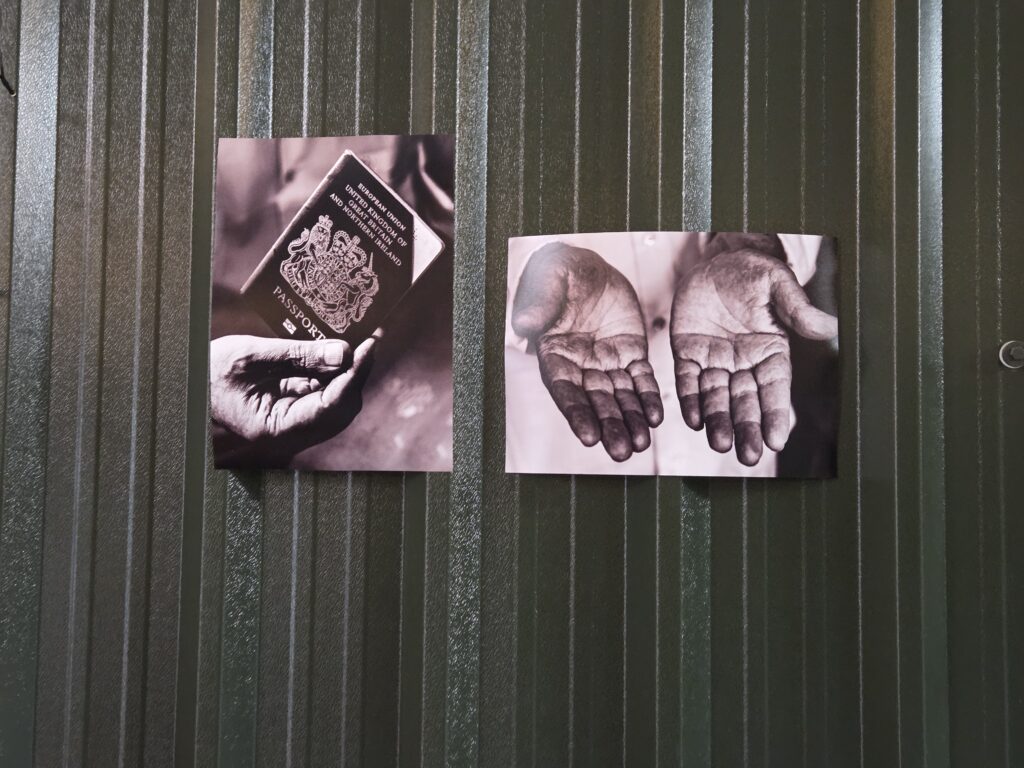
We were delighted to collaborate with Hikayetna on I Am Your Local…, a photography exhibition at Shepherd’s Bush Market marking Refugee Week 2025. Curated by our founder and director Cinzia D’Ambrosi, the exhibition brought together the work of twelve photographers from migrant and refugee backgrounds, including those who fled the wars in Ukraine and Syria. Through photography, video, and installation, the exhibition reflected on how our community is shaped and supported by those who are often overlooked—shopkeepers, teachers, drivers, entrepreneurs, doctors, nurses, and many more. The opening event was filled with inspiring conversations and connections, celebrating the strength, diversity, and creativity that migrants and refugees bring to our shared community.
Photojournalism Hub is delighted to present guest photographers Evgeniya Strygina and Tori Ferenc for the IN FOCUS event on the 23rd June, 7:15 pm, hosted at Riverside Studios.
Both photographers explore themes of place, identity, and belonging from distinct yet complementary perspectives. Strygina’s minimalist landscapes, often void of people, reflect on space, architecture, and the quiet tension between presence and absence. Ferenc focuses on portraiture and documentary work, capturing the nuances of family, community, and our connection to nature. Together, their work forms a thoughtful dialogue on what it means to inhabit a space, physically, emotionally, and collectively.
Evgeniya Strygina (b. 1989) is a lens-based visual artist exploring urbanisation, contemporary landscape, and immigration. She honed her skills at the Fine Art Photography School, Moscow Museum of Modern Art, and PhMuseum. Since relocating to the UK in 2022, her work has been exhibited at Photo|Frome Festival, London Lighthouse Gallery, Cicek Gallery, and LoosenArt Gallery, with publications in Fisheye Magazine, Truth in Photography, Al-Tiba9 Art Magazine, and Artdoc Photography Magazine. Notable awards include the Top 150 MIRA Mobile Prize, MonoVisions Awards, and Photometria Awards judged by Martin Parr. In 2023, she held a solo exhibition after an art residency in Czechia. Her first photobook, Home from Home, is scheduled for release in 2025 with the publisher Ephemere. As a contemporary photographer with an interest in shooting both urban and natural landscapes, I make a point of keeping my images almost or totally uninhabited as I consider people to be but one part of the world as opposed to being its centre. Even in my pictures of architecture, obviously built by people for other people to use, I am fascinated by the space and its details rather than its occupants. Juxtapositions, interactions and contradictions, rhythms and rhymes – be they intended or otherwise – is what I never stop looking for in nature and cities. In an attempt to make the viewer see aspects of the landscape that routinely go unnoticed, I offer a different perspective on things and deliberately strip down the style of my photographs. Minimalistic and geometric, my pictures are both an experiment in deconstructing reality and a quest for quiet harmony in our noisy existence. Besides exploring the nature of space in my work, I am also keen on studying the notion of home, which could be both a place and a non-place, and portraying a longing for an environment you can call your own. This is probably because, being born in a small town and currently living hundreds of miles away from it, I cannot but wonder where I actually belong.
Tori Ferenc is a portrait and documentary photographer, born in Poland in 1989. In her work, Tori is focusing on the themes of identity, community, family dynamics, and exploring the relationship between humans and nature. Over the years, her projects have been shown at renowned exhibitions such as the Taylor Wessing Photographic Portrait Prize in 2021, the Hamburg Portfolio Review and Prix Virginia in 2022, and Rencontres d’Arles in 2023. She is a member of Women Photograph and Equal Lens. IN FOCUS is presented by the Photojournalism Hub in collaboration of Riverside Studios, bringing to the public compelling and thought-provoking contemporary documentary photography and photojournalism,