IN FOCUS: Sascha Klamp and Valeria Luongo

22nd April 2024, 7 pm
Riverside Studios
101 Queen Caroline Street
London W6 9BN

To join: HERE

Photojournalism Hub and Riverside Studios are delighted to announce Sascha Klamp and Valeria Luongo as the featured photographers for ‘In Focus,’ a captivating series of photography events. This series present photographers whose work engage with social documentary photo storytelling, using the lens as a powerful tool for engagement, exploration and raising awareness. The event includes presentations, live interactive Q&As and a social.
Our guests of this edition have a background or work with an anthropological approach, using documentary photography to present stories that capture and explore community and individual memory, archives and rituals.

Valeria Luongo is an Italian documentary photographer, filmmaker, and anthropologist who’s based between Mexico and the UK. Her photographic approach is characterised by working on long term projects. Her work explores stories regarding gender, spirituality and rituals and has been featured in National Geographic, The Guardian, BBC, GEO Magazine and exhibited internationally.

“When Women Fly” is a  project about a group of indigenous women from Cuetzalan del Progreso, Mexico, challenging gender roles by participating in a traditionally male ritual called Danza de los Voladores.
The ritual begins with a ceremonial dance. Five participants then ascend a 30-metre pole and jump off the top, head first, tied to ropes as they revolve around the pole towards the ground.
Historically, only men were allowed to partake in the ritual. However, a few women in Cuetzalan have recently joined the practice. The flying women defy traditional gender roles, symbolising transformation within their social context. Since 2022 I’ve been working alongside several women and girls who fly, documenting their everyday lives among their community.

Sascha Klamp is a British/German multi-award winning Documentary Filmmaker, Photo-documentary Journalist and Producer based in London, UK. He spent the majority of his career as an investor and entrepreneur which enabled him to travel across frontier and emerging markets. His photography practice centres on highlighting social impact and social justice affairs which is deeply rooted in his curiosity to learn more of the world around him. He tells frontline human and community stories based on empathy for the situation and the people involved. His thinking is informed by his interest in ethnology and social anthropology. Sascha exhibited a small selection of his The Art of Seeing, The Art of Remembering project in London in November 2022. His work was highly commended by the TPF Social Documentary Awards (Professional Category, Series) for his The Art of Seeing, The Art of Remembering work. Sascha completed his MA Photojournalism & Documentary Photography studies at the University of the Arts (Distinction), London. He also holds an MBA (Bayes Business School, London) and a Masters in Law, LLM (King’s College, London), and a BSc International Securities, Investment & Banking from Henley Business School (ICMA Centre). Filmography: “The Art of Seeing, The Art of Remembering” (2022), “The Blockade” (2023).

In a remote village in Kosovo, the past casts a long shadow. A single family of 2500 souls, now in its 13th generation, struggles to find its place in a changing world. Based on the Directors engagement with the community and renowned Community Archival work, KINSHIP tells the story of one family’s search for belonging.
We meet Rabit, the community’s Doctor, who recounts his heart-breaking tale of being ‘gifted’ to his uncle as a young boy. An all too common practice rooted in ancient customs. He grapples with the trauma of his stolen innocence. Meanwhile, Couple Mumin and Qamile Dermaku tell their moving story of how they met, the challenge he went through gifting a brother to a neighbour and his wife’s struggle to join the ‘jungle’ of a remote community. Expecting mother Florentina faces her own struggle. Pregnant with her first child, she dreams of a better future. But is that future possible here? Or must she also make the painful choice to leave everything she has ever known behind? The village Elders tell their stories aided by black-and-white photographs sourced from their family photo albums. They recount stories of happier times but also times of conflict and change. These memories contradict with the experience of the younger generations who cannot imagine a rural life with its limited resources and opportunities. Joining the diaspora is a potential way out to seek a fortune and future elsewhere. The cleric focuses on holding the community together. But his own story contradicts the ambitions of his community. The state looks away from the Kanun law/ tradition (Kanun of Lek Dukagjini). The honour code (vendetta in Italy) contradicts with the country’s ambition to become a full EU member. We engage with Child Psychologists who explain the harm done to children being gifted to family members and how that trauma informs their choices. Running away from it all sounds like a sound choice for many.

BECOME A PJH MEMBER
Consider becoming a member of the Photojournalism Hub and receive the benefits of free access to events, resources, premier editorial content, portfolio reviews, and discounts on entry to our photography exhibitions, training and in our shop, whilst you will be supporting our work advocating, advancing social justice and human rights, amplifying community voices and enhance access to media to those facing social, economic and structural challenges. If there were ever a time to join us, it is now. Support the Photojournalism Hub from as little as £1 every month. If you can, please consider supporting us with a regular amount each month. Thank you. JOIN US HERE

Why shop small business?

Photojournalism Hub presents Why shop small business? – the latest edition of documentary photography and writings from our local young and senior participants of our documentary photography courses.
Why shop small business? brought a lot of conversations and critical analysis on what it really means. Are we shopping more ethically because more conscious of what we eat? Are we more aware of the authenticity and the personal experiences that one has in small independent outlerier. Or the choices of shopping small points to having the economic capacity to do so and thus a statement of wealth. One pervading reflection is that shopping small is very much tied to serving communities. We could say that we have many communities around each local shop, something that we cannot find in much bigger commercial chain.

We have printed a number of copies of the magazine for our beneficiaries and for sharing and making it available in our community. If you would like a copy or discuss a feature, please contact us.

We would like to thank the NHS West London Trust, Hammersmith & Fulham Council, Sobus and Hammersmith United Charities for their support.

Support our work and become a Photojournalism Hub member! and receive the benefits of free access to events, resources, premier editorial content, and discounts on entry to our photography exhibitions, training and shop. You will be supporting our work advocating, advancing social justice and human rights, amplifying community voices and enhance media educational and work opportunities to those facing social, economic and structural challenges. Support the Photojournalism Hub from as little as £1 every month. Thank you. Join us HERE

IN FOCUS: Denise Laura Baker & Etienne Bruce

26th February 2024, 7 pm
Riverside Studios
101 Queen Caroline Street
London W6 9BN

To Join us: HERE

Photojournalism Hub and Riverside Studios are delighted to announce Denise Laura Baker and Etienne Bruce as the featured photographers for ‘In Focus,’ a captivating series of photography events. This series delves deep into the realm of socially engaged documentary photography, using the lens as a powerful tool for engagement and exploration. The event includes presentations, live interactive Q&As and a social.
Etienne Bruce will present us Xenitia, which is an archive, centered on displacement to Greece. It is framed by two motifs: “nostos” (Classical Greek; to return home, homecoming) and “algos” (Classical Greek; pain, grief). Together, these affect-laden words form the root of “nostalgia”. “Xenitia” itself is a Greek term that encompasses the state of being a foreigner, otherness, estrangement, loss, distance, and a profound yearning for home soil. And Dr. Denise Laura Baker will share Deeds, Not Words: motivations and methods of resistance from a photographer’s perspective, currently being shown until April 13th at Gallery 74, Waterside Arts in Sale, Manchester, which explores the myriad ways photography crosses into the realm of activism and the complex relationship between photojournalism and activism.

Denise Laura Baker is a socially engaged photojournalist and documentary photographer and storyteller, focusing on environmental and social issues, climate change, activism, and community. Through these she explores themes of connection, journeys, identity, change and transition. Denise’s photographic and creative work draws on influences from her career as a visual artist, and her previous career as an ethnographic psychologist where she interviewed and collected the stories of the people with whom she worked. In March 2020 she was featured as an emerging female photographer in film  https://analoguewonderland.co.uk/blogs/film-news/female-voices-in-film-denise-laura-baker and in 2021 and 2022 she won PX3 State of the World. She has published numerous photographs in the mainstream press as well as photo essays in magazines such as New Internationalist, Open Democracy and Novara Media. Her work has been featured in group exhibitions as well as solo shows most notably LLAWN Llandudno Arts Weekend in 2019, Galeri Caernarfon, North Wales 2022, Islington Climate Centre 2023, The Black E Gallery in Liverpool as part of The World Transformed 2023 and Open Eye Gallery, Liverpool 2023. Denise’s work is currently being shown until April 13th at Gallery 74, Waterside Arts in Sale, Manchester. 
Denise teaches and mentors, runs community arts workshops, and has received funding through the Arts Council for Wales, Creative Gwynedd, RBKC Creative Grants, The Westway Trust and Imaginary Millions. With Deeds, Not Words (Deeds, Not Words: motivations and methods of resistance from a photographer’s perspective) Denise explores the myriad ways photography crosses into the realm of activism and the complex relationship between photojournalism and activism. In this project she examines protest through the female eye, which has enabled her to connect with her own background in activism as well as others, and her relationship to photography as activism. @deniselaurabaker

Etienne Bruce is an Anglo-French visual artist, editorial photographer and educator currently based in London, UK. Her project-based work is a form of documentation driven by an engagement with the nature of the photographic image, which often includes an element of recording oral histories. A preoccupation with the relationship between form and content has led her to embrace different modes of expression including text, movement, sound, space, sequence and literary forms as portals through which to re-examine documentary image-making practice and embrace its inherent ambiguity. Through her work, Etienne seeks to challenge her perceptions and reinterpret things as she understands them while always striving to engage respectfully and collaboratively with the people and stories that are central to her practice. Etienne is a member of Women Photograph, she is Education & Training Manager at The Photography Foundation, and her book Xenitia was published by Zone6 Press in 2023. @etienne_bruce

BECOME A PJH MEMBER
Consider becoming a member of the Photojournalism Hub and receive the benefits of free access to events, resources, premier editorial content, portfolio reviews, and discounts on entry to our photography exhibitions, training and in our shop, whilst you will be supporting our work advocating, advancing social justice and human rights, amplifying community voices and enhance access to media to those facing social, economic and structural challenges. If there were ever a time to join us, it is now. Support the Photojournalism Hub from as little as £1 every month. If you can, please consider supporting us with a regular amount each month. Thank you. JOIN US HERE

Photojournalism

Archive

Free Palestine Rally in London

Thousands rallied in London’s Trafalgar Square to advocate for a Free Palestine and to call for an immediate Ceasefire. Among the crowds, were Londoners, families with their children, and representatives from various organisations, all uniting in in central London Trafalgar Square to demand an end to the violent conflict. The vast majority of demonstrators conveyed their message peacefully, holding up placards, and posters with messages emphasising the urgency of a ceasefire, on a day marked by numerous protests across the capital.

A young girl holds up a Freedom for Palestine poster, London Trafalgar Square. @Cinzia D’Ambrosi

©Safeena Chaudhry

Demonstrators and peaceful groups waved flags and banners around Trafalgar Square. @Cinzia D’Ambrosi

Photos from above: ©Safeena Chaudhry (first left),
(second, third, fourth) @Cinzia D’Ambrosi

Safeena Chaudhry
Insta: @photographerdreamertraveller
Cinzia D’Ambrosi
Insta: @cinziadambrosi

www.photojournalismhub.org

Photojournalism Nights: Acacia Diana & Chelsea Pineda

15th November 2023 7pm
Riverside Studios
101 Queen Caroline Street
London W6 9BN

To Join us HERE

We’re delighted to welcome Acacia Diana and Chelsea Pineda to the 37th edition of the Photojournalism Nights.

Acacia Diana is a visual artist whose work explores culture, identity, travel and the built environment. An enthusiastic advocate of exploring the world, she has worked with numerous global brands to create and curate images, as well as developed a portfolio of photographs on international humanitarian missions. She is a 2023 Canon EOS Master and was listed in 2022 by Tatler Asia as an inspiring female photographer making a social impact. Her works have been displayed in Amsterdam, London and Kuala lumpur. 
Travelling around the world to capture culture and community, Acacia will be presenting a curation of  photographs, themed ‘Colours of Community’, that focuses on the Muslim celebration of Ramadan in London and Eid in Tanzania, in between touching on a selected humanitarian work images in Syria and Turkey. 
In this theme, Acacia delves into the tapestry of Muslim life in London during the sacred month of Ramadan in 2023. She followed the Ramadan Tent Project, a community non-profit, as they orchestrated the Open Iftar event across the city’s revered landmarks. Muslims and non-Muslims from diverse backgrounds converged to break their fast together, harmoniously bridging divides. At every meal, the ethereal call to prayer, the Azan, resounded through the cityscape, leading the faithful to publicly commune in prayer. In 2022, Acacia was with a mission team to donate meat to the muslim community in Tanga, Tanzania with Impactive Malaysia, for the celebration of Eid. The vibrant festivities are an annual hallmark, as most in the community live below the poverty line and are not able to afford meat.
Insta: acaciadiana
acaciadiana.com

Chelsea Pineda is a Filipina-American artist whose work encompasses photography, writing and performance. Her practice explores the intimacies of cultural identity, familial relationships and memory. She is based between London and New York City, and graduated from London College of Communication with an MA in Photojournalism and Documentary Photography in 2023. Previously, she was a supervising producer at Insider (formerly Business Insider) overseeing production and post-production for the video team. With a background in journalism and art, she centers narrative and identity in her approach to photography, film and writing as it spans across fine art, editorial and commercial spaces.
In the Photojournalism Nights, Chelsea will share “Barako”, which explores themes of masculinity and paternal relationships through the exploration of her father’s experiences street fighting in the 1960s and 1970s Philippines. Growing up at a time when the “tough guy” archetype was idolized, her father was engrossed in his boxing training. Having never backed down from a fight, he utilized these skills to protect himself from other men throughout his youth, but also fought as a way to cope with his anger towards his father, who physically disciplined him at home.
“Barako” moves through various fights throughout Chelsea’s father’s youth, including his first fight at five years old over a game of marbles and a spontaneous street fight with a professional boxer in college — all the while exploring other memories significant to his boyhood. His final fight took place when he was 24 years old — a brawl with 10 men outside his father’s funeral viewing. Weeks later, her father moved to America to find work and support his family back home. He never fought again.
The importance of this project lies in its aim not to reproduce or glorify images of violence, but to evoke a viscerality that exists when coming of age in a container of hegemonic masculinity and its intergenerational effects as they were passed down from Chelsea’s grandfather to her father to herself. Through “Barako,” I examine an intimate legacy that allows me to reflect on my own relationship with masculinity, intergenerational trauma, and my father.
Insta: @chelspineda
chelseapineda.com

Photos above: ©Chelsea Pineda ©Acacia Diana

To book a place HERE

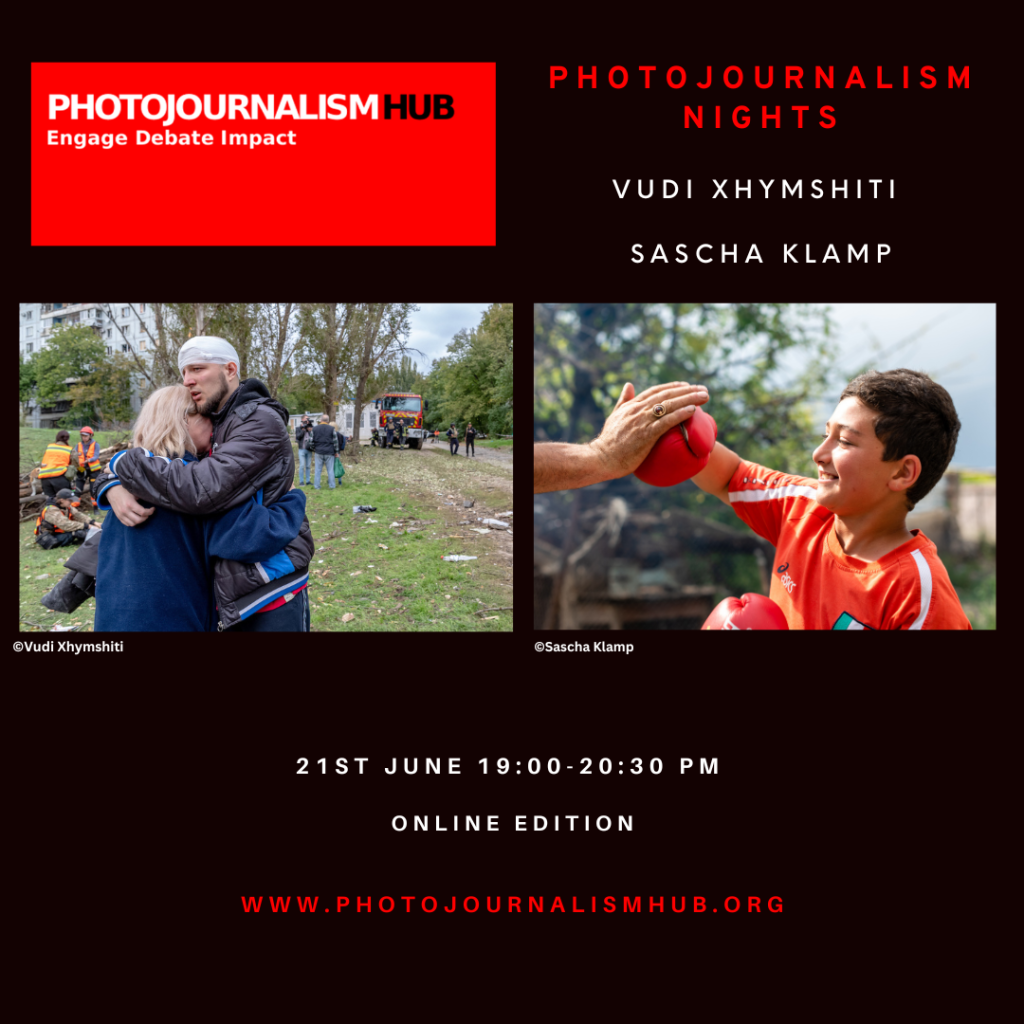
PHOTOJOURNALISM NIGHTS: Vudi Xhymshiti and Sascha Klamp

Join us for an exciting night of PHOTOJOURNALISM! Our online event starts on Wed Jun 21 2023 at 7:00 PM BST. To book: HERE

This event will showcase the works of talented photojournalists Vudi Xhymshiti and Sascha Klamp. Get ready to be inspired by their captivating images and stories. Vudi a renowned photojournalist will share stories from war torn Ukraine where he has been reporting from over 7 months and Sascha who is a multi awarded filmmaker will be speaking about his latest work in Armenia.

During the event, you’ll have the opportunity to interact with the photographers and learn about their experiences in the field. You’ll also get a chance to ask questions and share your own thoughts on the power of photojournalism.

Don’t miss out on this incredible opportunity to connect with two great photojournalists, documentary photographers and filmmakers with and connect with a peer community. Register now and get ready for a night that will inspire.

Vudi Xhymshiti is a photographer and journalist based in London, who has covered major world events since 2007, with his work appearing in prestigious news outlets such as The New York Times, TIME Magazine, The New Yorker, The Guardian, The Times and the Sunday Times of London, CNN, BBC, DW etc. His assignments have taken him to the frontlines of the Arab Spring, the Syrian and Libyan Civil Wars, and the aftermath of the Armenian-Azerbaijani armed conflict in Nagorno Karabakh. Throughout 2022, he reported on the Russian military aggression in Ukraine and travelled to Moldova to observe and report on the impact of Russian territorial expansionist foreign policy on neighbouring countries. He also spent four months familiarising himself with rising tensions in Kosovo, Bosnia and Herzegovina, and Montenegro, following Serbia’s alignment of its Foreign Policy with the Russian Federation. Xhymshiti is not only a talented journalist, but also the founder of VX Pictures and an educator in the visual journalism industry. Don’t miss out on his insights and coverage – visit his website https://vudixhymshiti.uk/ to learn more about him, read his blog https://vudixhymshiti.uk/blog/, and view his latest work on https://vximages.com/.

©Vudi Xhymishiti

Sascha Klamp is a British/German multi-award winning Documentary Filmmaker, Photo-documentary Journalist and Producer based in London, UK. He spent the majority of his career as an investor and entrepreneur which enabled him to travel across frontier and emerging markets. His photography practice centres on highlighting social impact and social justice affairs which is deeply rooted in his curiosity to learn more of the world around him. He tells frontline human and community stories based on empathy for the situation and the people involved. His thinking is informed by his interest in ethnology and anthropology. Sascha exhibited a small selection of his The Art of Seeing, The Art of Remembering project in London in November 2022. His work was highly commended by the TPF Social Documentary Awards (Professional Category, Series) for his The Art of Seeing, The Art of Remembering work. Sascha completed his MA Photojournalism & Documentary Photography studies at the University of the Arts (Distinction), London. He also holds an MBA (Bayes Business School, London) and a Masters in Law, LLM (King’s College, London), and a BSc International Securities, Investment & Banking from Henley Business School (ICMA Centre). He is married with three daughters. Filmography: “The Art of Seeing, The Art of Remembering” (2022), “The Blockade” (2023)

BECOME A PJH MEMBER

Consider becoming a member of the Photojournalism Hub and receive the benefits of free access to events, Photojournalism Hub resources, premier editorial content, portfolio reviews, photography exhibitions, discounts on our courses and training, whilst you will be supporting our work advocating, advancing social justice and human rights. If there were ever a time to join us, it is now. Support the Photojournalism Hub from as little as £1 every month. If you can, please consider supporting us with a regular amount each month. Thank you. JOIN US HERE

JONATHAN ALPEYRIE: a look at his career

Jonathan Alpeyrie’s career spans over two decades, has brought him to 35 countries, and has covered 14 conflict zone assignments, in the Middle East and North Africa, the South Caucasus, Europe, North America, and Central Asia.

Born in Paris in 1979, Jonathan Alpeyrie moved to the United States in 1993. He graduated from the Lycée Français de New York in 1998 and went on to study medieval history at the University of Chicago, from which he graduated in 2003. Alpeyrie started his career shooting for local Chicago newspapers during his undergraduate years. He spent a month driving across the country to create my first photo essay like a professional. The essay focused on the remnant of the Communist era heavy industry. His driver at the time took him to all the major industrial sites, visiting abandoned factories and taking photographs of what once was. The decaying infrastructure was a fascinating reminder of a collapsed system barely 10 years prior.

May 16, 2021 – La Joya, Texas, USA. La Joya has become a new hot bed of passing migrants trying their luck in entering the USA. Strong Border Patrol and local police as well as national guard units are present all along the area in order to arrest as many as possible. ©Jonathan Alpeyrie

After graduating from the University of Chicago in the spring of 2003, Jonathan was sent off to start his first dangerous photo essay which he hoped at the time would help me further to launch his career as a photojournalist. He spent over a month covering gang activity in the Congolese capital of Kinshasa. With the photo essay completed, he returned home and was quickly picked up by Getty images for the reportage section after it was noticed by some editors at the NYC office. 2004, was a watermark year for Jonathan as he started covering wars that very same year, from West Africa to the Caucasus, all for Getty Images. 

March 25, 2017, West Mosul, Northern Iraq. A son is crying over the dead body of his father after he was killed after a car bomb blew up on the street. A massive car bomb sent by ISIS has targeted an Iraqi army controlled street on the front lines, destroyed a few humvees, and killing a local civilian who was delivering water to his family. ISIS units has been using car bombs to destroy Iraqi army units and defensive positions, however, civilians usually pay the price of such attacks. ©Jonathan Alpeyrie

I became a war photographer in order to immerse myself into historical situations to then report them back to the public. Cut and dry

Jonathan Alpeyrie

With almost a decade of experience behind him and half a dozen wars under my belt, Jonathan decided to go on his own and leave the agency business partially behind. Dealing directly with his own clients while still working for various photo agencies, he started covering wars in the Middle East and Central Asia, furthering his resume as a war photographer. A year later, the Arab Spring launched a new phase in his career. 
With the various conflicts erupting all around the Middle East, Syria started to attract war reporters from all over the world interested in covering this new hot conflict. After two trips to the war-torn country in 2012, Jonathan decided to return in 2013. It happened after he was kidnapped for three months by Islamic rebels.

May 4, 2017 – Northern Mosul, Iraq. The 9th division of the Iraqi army is launching a new operation to relieve pressure on the Federal police in Southern Mosul after suffering multiple setbacks from constant Daesh counter attacks. This new offensive is meant to end all ISIS resistance inside the city, which would free the remainder of the areas still controlled by ISIS fighters. Severe resistance is causing significant casualties amongst Iraqi ranks. ©Jonathan Alpeyrie

March 6, 2022 – Irpyn, Municipality of Kiev, Ukraine. Some civilians have remained on the other side of the river and still trying to escape towards Kiev and seek for safety. Russian forces North West of Kiev are slowly closing in on the Ukrainian capital trying to push South and enter the city. The Ukrainian army is so far is resisting the Russian onslaught and causing significant casualties and delays to the advancing Russian troops. ©Jonathan Alpeyrie

By 2014, right after his release from Syria, he embarked on another voyage, this time into Slavic land to start covering the new hot war: Ukraine. After almost 14 months of coverage, he was injured during a gun battle in Mariupol. 

February 6, 2015, Debalteve, Donbass Oblast, Ukraine. A lone woman is standing in front of the bombed out house. Thousands of civilians are still trapped inside the besieged city of Debaltseve. The rail way hub has been hotly contested by both pro-Russian separatists and Ukrainian forces, where hundreds of civilians are soldiers have died since the battle stated 10 days ago. Each day volunteers form all over Ukraine risk their lives to go inside the city to provide with food to the remaining locals still inside the town as artillery fire from both sides rains down in and around the city. ©Jonathan Alpeyrie

That year his career took another turn as he almost permanently stopped working for agencies and focused on some of his big clients like Vanity Fair, CNN, and others, which, interestingly was a reminiscence of the earlier part of his career when he was solely doing photo essays and almost no news. He focused on personal projects which took him closer to a region a new from his previous travels like Mexico and Central America while keeping an eye on South America.

September 9, 2022 – Guayaquil, Guayas, Ecuador. With the ramping up of the drug war in Ecuador, the small South American nation has become one of the major passing point of drug and arms smuggling of the Southern Continent. Indeed, most of the illecit drug trade has its starting point in Peru where the Cocaine is being produce then shipped through Ecuador, then Colombia for refining. The Ecuadorian authorities hare struggling to keep up with the violence the trade induces. ©Jonathan Alpeyrie

After a hiatus from covering wars, he went to Iraq to cover the battle of Mosul in 2017, and took another break from war in 2018, except for some time spent on the front lines in Ukraine, he decided to focus on the drug wars in South America, and more specifically in Brazil. Covid19 cut short his project and focused on the pandemic with an exception: the war in Armenia at the end of 2020. 

The War in Ukraine since 2014 never ended but rather was in a state of hiatus with more upsurge of fighting once in a while. February 2022, with the Russian invasion of its neighbor, has had everyone surprised by the scale of its aggression. When the fighting erupted he was in Mexico shooting a story on the drug war, as soon as his assignment ended he departed for the front in Central Ukraine. He spent a month covering the war between the two Slavic nations. Once more, he was drawn back into a conflict. 

With the ongoing drug war tearing apart Mexico, it’s Northern boder with the USA has been for decades now a strategic location in order to pass drugs and migrants into the USA, making the area a highly lucrative spot in Tijuana, Baja California , Mexico, March 27, 2023. In recent years, Tijuans has been prone to intense violence between various drug cartels and the government, seeing at some point up to 10 murders each day, making Tijuana one of the most dangerous cities in the Americas. Photographer: ©Jonathan Alpeyrie

May 22, 2019 – Rio de Janeiro, Brazil. An operation is under way to capture and kill drug dealers operating ner the police station. A unit of the famous UPP police unit is operating in one of the most dangerous favela of Rio. Clashes errupt on a daily basis between the military police and drug gangs. Rio Police suffers about 200 killed each year in the hands of the various armes gangs populating the favelas. ©Jonathan Alpeyrie

Alpeyrie has worked as a freelancer for various publications and websites, such as the Sunday Times, Le Figaro Magazine, ELLE, American Photo, GLAMOUR, Aftenposten, Le Monde, & bbc among others. Jonathan Alpeyrie’s career spans over a decade, and has brought him to over 36 countries, covered 14 conflict zones assignments, in the Middle East and North Africa, the South Caucasus, Europe, North America and Central Asia. A future photography book about wwii. Veterans with verve editions are in the works.

Alpeyrie has been published in magazines such as: Paris Match, aftenposten, times (Europe), Newsweek, Wine Spectator, Boston Globe, glamour, bbc, vsd, Le Monde, newsweek, Popular Photography, Vanity Fair, La Stampa, cnn, and Bild Zeit, elle Magazine, Der Spiegel, Le Figaro, marie claire, The Guardian, The Atlantic.

Jonathan Alpeyrie
www.jonathanalpeyrie.com
E: peloponnessian@hotmail.com
@Jonalpeyrie

BECOME A PJH MEMBER

Consider becoming a member of the Photojournalism Hub and receive the benefits of free access to events, Photojournalism Hub resources, premier editorial content, portfolio reviews, photography exhibitions, discounts on our courses and training, whilst you will be supporting our work advocating, advancing social justice and human rights. If there were ever a time to join us, it is now. Support the Photojournalism Hub from as little as £1 every month. If you can, please consider supporting us with a regular amount each month. Thank you. JOIN US HERE

Prints

A collection of social justice and human rights issue driven photographic prints supporting photojournalists and documentary photographers who courageously and truthfully work to effect change.

Maria Tomas Rodriguez


Paper size: 16 x 12 inches
Unframed

£150 + p&p
Photojournalism Hub Members £ 120 + p&p

Young girl after school.
Photo taken in Kenya, 2019. In many places, when Christmas holidays are over, girls are back to their homework routines, classes, and perhaps midterm exams.  In some Kenyan villages, girls aged between 9-17 years old returning to school after the Christmas break means that they will be subjected to pregnancy tests and examined for female genital mutilation – FGM – by trained medical professionals in local schools and clinics. The tests have been put in place as many girls are forced to undergo FGM during the Christmas vacation, and pregnancies following it are not uncommon.


Paper size: 16 x 12 inches
Unframed

£150 + p&p

Photojournalism Hub Members £ 120 + p&p

Celebration day.
Photo taken in Senegal, 2016. This woman lives in the Ossouye, a small village in the Casamance, Senegal’s south. On this day, new young men circumcisions were taking place and women were out dressed up in their best outfits.


Paper size: 16 x 12 inches
Unframed

£150 + p&p

Photojournalism Hub Members £ 120 + p&p

Bedik woman.
Photo taken in Senegal 2016. The Bedik tribe lives in the south-eastern corner of Senegal, near the Guinean border and close to the headwaters of the Gambia River. They arrived at different times between the 11th and 19th centuries. The area remains remote and many of the cultural adaptations of the people, including their agro-pastoral, social, ritual and spiritual practices persist to this day.


Paper size: 16 x 12 inches
Unframed

£150 + p&p
Photojournalism Hub Members £120 + p&p

Traditional celebration.
Photo taken in Senegal 2017. Male circumcision is one of the oldest and most widespread surgical procedures in the world performed in pre-pubertal boys, adolescents or adults. In Senegal, male circumcision is considered essential for becoming a full member of society and it is a major festivity across the community with big celebrations for which men wear their traditional outfits.


£150+ p&p
Photojournalism Hub Members £ 120 + p&p

Boats of shame. Photo taken in Canary islands, Spain, in 2021. In 2020/21, around 45,000 illegal immigrants from West Africa arrived by boat to the Canary Islands (Spain, EU). This route is the deadliest migratory path: 1 out of 20 migrants dies on the attempt to reach European soil. Poorly equipped boats travel distances of up to 1,500 kms. The engines break often, leaving the passengers adrift for days or weeks in which food and water run out. Frequently the occupants die during the crossing. Those who remain alive throw the corpses into the ocean to save on fuel. Ports on the Canary Islands are these days plagued with hundreds of these abandoned boats.

Maria Tomas Rodriguez
Maria Tomas-Rodriguez is a Spanish born photographer living in UK for the last 22 years. Her photography work has always been black and white social – documentary photography, although recently, with the pandemic and domestic lockdown, she started exploring colour photography. Maria combines her current university academic job with her interest in photography and travelling for documenting social matters and people’s cultures & traditions. She collaborates on regular basis with Baolar, a charity based in Senegal as an active member and photographer. Her major photography work concerns the modern-slavery conditions of children and the harsh working conditions of fishermen, both works in Senegal. She also has documented the Afar salt miners work in Ethiopia just a few months before the war started in the Eritrean border.
Her main interest is to contribute to raise awareness on injustices and social inequalities. Some of her work has been published in UK online magazines and Spanish local newspapers. In parallel to her interest in documentary photography, she is very keen on water sports and has
developed a still ongoing portfolio on wind and water sports, attending major championships and documenting the training of professionals of these sports. Her work has been recognized at several international photography awards and exhibited in the last
years, both individual and group exhibitions.
Instagram @photomtr

Images will be printed by Genesis Imaging.

Mohammed Salim Khan


Paper size: 16 x 12 inches
Unframed

£150 + p&p
Photojournalism Hub Members £120 + p&p


Children in the camp don’t have toys to play like most other children outside the refugee camp


Paper size: 16 x 12 inches
Unframed

£150 + p&p
Photojournalism Hub Members £120 + p&p

We don’t have any ambulances and during an emergency we need to walk to the nearest primary level hospital, which is very far from the camp.


Paper size: 16 x 12 inches
Unframed

£150+ p&p
Photojournalism Hub Members £120 + p&p

Conflagrations are common in the camp. In one of these events a mother was separated from her son in the ensuing chaos. They were reunited a day later.

on the reverse
Paper size: 16 x 12 inches
Unframed

£150+ p&p
Photojournalism Hub Members £120 + p&p

Genocide remembrance day.


Mohammed Salim Khan
Mohammed Salim Khan, I am a 28 years old photographer. My family became refugees and fled from Myanmar in 1991. I grew up in Kutupalong refugee Camp in Bangladesh. I am a person, who has never ever seen his own country and home village. I have been capturing lives and emotions of my community who has been fleeing violence and persecution in Myanmar for decades and now are dispersed in refugee camps.
My photos have been published in several Bangladeshi and international media, including The Guardian, The Independent, ABC news, Reuters, Al Jazeera, NPR, The Washington Post, AFP, South China Morning Post to name a few, as well as been presented in many international exhibitions in Italy, Japan, and the UK, including featured in the Oxford Human Rights Festival, UK

Ségolène Ragu


Paper size: 16 x 12 inches
Unframed

£150 + p&p
Photojournalism Hub Members £120 + p&p

Semiramis
Like Beirut itself, the Semiramis building is falling into ruin. Built in the 1960s, it was a luxury building decorated with rich mosaics and statues of lions at the entrance. It used to host rich tourists from the Gulf in furnished flats. Today, the owners no longer want to maintain it. With the soaring devaluation of the Lebanese pound (which has lost 98% of its value in three years), they are now only receiving symbolic rents. They are therefore trying to evict the current tenants in order to resell the building or destroy it.


Paper size: 16 x 12 inches
Unframed

£150 + p&p
Photojournalism Hub Members £120 + p&p

Like Beirut itself, the Semiramis building is falling into ruin. Built in the 1960s, it was a luxury building decorated with rich mosaics and statues of lions at the entrance. It used to host rich tourists from the Gulf in furnished flats. Today, the owners no longer want to maintain it. With the soaring devaluation of the Lebanese pound (which has lost 98% of its value in three years), they are now only receiving symbolic rents. They are therefore trying to evict the current tenants in order to resell the building or destroy it.

Ségolène Ragu is a French-Lebanese photojournalist based between Paris and Beirut. After a professional experience in cultural desk research and audiovisual, she completed a training course in documentary photojournalism at EMI-CFD in Paris. Since then, she has been documenting the consequences of the economic, political, and social crisis in Lebanon through personal projects and assignments.

To purchase a print, please contact Photojournalism Hub, admin@photojournalismhub.org