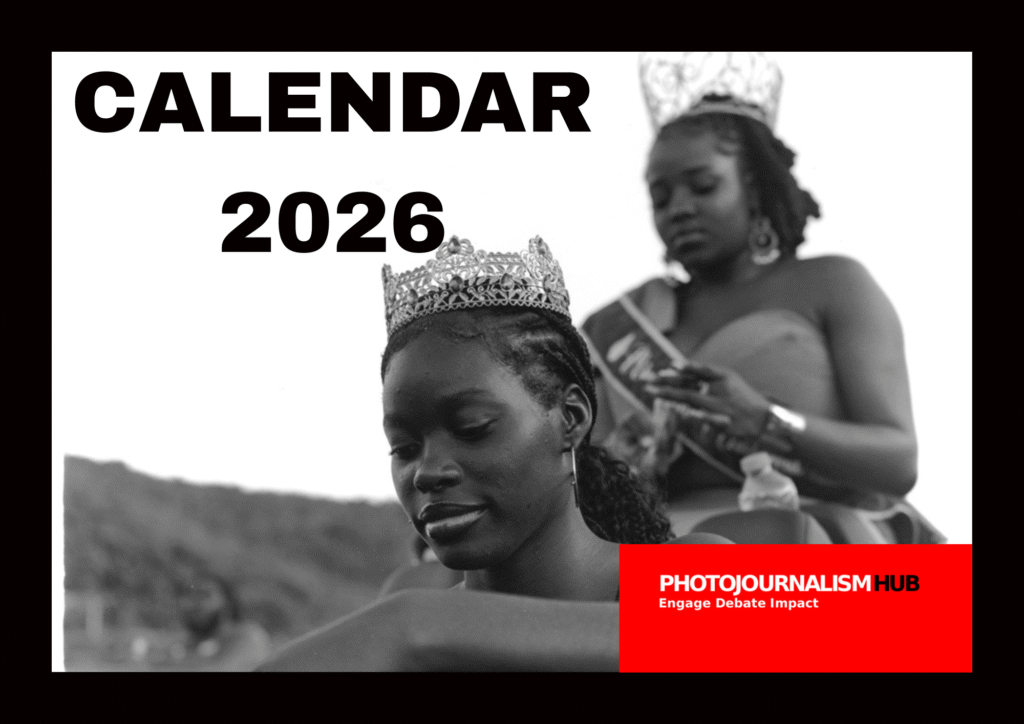
The Photojournalism Hub Calendar 2026 showcasing the incredible work of photojournalists and documentary photographers who have contributed to our mission.
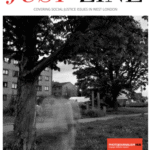
I am incredibly pleased to present the fifth edition of Capturing Crisis photography and reporting magazine produced by the group of youths of the ‘Stories, Reporting Mag, Photography Course’ project. Responding to the cost of living crisis, the young photographers have produced photo stories and photographs covering topics that expose social justice issues as well as current social and environmental changes. In this issue, you will find photo stories documenting a community led urban space called ‘Meanwhile’ and street photography that in a candid manner seek to document the impact of the economic crisis. I am very proud for the commitment, talent and drive demonstrated by the young participants.
Photojournalism Hub presents Zula Rabikowska and Giorgia Tobiolo, two photographers whose powerful and committed work engages with social justice and human rights. This event offers audiences an opportunity to hear directly from the photographers about the stories behind their work, ask questions, and discover how photography can contribute to greater understanding and social change. The conversation will explore the experiences, approaches and motivations behind the photographs, as well as the issues and communities at their heart. Following the presentations, audiences and guest photographers are invited to continue the conversation and socialise in the bar and coffee lounge area at Riverside Studios.
Zula Rabilowska is a Polish queer photographer and visual artist based in London. Zula was born in Poland, grew up in the UK and her experience of migration influences her photography practice. Zula’s projects explore migration, gender and LGBTQI+ communities with a focus on Central and Eastern Europe and her work unpicks the binary understanding associated with the “West” and the “East”. Zula works with multimedia, film, and photography, and incorporates archival images and documents to challenge conventional visual story-telling norms. Zula holds an MRes in French Postcolonial Literature from the University of Warwick and an MA in Documentary Photography from the University of the Arts London. Zula exhibited as a solo artist in London (England) and Belfast (Northern Ireland), and her group shows include Format Festival (UK), Brighton Photo Fringe (UK), Lahti Fringe Festival (Finland), Gothenburg Fringe Festival (Sweden) Urban Banks Berlin (Germany) and Enjoy Museum of Art Beijing (China). Zula’s work has been published internationally including Dazed and Confused, the British Journal of Photography, the BCC, The Times. Guardian, The Calvert Journal. Zula works as a photographer in Europe, and a photography lecturer at Kingston University London, she is also a co-founder of the Red Zenith Collective, an online platform for non-binary and female artists from Central and Eastern Europe. Zula will be presenting 2 projects, “Nothing but a Curtain” and “Scared to Love.” Her photographs from “Nothing but a Curtain” will be exhibited a the Four Corners in October with the Private View on Thursday 12th October. All are welcome, please register here: https://www.fourcornersfilm.co.uk/whats-on/nothing-but-a-curtain IG: @zula.ra and zulara.co.uk
Giorgia Tobiolo Giorgia is an Italian documentary photographer and educator, based in London. Raising internal questions stimulates Giorgia to examine the external environment. In this two-way relationship, she is keen to reveal the humanity, diversity, and vulnerability of labelled or stereotyped subjects, often objects of prejudice. Ultimately with her practice, she aims to break down the indifference towards certain topics and give a voice to people that need recognition, support, or inclusion. Besides her MA in Photojournalism and Documentary Photography at the University of Westminster, she has completed an Internship with Magnum Photos. Giorgia has, and continues to, collaborate with schools, festivals, charities, associations, private clients, magazines and institutions such as UAL, The British Academy of Photography, Urban Photo Fest, Photography Oxford Festival, the Calthorpe Project, Caritas Foundation, Migrants Resource Centre, the Prison of Pescara, Reuters Institute, CNN, AlJazeera, Source Magazine and more. IG: @giorgiatobiolo and giorgiatobiolo.com
We are delighted to welcome Marcin Kornacki and Nathaniel White-Steele to thePhotojournalism Nightson the 31st July at the Riverside Studios, 7pm. To join us HERE.
Photojournalism Nights invites contemporary photojournalists and documentary photographers to share their powerful, committed photography and engage audiences in social justice and human rights causes. Photojournalism Nights feature Q&A’s from guest speakers and an opportunity to connect with photojournalists who are helping advance social justice and human rights around the world.
About the Photographers
Nathaniel White-Steeleis a documentary artist from Bristol, UK. He is interested in the visual register of authority, how power inscribes itself on landscapes and how ‘territory’ is made. He has worked with satellite images, GIS mapping technology, audio, archive, wet plate collodion tintypes and other methods to unpick how we attempt to control the landscape in order to govern people and the moments when the landscape and the people resist. Nathaniel is currently based in London and has exhibited both nationally and internationally, most recently showing alongside anthropologist Jason de Leon’s work Hostile Terrain 94 in Den Haag, The Netherlands.
Marcin Kornacki is a London-based photographer currently completing his MA in Photojournalism and Documentary Photography at LCC London. His photography focuses on the often untold human stories behind the headlines of communities affected by both chronic and acute distress. His most recent project on Jaywick, the most deprived area in the UK, was recognised by the British Journal of Photography as a winner of the 2022 Portrait of Britain. He is currently working on a project with Haitians displaced by gang violence in the country’s capital city Port-au-Prince.
BECOME A PJH MEMBER Consider becoming a member of the Photojournalism Hub and receive the benefits of free access to events, Photojournalism Hub resources, premier editorial content, portfolio reviews, photography exhibitions, discounts on our courses and training, whilst you will be supporting our work advocating, advancing social justice and human rights. If there were ever a time to join us, it is now. Support the Photojournalism Hub from as little as £1 every month. If you can, please consider supporting us with a regular amount each month. Thank you. JOIN US HERE
Inspiring Voices Amidst Ukraine’s Struggle for Justice
Date: June 10, 2023
Renowned photojournalist Vudi Xhymshiti empowers Ukrainian scholars through his groundbreaking education program, emphasising metadata mastery and ethical principles. Inspiring voices amidst Ukraine’s struggle for justice.
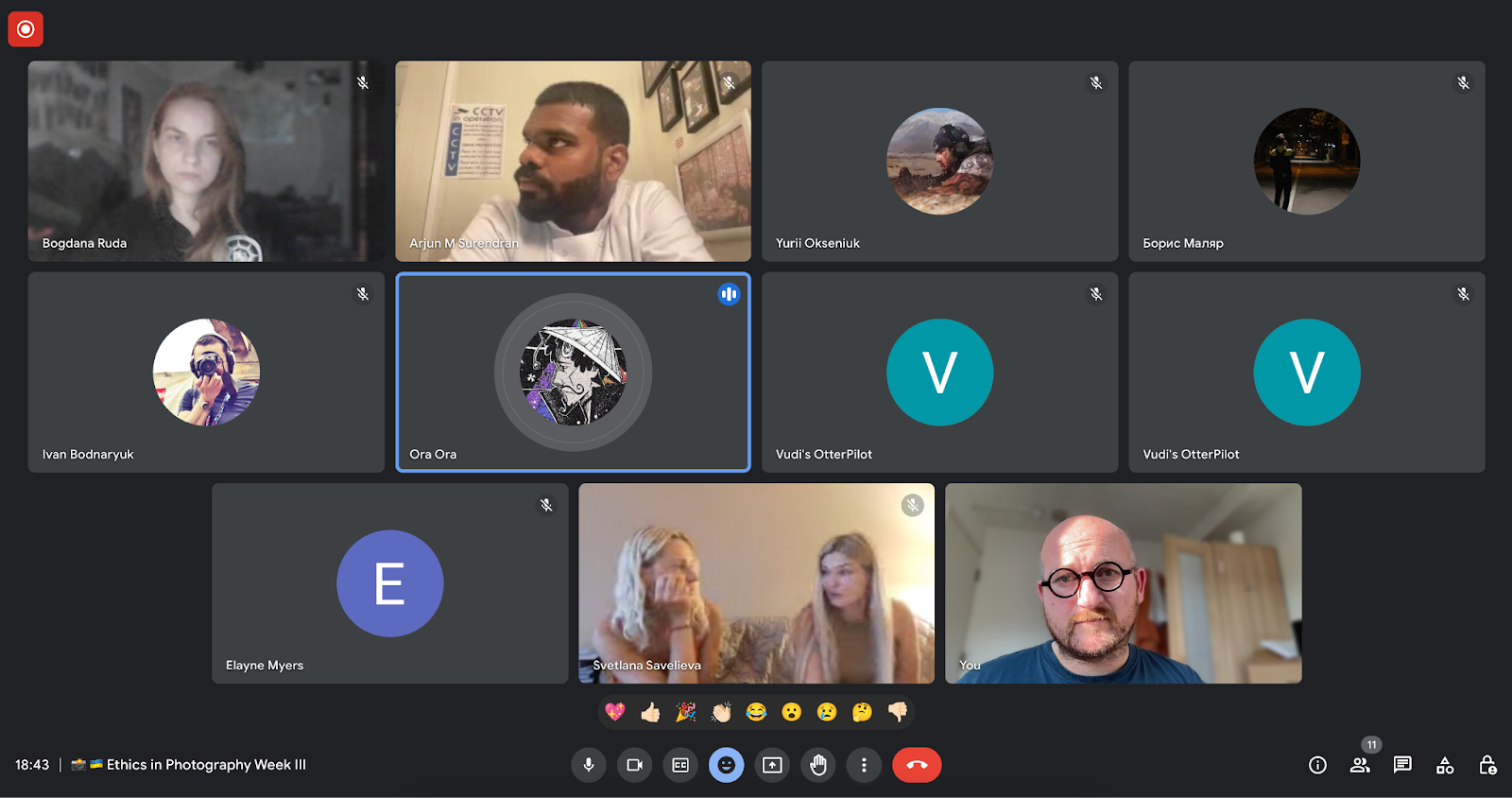
Renowned Kosovar-British photojournalist and educator, Vudi Xhymshiti, embarks on the third week of his journey, dedicated to educating fifteen Ukrainian scholars who have been awarded scholarships in his groundbreaking photojournalism educational program. Over the course of this Thursday and Friday, the scholars engaged in enlightening discussions on the paramount importance of mastering metadata and adhering to the ethical principles of photojournalism.
Following an extensive year of reporting in Ukraine throughout 2022, Xhymshiti recognized the dire need to extend support to the Ukrainian people. Moved by the plight of voiceless men, women, and children, who have suffered the harrowing atrocities inflicted by the Russian military aggression since the full-scale invasion launched by Russian President Putin on February 24, 2022, Xhymshiti made it his mission to share his wealth of knowledge in photojournalism. By doing so, he aimed to equip the scholars with the necessary skills to become the unwavering voice of Ukraine.
In today’s digital age, photojournalists face a myriad of challenges when it comes to showcasing and monetizing their work. One aspect often overlooked, yet crucial, is the meticulous handling of metadata and captioning. This vital information not only assists photographers in organising their collections but also plays a pivotal role in capturing the attention of editors and potential clients.
During an exclusive conversation with Photojournalism HUB in London, Vudi Xhymshiti expressed his unwavering dedication to promoting high-quality journalism worldwide. He shared insights into his education programs, which are specifically designed to elevate the skills of emerging professionals and students from diverse backgrounds. Through the provision of scholarships and access to valuable resources, Xhymshiti aims to empower individuals, enabling them to become leaders in their respective fields and share their unique perspectives with the global audience.
In discussing his educational initiatives, Xhymshiti emphasised his role in guiding fellow professionals away from ignorance. Recognizing that traditional forms of education can often perpetuate narrow viewpoints, he is committed to offering programs that foster critical thinking, creativity, and diverse thought. His ultimate vision is to contribute to the advancement of journalism and the democratisation of public narrative, inspiring the next generation of journalists to strive for excellence and create a better world through their impactful work.
Furthermore, Xhymshiti’s conversation highlighted the paramount importance of mastering metadata in the field of photojournalism. With his expertise and experience as an esteemed instructor, he shed light on the profound influence that metadata mastery can have on the career prospects of aspiring photojournalists. By stressing the significance of this aspect, Xhymshiti aims to equip his students with the necessary skills to thrive in their professional journeys.
Xhymshiti, with his unrivalled expertise, highlights the indispensable connection between accurate metadata and professional success. He asserts, “Without proper metadata, no news editor, whether in London, New York, Paris, or elsewhere, will consider your photographs. The absence of this crucial information hampers editors’ ability to comprehend the contextual significance of an image.“
According to Xhymshiti, countless talented photographers miss out on lucrative assignments simply because they neglect to master the art of metadata and captioning. He explains, “Editors are unwilling to take the risk of hiring someone who lacks these essential skills. The absence of metadata and captions can lead to confusion and disrupt the seamless progress of a project. Editors would rather replace you with someone who understands the significance of these vital details.“
Furthermore, Xhymshiti unveils a startling truth about the scarcity of formal education concerning metadata in photography programs. He notes, “Unfortunately, universities rarely impart these critical skills to aspiring photographers. Furthermore, some professional photographers who offer courses intentionally withhold this information due to their own self-doubts and fears of competition.“
Xhymshiti’s comprehensive course aims to bridge this knowledge gap and equip students with the indispensable skills required to excel in the industry. He emphasises the importance of regularly practising metadata mastery and captioning, asserting that these tasks should become as routine as brushing one’s teeth in the morning. By instilling these practices early on, students can confidently collaborate with editors and significantly increase their chances of securing coveted assignments.
One of the intriguing topics raised during the course revolves around the use of watermarks on photographs. Xhymshiti clarifies that watermarks play a vital role in protecting copyrighted work when selling images on certain platforms. However, he advises against using watermarks on websites or portfolios intended to attract potential clients. By allowing clients to view high-quality, unmarked images, photographers heighten their chances of securing paid work.
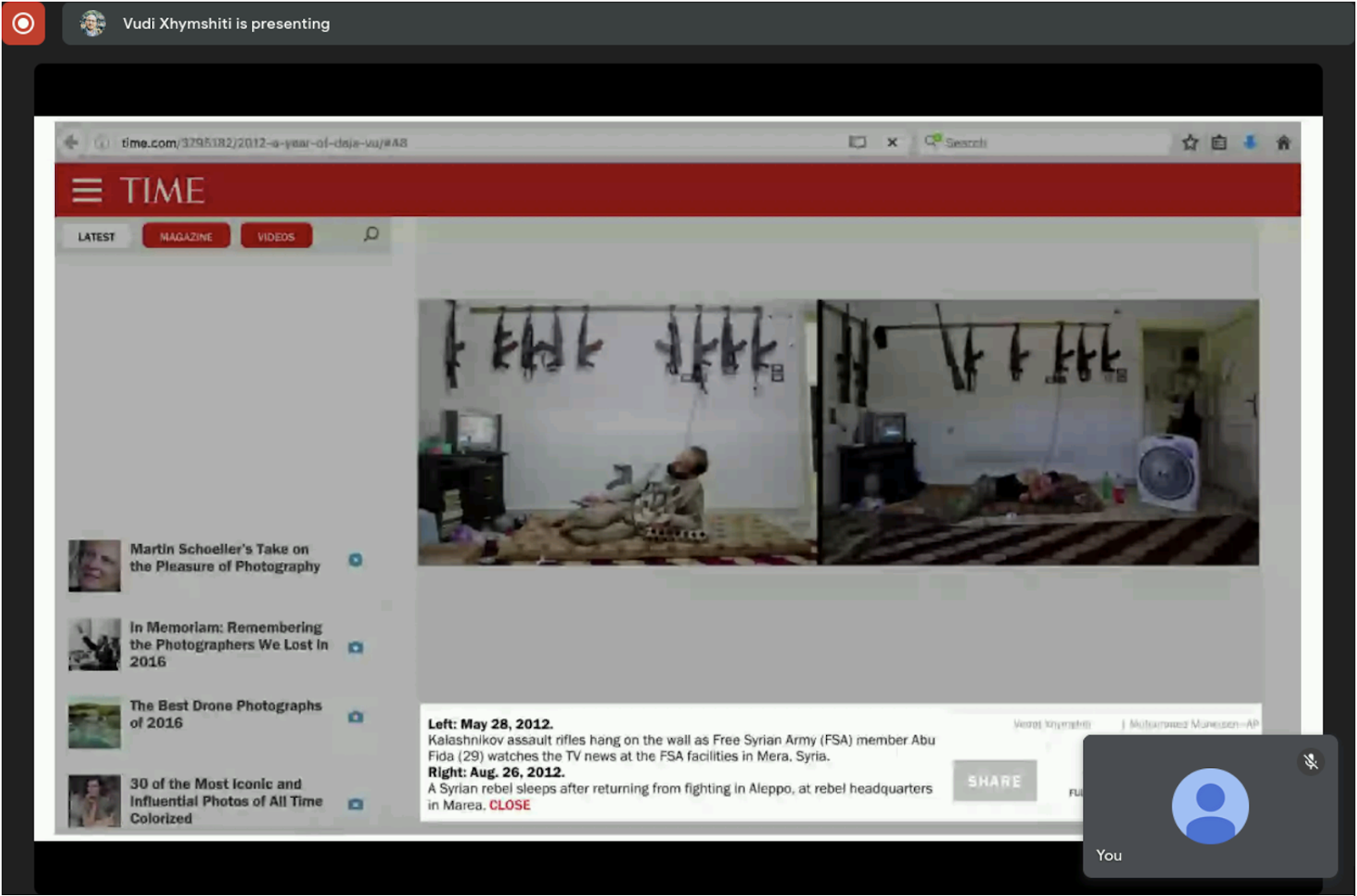
To illustrate his points effectively, Xhymshiti showcases his own websites, featuring both watermarked and unmarked images. He emphasises the importance of presenting pristine, high-quality images to potential clients, enabling them to accurately assess a photographer’s skills and capabilities.
Throughout the course, students actively engage in discussions, sharing their personal experiences and challenges. Xhymshiti fosters an environment of open dialogue, encouraging the exchange of ideas and the cultivation of growth.
By shedding light on the profound significance of metadata mastery and ethical considerations in photojournalism, this exclusive course offers aspiring photojournalists invaluable knowledge. It equips them with the skills necessary to navigate the fiercely competitive industry, ensuring they are prepared to meet the demands of professional assignments. Xhymshiti’s unwavering dedication to empowering his students and safeguarding them from exploitation shines through, making this course an extraordinary and priceless opportunity within the realm of photography education.
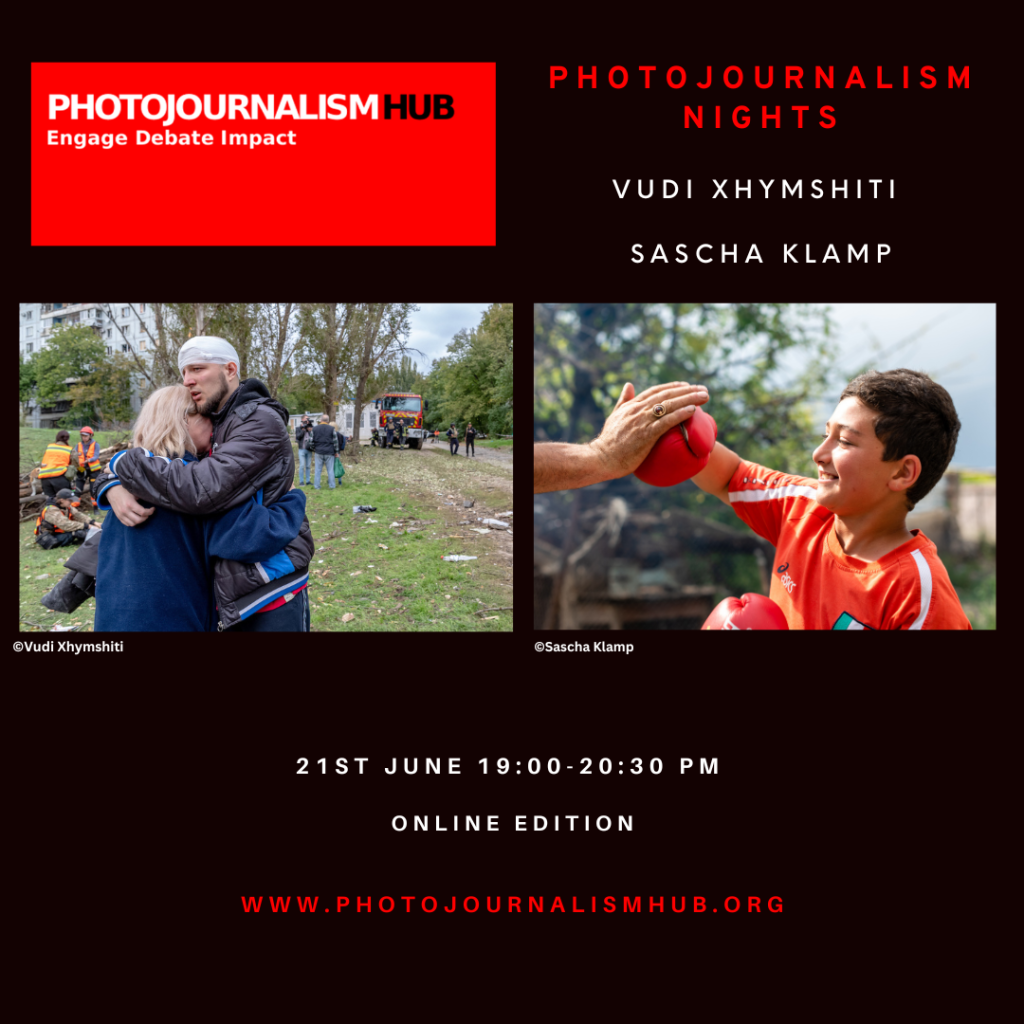
Join us on June 21, 2023, for an upcoming online edition of Photojournalism Nights, where we are thrilled to have Vudi Xhymishiti as our guest speaker. Discover the incredible work of this renowned photojournalist and educator by joining us via our ticketing system. HERE.
Join us for an exciting night of PHOTOJOURNALISM! Our online event starts on Wed Jun 21 2023 at 7:00 PM BST. To book: HERE
This event will showcase the works of talented photojournalists Vudi Xhymshiti and Sascha Klamp. Get ready to be inspired by their captivating images and stories. Vudi a renowned photojournalist will share stories from war torn Ukraine where he has been reporting from over 7 months and Sascha who is a multi awarded filmmaker will be speaking about his latest work in Armenia.
During the event, you’ll have the opportunity to interact with the photographers and learn about their experiences in the field. You’ll also get a chance to ask questions and share your own thoughts on the power of photojournalism.
Don’t miss out on this incredible opportunity to connect with two great photojournalists, documentary photographers and filmmakers with and connect with a peer community. Register now and get ready for a night that will inspire.
Vudi Xhymshiti is a photographer and journalist based in London, who has covered major world events since 2007, with his work appearing in prestigious news outlets such as The New York Times, TIME Magazine, The New Yorker, The Guardian, The Times and the Sunday Times of London, CNN, BBC, DW etc. His assignments have taken him to the frontlines of the Arab Spring, the Syrian and Libyan Civil Wars, and the aftermath of the Armenian-Azerbaijani armed conflict in Nagorno Karabakh. Throughout 2022, he reported on the Russian military aggression in Ukraine and travelled to Moldova to observe and report on the impact of Russian territorial expansionist foreign policy on neighbouring countries. He also spent four months familiarising himself with rising tensions in Kosovo, Bosnia and Herzegovina, and Montenegro, following Serbia’s alignment of its Foreign Policy with the Russian Federation. Xhymshiti is not only a talented journalist, but also the founder of VX Pictures and an educator in the visual journalism industry. Don’t miss out on his insights and coverage – visit his website https://vudixhymshiti.uk/ to learn more about him, read his blog https://vudixhymshiti.uk/blog/, and view his latest work on https://vximages.com/.
Sascha Klamp is a British/German multi-award winning Documentary Filmmaker, Photo-documentary Journalist and Producer based in London, UK. He spent the majority of his career as an investor and entrepreneur which enabled him to travel across frontier and emerging markets. His photography practice centres on highlighting social impact and social justice affairs which is deeply rooted in his curiosity to learn more of the world around him. He tells frontline human and community stories based on empathy for the situation and the people involved. His thinking is informed by his interest in ethnology and anthropology. Sascha exhibited a small selection of his The Art of Seeing, The Art of Remembering project in London in November 2022. His work was highly commended by the TPF Social Documentary Awards (Professional Category, Series) for his The Art of Seeing, The Art of Remembering work. Sascha completed his MA Photojournalism & Documentary Photography studies at the University of the Arts (Distinction), London. He also holds an MBA (Bayes Business School, London) and a Masters in Law, LLM (King’s College, London), and a BSc International Securities, Investment & Banking from Henley Business School (ICMA Centre). He is married with three daughters. Filmography: “The Art of Seeing, The Art of Remembering” (2022), “The Blockade” (2023)
BECOME A PJH MEMBER
Consider becoming a member of the Photojournalism Hub and receive the benefits of free access to events, Photojournalism Hub resources, premier editorial content, portfolio reviews, photography exhibitions, discounts on our courses and training, whilst you will be supporting our work advocating, advancing social justice and human rights. If there were ever a time to join us, it is now. Support the Photojournalism Hub from as little as £1 every month. If you can, please consider supporting us with a regular amount each month. Thank you. JOIN US HERE
Jonathan Alpeyrie’s career spans over two decades, has brought him to 35 countries, and has covered 14 conflict zone assignments, in the Middle East and North Africa, the South Caucasus, Europe, North America, and Central Asia.
Born in Paris in 1979, Jonathan Alpeyrie moved to the United States in 1993. He graduated from the Lycée Français de New York in 1998 and went on to study medieval history at the University of Chicago, from which he graduated in 2003. Alpeyrie started his career shooting for local Chicago newspapers during his undergraduate years. He spent a month driving across the country to create my first photo essay like a professional. The essay focused on the remnant of the Communist era heavy industry. His driver at the time took him to all the major industrial sites, visiting abandoned factories and taking photographs of what once was. The decaying infrastructure was a fascinating reminder of a collapsed system barely 10 years prior.
After graduating from the University of Chicago in the spring of 2003, Jonathan was sent off to start his first dangerous photo essay which he hoped at the time would help me further to launch his career as a photojournalist. He spent over a month covering gang activity in the Congolese capital of Kinshasa. With the photo essay completed, he returned home and was quickly picked up by Getty images for the reportage section after it was noticed by some editors at the NYC office. 2004, was a watermark year for Jonathan as he started covering wars that very same year, from West Africa to the Caucasus, all for Getty Images.
I became a war photographer in order to immerse myself into historical situations to then report them back to the public. Cut and dry
Jonathan Alpeyrie
With almost a decade of experience behind him and half a dozen wars under my belt, Jonathan decided to go on his own and leave the agency business partially behind. Dealing directly with his own clients while still working for various photo agencies, he started covering wars in the Middle East and Central Asia, furthering his resume as a war photographer. A year later, the Arab Spring launched a new phase in his career. With the various conflicts erupting all around the Middle East, Syria started to attract war reporters from all over the world interested in covering this new hot conflict. After two trips to the war-torn country in 2012, Jonathan decided to return in 2013. It happened after he was kidnapped for three months by Islamic rebels.
By 2014, right after his release from Syria, he embarked on another voyage, this time into Slavic land to start covering the new hot war: Ukraine. After almost 14 months of coverage, he was injured during a gun battle in Mariupol.
That year his career took another turn as he almost permanently stopped working for agencies and focused on some of his big clients like Vanity Fair, CNN, and others, which, interestingly was a reminiscence of the earlier part of his career when he was solely doing photo essays and almost no news. He focused on personal projects which took him closer to a region a new from his previous travels like Mexico and Central America while keeping an eye on South America.
After a hiatus from covering wars, he went to Iraq to cover the battle of Mosul in 2017, and took another break from war in 2018, except for some time spent on the front lines in Ukraine, he decided to focus on the drug wars in South America, and more specifically in Brazil. Covid19 cut short his project and focused on the pandemic with an exception: the war in Armenia at the end of 2020.
The War in Ukraine since 2014 never ended but rather was in a state of hiatus with more upsurge of fighting once in a while. February 2022, with the Russian invasion of its neighbor, has had everyone surprised by the scale of its aggression. When the fighting erupted he was in Mexico shooting a story on the drug war, as soon as his assignment ended he departed for the front in Central Ukraine. He spent a month covering the war between the two Slavic nations. Once more, he was drawn back into a conflict.
Alpeyrie has worked as a freelancer for various publications and websites, such as the Sunday Times, Le Figaro Magazine, ELLE, American Photo, GLAMOUR, Aftenposten, Le Monde, & bbc among others. Jonathan Alpeyrie’s career spans over a decade, and has brought him to over 36 countries, covered 14 conflict zones assignments, in the Middle East and North Africa, the South Caucasus, Europe, North America and Central Asia. A future photography book about wwii. Veterans with verve editions are in the works.
Alpeyrie has been published in magazines such as: Paris Match, aftenposten, times (Europe), Newsweek, Wine Spectator, Boston Globe, glamour, bbc, vsd, Le Monde, newsweek, Popular Photography, Vanity Fair, La Stampa, cnn, and Bild Zeit, elle Magazine, Der Spiegel, Le Figaro, marie claire, The Guardian, The Atlantic.
Jonathan Alpeyrie www.jonathanalpeyrie.com E: peloponnessian@hotmail.com @Jonalpeyrie
BECOME A PJH MEMBER
Consider becoming a member of the Photojournalism Hub and receive the benefits of free access to events, Photojournalism Hub resources, premier editorial content, portfolio reviews, photography exhibitions, discounts on our courses and training, whilst you will be supporting our work advocating, advancing social justice and human rights. If there were ever a time to join us, it is now. Support the Photojournalism Hub from as little as £1 every month. If you can, please consider supporting us with a regular amount each month. Thank you. JOIN US HERE
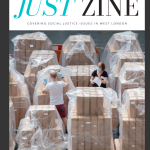
We are pleased to present the 4th issue of ‘Me, and my Community’, a photography magazine produced by a group of senior residents of Hammersmith & Fulham.
In this issue, the group has continued to explore their individual ideas and projects on communities and their lives within. We present photo stories that document the impact of regeneration in the borough of Hammersmith & Fulham, street photography exploring life through shop windows, eco-community and sustainable living at Meanwhile Gardens, Ravenscourt Park and much more.
The Photojournalism Hub Calendar 2026 showcasing the incredible work of photojournalists and documentary photographers who have contributed to our mission.
We are proud to present a striking collection of images that tell powerful stories from across the globe. This year’s calendar features outstanding work by acclaimed photographers Mahmoud Abu Al-Qaraya, Masoud Amin Naji, Mark Chapman, Cinzia D’Ambrosi, Manuela Federl, Francesca Gabbiadini, Myah Asha Jeffers, Daniel Lai, Gašper Lešnik, Sabrina Merolla, Bruno Saguer, Richard Zubelzu Each photograph embodies the heart of our mission using documentary photography and photojournalism to inspire awareness, connection, and action.
Proceeds from the sale of the Photojournalism Hub 2026 Calendar will fund bursaries for portfolio reviews for young disadvantaged photographers and a grant supporting the development of an emerging photographer’s photojournalism project.
I am incredibly pleased to present the first edition of ‘Capturing Crisis’ photography and reporting magazine produced by our youths group living in west London participating in the ‘Stories, Reporting Mag, Photography Course’ project. In this first edition of ‘Capturing the Crisis’, we present photo stories and articles on the impact of the cost of living crisis on various communities in London. It includes personal and introspective stories of people living the crisis as well as stories reflecting on the way the city of London is rapidly changing as a result of it. Nonetheless, the photography is particularly captivating as each participant is developing their individual style and line of research. I hope you enjoy this first edition and will follow and support the ‘Capturing Crisis’ magazine. I am very proud for the commitment, talent and drive demonstrated by the young participants.
Capturing Crisis is a youth documentary and photojournalism magazine. All features and photographs are created by participants of ‘Stories, Reporting Mag, Photography Course’. The magazine provides the opportunity for youths who never had access to, to share their photography and photo stories to a large audience. Photojournalism Hub is committed to providing opportunities and support to youths, enabling equality in accessing opportunities for further education and work in the photo industry. Capturing Crisis magazine is a testament of the great work and inspiring contribution of our youths.
The project is supported by the NHS west London trust, Hammersmith and Fulham Council and Sobus.
BECOME A PJH MEMBER Consider becoming a member of the Photojournalism Hub and receive the benefits of free access to events, Photojournalism Hub resources, premier editorial content, portfolio reviews, photography exhibitions, discounts on our courses and training, whilst you will be supporting our work advocating, advancing social justice and human rights. If there were ever a time to join us, it is now. Support the Photojournalism Hub from as little as £1 every month. If you can, please consider supporting us with a regular amount each month. Thank you. Join us: HERE